Want more images or videos?
Request additional images or videos from the seller
1 of 7

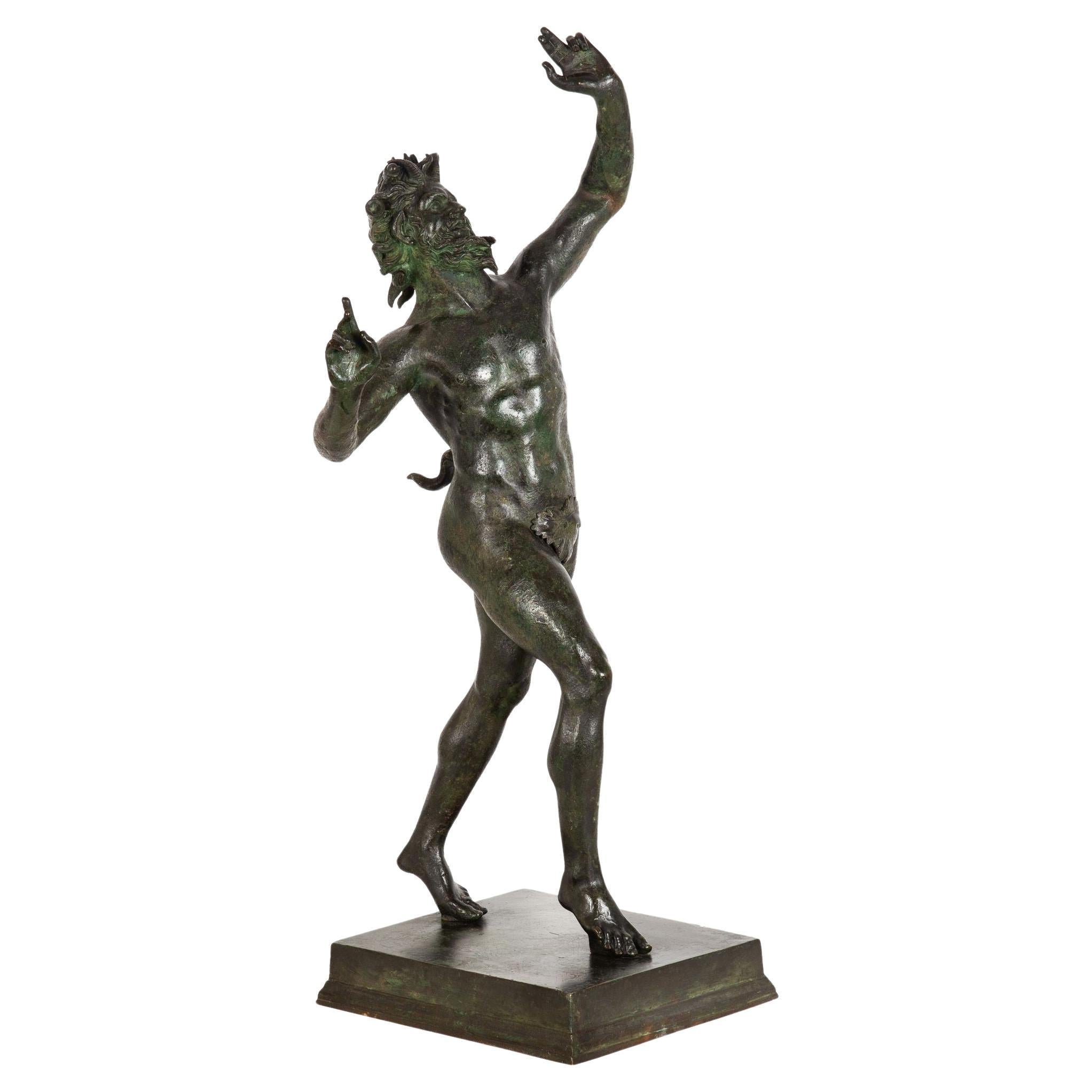
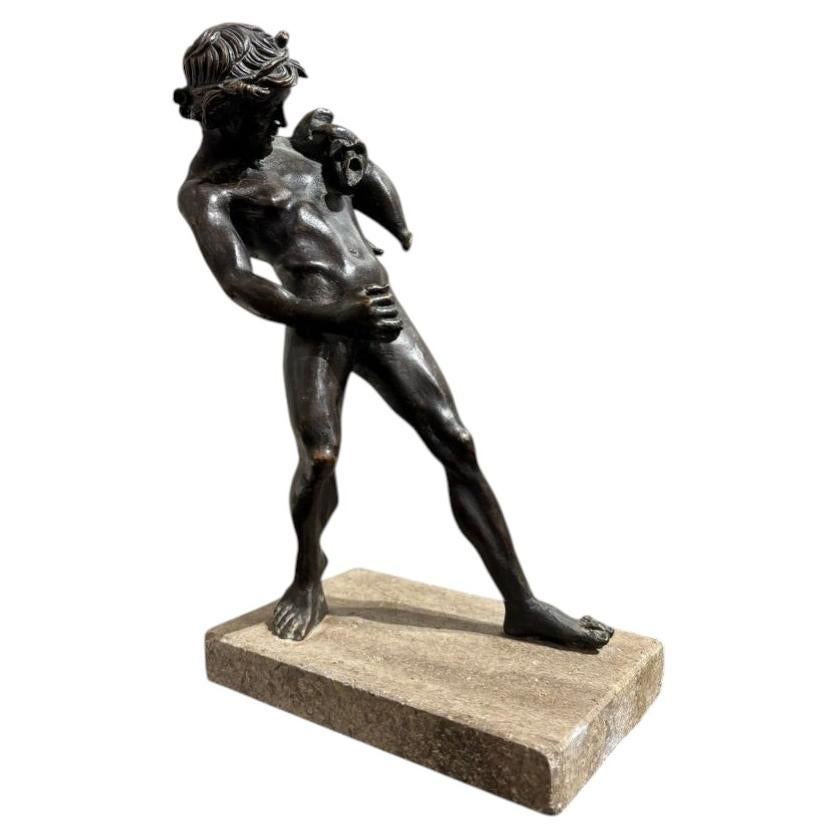
Study of a Satyr - Italy, early 19th century

$4,711.77
£3,500.49
€4,000VAT Included
CA$6,603.10
A$6,685.80
CHF 3,803.53
MX$81,253.43
NOK 44,959.65
SEK 44,723.46
DKK 30,498.99

About the Item

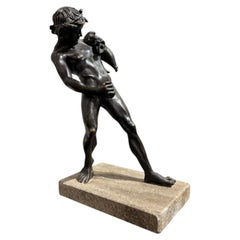
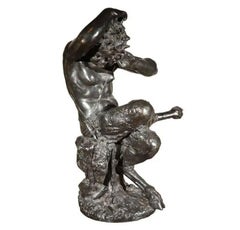
Study of a Satyr Bronze, cast using the lost-wax (cire perdue) method Italy, early 19th century 14 x 7 x 10 cm This evocative bronze sculpture represents a satyr, the half-human, half-goat creature of classical mythology often associated with Dionysian revelry and untamed nature. Cast using the lost-wax method, the figure captures a vivid sense of movement and muscular tension, despite being in an unfinished state—an aspect that offers unique insight into the sculptor’s creative process. The satyr is depicted in a crouching or forward-leaning posture, his arms extended before him, as if lunging or caught mid-gesture. His facial expression is animated, with sharply defined features—arched eyebrows, a pronounced nose, open mouth, and a pointed beard—conveying intensity and alertness. The upper body is fully realized, anatomically articulated with attention to the curvature of the spine, shoulder blades, and musculature. In contrast, the lower part of the figure remains rough and incomplete, especially around the hips, thighs, and legs, where textural irregularities and casting traces are clearly visible. The goat-like legs are partially modeled but not fully refined, with evident tool marks and raw surfaces suggesting an interrupted or intentionally preliminary stage. This stark juxtaposition between the polished and the unfinished may indicate that the bronze was a maquette or sculptural study, possibly prepared for a larger or more finished work. The use of bronze and the precision evident in the completed sections attest to the artist’s technical proficiency, while the evident incompletion invites reflection on the artistic process. It may have functioned as an academic study—used to explore form, pose, and expression—or as a presentation piece to test compositional ideas. The patina is uneven, consistent with an unpatinated or partially processed cast, ranging from dark brown to reddish-brown tones, with traces of oxidation, especially in the unworked areas. The figure is now mounted on a modern wooden base, offering support and visibility while preserving its fragmentary integrity. This bronze satyr exemplifies the revival of antiquity in the early 19th century, filtered through a Romantic fascination with expressive, mythological subjects. Its unfinished condition is a compelling feature, providing rare evidence of artistic experimentation and the tactile immediacy of the sculptor’s hand.
  • Dimensions:
    Height: 5.52 in (14 cm)Width: 2.76 in (7 cm)Depth: 3.94 in (10 cm)
  • Style:
    Modern (In the Style Of)
  • Materials and Techniques:
    Bronze,Cast
  • Place of Origin:
  • Period:
  • Date of Manufacture:
    19th century
  • Condition:
    Wear consistent with age and use.
  • Seller Location:
    Bruxelles, BE
  • Reference Number:
    1stDibs: LU6666245716612

More From This Seller

View All
Bacchus - Southern Italy, late 17th century

Bacchus - Southern Italy, late 17th century

Located in Bruxelles, BE

Bacchus 
Southern Italy, late 17th century
 Alabaster Sculpture
 H: 20 cm A finely carved 17th-century alabaster sculpture of a naked Bacchus. This Italian alabaster figure depicts ...

Category

Antique 17th Century Italian Baroque Figurative Sculptures

Materials

Alabaster

AFTER A MODEL BY GIAMBOLOGNA (1529–1608) - Pacing Bull

AFTER A MODEL BY GIAMBOLOGNA (1529–1608) - Pacing Bull

Located in Bruxelles, BE

AFTER A MODEL BY GIAMBOLOGNA (1529–1608)
 Pacing Bull
17th century
 Bronze, on an ebonised wood base H totale 15 x L 11,5 x P 8,2 cm Since antiquity, the bull has been venerated as ...

Category

Antique 17th Century Italian Renaissance Animal Sculptures

Materials

Bronze

Young Boy - after Charles-Antoine Bridan

Young Boy - after Charles-Antoine Bridan

Located in Bruxelles, BE

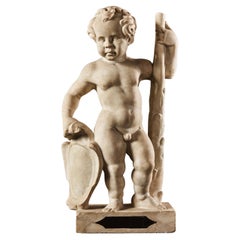
Young Boy - after Charles-Antoine Bridan Italy, 19th Century Marble H 57 cm x W 18 cm x D 15.5 cm This delightful Carrara marble sculpture depicts a young boy playfully holding a bi...

Category

Antique Mid-19th Century Italian Grand Tour Figurative Sculptures

Materials

Marble

Hercules Holding a Coat of Arms, Flemish, XVII Century

Hercules Holding a Coat of Arms, Flemish, XVII Century

Located in Bruxelles, BE

Hercules holding a coat of arms Flemish, XVII century White and black marble Measures: 67 x 32 x 19 cm Hercules is depicted naked, holding a coat of arms with the right hand an...

Category

Antique 17th Century Belgian Renaissance Figurative Sculptures

Materials

Marble, Belgian Black Marble

Sleeping Eros - Rome, 16th century

Sleeping Eros - Rome, 16th century

Located in Bruxelles, BE

Sleeping Eros Rome, 16th century
 Carrara marble, on a wooden base
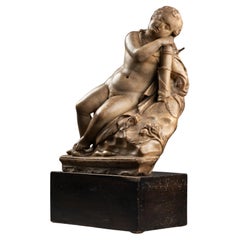
 of an ancient collection 31 × 44 x 17 cm Carved from a fine block of Carrara marble, this sculpture depicts Eros ...

Category

Antique 16th Century Italian Renaissance Figurative Sculptures

Materials

Carrara Marble

Saint John the Baptist - Central Italy, 16th century

Saint John the Baptist - Central Italy, 16th century

Located in Bruxelles, BE

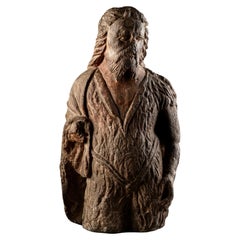
Saint John the Baptist Central Italy, 16th century Carved limestone, traces of polychromy H 43,5 x L 24 x P 15 This remarkable carved limestone sculpture depicts Saint John the Bap...

Category

Antique 16th Century Italian Renaissance Figurative Sculptures

Materials

Limestone

You May Also Like

19th Century Italian Grand Tour Bronze of a Satyr Sculpture, Pompeii

19th Century Italian Grand Tour Bronze of a Satyr Sculpture, Pompeii

Located in Stamford, CT

19th century Neapolitan Grand Tour bronze of a Satyr with wine skin, also known as the 'Drunken Satyr'. The cup he would have been holding was lost in the conflagration. The lean, mu...

Category

Antique Late 19th Century Italian Grand Tour Figurative Sculptures

Materials

Travertine, Bronze

19th Century French Ormolu & Patinated Bronze Sculpture of a Seated Satyr

19th Century French Ormolu & Patinated Bronze Sculpture of a Seated Satyr

Located in West Palm Beach, FL

19th Century French Ormolu & Patinated Bronze Sculpture of a Seated Satyr France, Circa 1875 A good quality 19th Century French Ormolu & Patinated Bronze Sculpture of a Seated Saty...

Category

Antique 19th Century Figurative Sculptures

Materials

Bronze, Ormolu

Early 19th c., Bronze Satyr Sculpture

Early 19th c., Bronze Satyr Sculpture

By Claude Michel Clodion

Located in Los Angeles, CA

Cast bronze sculpture of a yawning Satyr after the original by important French sculptor, Claude Michel Clodion (1738-1814). According to artnet: Claude Michel Clodion was a Frenc...

Category

Early 1800s Sculptures

Materials

Bronze

19th Century Bronze Statue of a Faun

19th Century Bronze Statue of a Faun

Located in West Palm Beach, FL

A 19th century bronze statue of a faun. Raised on a rectangular base this figure of a faun, with a man's body and the horns, pointed ears an...

Category

Antique 19th Century French Figurative Sculptures

Materials

Bronze

Italian Bronze and Porphyry Figure of the Dancing Faun After the Antique

Italian Bronze and Porphyry Figure of the Dancing Faun After the Antique

Located in Kittery Point, ME

An Italian Bronze Figure of the Dancing Faun After the Antique depicted standing ‘in contrapposto’ and raised on a Louis XVI style ormolu mounted porphyry and red marble base. The D...

Category

Antique Early 19th Century Italian Baroque Figurative Sculptures

Materials

Marble, Porphyry, Bronze

Augusto Rivalta (Italian 1838 - 1925) Satyr Dancing, Bronze Sculpture

Augusto Rivalta (Italian 1838 - 1925) Satyr Dancing, Bronze Sculpture

Located in Germantown, MD

Augusto Rivalta (Italian 1838 - 1925) Satyr Dancing Bronze Sculpture. Late 19th Century 8" Width x 9" in Depth and x 18.5" Height. Plinth is 6" in diameter.

Category

Antique Late 19th Century Italian Greco Roman Figurative Sculptures

Materials

Marble, Bronze