Video Loading
Want more images or videos?
Request additional images or videos from the seller
1 of 6

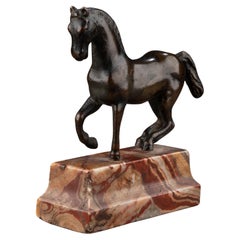
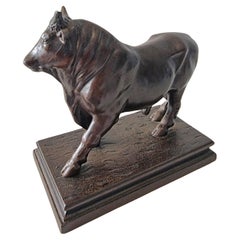
AFTER A MODEL BY GIAMBOLOGNA (1529–1608) - Pacing Bull

$10,034.05
£7,413.25
€8,500VAT Included
CA$13,919.98
A$14,126.23
CHF 8,143.47
MX$171,044.06
NOK 94,520.02
SEK 95,530.96
DKK 64,813.83

About the Item

AFTER A MODEL BY GIAMBOLOGNA (1529–1608)
 Pacing Bull
17th century
 Bronze, on an ebonised wood base H totale 15 x L 11,5 x P 8,2 cm Since antiquity, the bull has been venerated as a symbol of strength and fertility. Following the horse, it became one of the most favored animal subjects in European sculpture of the 17th century. This elegant bronze represents a fine cast of a model attributed to Antonio Susini, a close collaborator of Giambologna and a prominent figure in the Medici court workshop. Susini is believed to have created his version of the Pacing Bull while still working under Giambologna, drawing directly from the master's original conception. The present cast belongs to the extensive lineage of variants and replicas derived from this celebrated model. Likely of Northern Italian origin and dating to the 17th century, this cast displays technical features consistent with that period. The result is a finely executed sculpture, imbued with both dynamism and sculptural finesse, characteristic of the enduring influence of Giambologna’s workshop.
  • Dimensions:
    Height: 8.67 in (22 cm)Width: 4.53 in (11.5 cm)Depth: 3.23 in (8.2 cm)
  • Style:
    Renaissance (Of the Period)
  • Materials and Techniques:
    Bronze,Cast
  • Place of Origin:
  • Period:
  • Date of Manufacture:
    17th century
  • Condition:
    Wear consistent with age and use.
  • Seller Location:
    Bruxelles, BE
  • Reference Number:
    1stDibs: LU6666245073092

More From This Seller

View All
Pacing Horse - Italian School, 18th century

Pacing Horse - Italian School, 18th century

Located in Bruxelles, BE

Italian School, 18th century Pacing Horse Bronze with brown patina, on a rectangular marble base H 8 x L 8,5 x P 3 cm H totale 11 cm

Category

Antique 18th Century Italian Baroque Animal Sculptures

Materials

Marble, Bronze

Study of a Satyr - Italy, early 19th century

Study of a Satyr - Italy, early 19th century

Located in Bruxelles, BE

Study of a Satyr Bronze, cast using the lost-wax (cire perdue) method Italy, early 19th century 14 x 7 x 10 cm This evocative bronze sculpture represents a satyr, the half-human, h...

Category

Antique Early 19th Century Italian Modern Figurative Sculptures

Materials

Bronze

Cerberus, Italy, 17th Century

Cerberus, Italy, 17th Century

Located in Bruxelles, BE

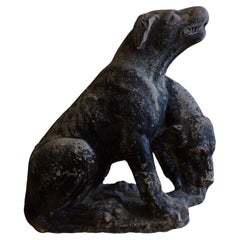
Cerberus Black painted stone Italy, 17th century Measures: 80 x 69 x 36cm (one head missing) Cerberus, cruel monster, fierce and strange, Through his wide threefold throat barks as a dog Over the multitude immers'd beneath. His eyes glare crimson, black his unctuous beard, His belly large, and claw'd the hands, with which He tears the spirits, flays them, and their limbs Piecemeal disparts (Dante, Inferno, Canto VI). Cerberus figure seated, in his role of ferocious guardian of the underworld; he shows a nervous musculature, an adherent skin which reveals the ribs, long and robust limbs; his heads are broad and the eyes set well apart. Painted in black to amplify his menacing look, the infernal guardian is depicted with his famous attributes, writhing his heads, growling and barking furiously. Cerberus, in Greek mythology, was the monstrous watchdog of the underworld – also known as the “hound of Hades” – preventing the dead from leaving, and making sure that those who entered never left. A child of Typhon and Echidna, he was part of a monstrous family, which included Orthus, the Lernaean Hydra, and the Chimaera as well. Only on three occasions Cerberus was tricked by visitors of Hades: Heracles did it with his strength, Orpheus with his music. In "The Inferno", Dante places Cerberus as the guardian of the third circle of Hell. With his three mouths, Dante saw Cerberus as a beast that was synonymous with the sin of Gluttony. Virgil gets past the monster by throwing mud in his three mouths, temporarily choking him. Very rare are the representations of Cerberus in ancient statuary...

Category

Antique 17th Century Italian Renaissance Figurative Sculptures
Materials

Stone

Saint Crespin - Renaissance sculpture - Loire Valley, 16th century

Saint Crespin - Renaissance sculpture - Loire Valley, 16th century

Located in Bruxelles, BE

Saint Crispin
Loire Valley, 16th century
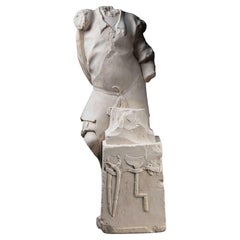
tuffeau stone Height: 67 cm Provenance: Private French collection since the 1960s This fragmentary limestone sculpture represents Saint Cris...

Category

Antique 16th Century French Renaissance Figurative Sculptures
Materials

Stone

Roman Lion's Protome - Gallo-Roman, 2nd century AD/3rd century

Roman Lion's Protome - Gallo-Roman, 2nd century AD/3rd century

Located in Bruxelles, BE

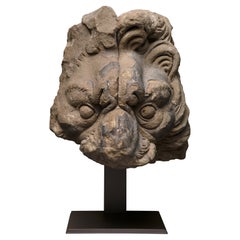
Roman Lion's Protome Sandstone Gallo-Roman, 2nd century AD - 3rd century Provenance : Private Collection Prof. Giesen (Konstanz on Bodensee), pré 1945 Most likely from the Chateau a...

Category

Antique 15th Century and Earlier German Classical Roman Animal Sculptures

Materials

Sandstone

reclining lion in finely chased bronze - Italy, 15th century

reclining lion in finely chased bronze - Italy, 15th century

Located in Bruxelles, BE

Small reclining lion in finely chased bronze Italy, 15th century Traces of gilding H 4,8 x L 6 x P 2 cm Delicately worked bronze depicting a lion in repose, characteristic of early ...

Category

Antique 15th Century and Earlier Italian Gothic Animal Sculptures

Materials

Bronze

You May Also Like

A Patinated Iron Sculpture of a Bull

A Patinated Iron Sculpture of a Bull

Located in London, GB

A fine patinated iron model sculpture of a bull. From the collection of the late Countess Bunny Esterhazy (1938-2021)

Category

Antique 1850s French Animal Sculptures

Materials

Iron

Contemporary Lost Wax Bronze Sculpture Depicting a Bull with Dark Patina

Contemporary Lost Wax Bronze Sculpture Depicting a Bull with Dark Patina

Located in Yonkers, NY

A contemporary bronze sculpture depicting a bull, with dark patina. Created with the traditional technique of the lost-wax (à la cire perdue) that allows a great precision and finesse in the details, this small bronze sculpture depicts a proud bull firmly standing on its four paws resting on a shaped base. Placed anywhere in a home, on a commode, buffet or console table, this cast bronze bull...

Category

21st Century and Contemporary Animal Sculptures

Materials

Bronze

Auguste Clésinger (French, 1814–1883)  Roman Bull, 1858  Bronze sculpture

Auguste Clésinger (French, 1814–1883) Roman Bull, 1858 Bronze sculpture

By Jean-Baptiste Auguste Clesinger

Located in Saint-Amans-des-Cots, FR

French Art Deco Bronze Sculpture – Roman Bull by Auguste Clésinger (1814–1883) Cast by Ferdinand Barbedienne Foundry – Reduction by Achille Collas France, 1858 This exquisite 19th-...

Category

Antique 1850s French Romantic Animal Sculptures

Materials

Bronze

Bronze Of A Standing Bull

Bronze Of A Standing Bull

Located in Essex, MA

Unsigned figure of a standing bull.

Category

Antique Early 1900s French Beaux Arts Animal Sculptures

Materials

Bronze

Maurice Favre a French Bronze Bull

Maurice Favre a French Bronze Bull

Located in West Palm Beach, FL

Maurice Favre (1875-1915) A French bronze bull The lean body revealing the rib cage, with multiple folds of skin at the neck, chocolate-brown patina. Measures: Height 8 in. (20.32...

Category

20th Century Animal Sculptures

Materials

Bronze

Indian Bull. Bronze, Marble.

Indian Bull. Bronze, Marble.

Located in Madrid, ES

Lost wax casting. Base in marble. On the oval base rises the figure of the animal, located facing forward. This type of small sculptures in bronze were already highly appreciated in ...

Category

20th Century European Other Animal Sculptures

Materials

Marble, Bronze