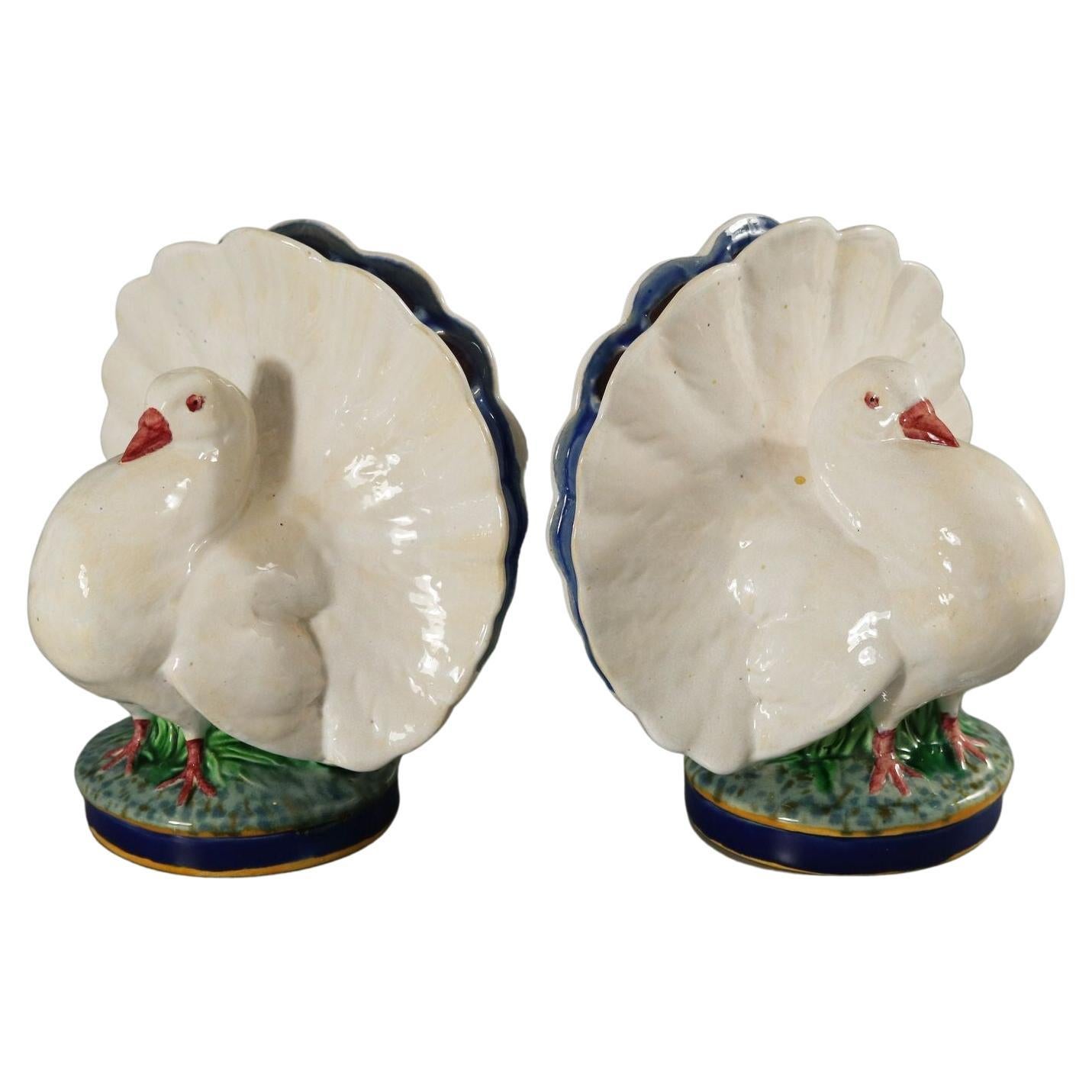
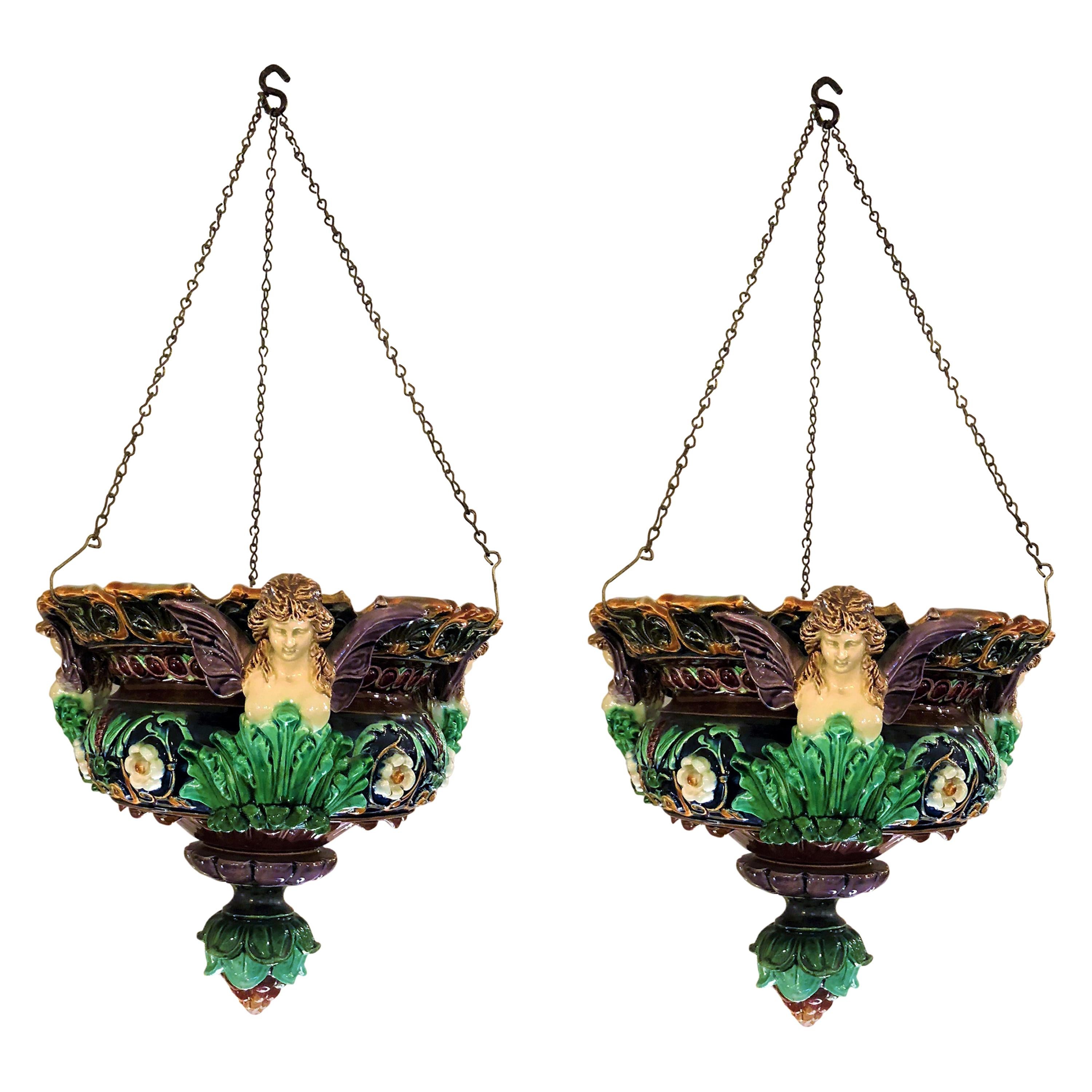
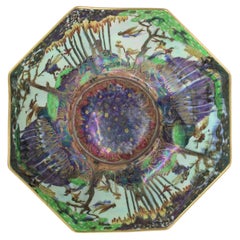
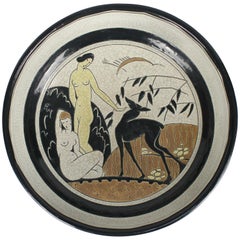
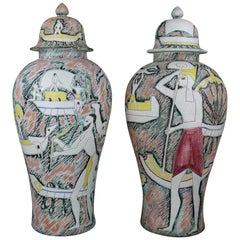
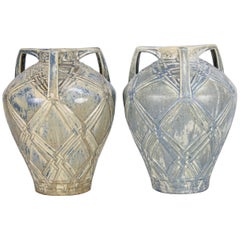
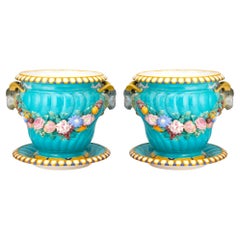
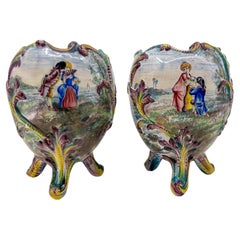
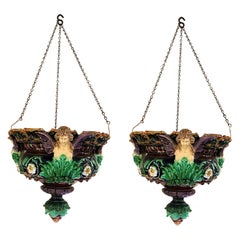
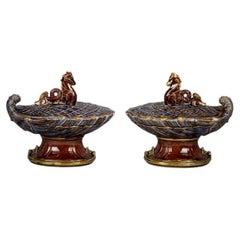
A pair of Minton Majolica Reticulated Baskets, designed by Albert-Ernest Carrier-Belleuse (1824-1887).
Excellent condition on both pieces, no issues!
Made in lead-glazed earthenware (Mintons "Majolica").
With full marks "MINTON 1210".
Albert-Ernest Carrier-Belleuse worked at Minton as chief designer between 1850 and 1855. During his time at Minton, he created models for porcelain items, including vases and sculptures, which combined his artistic style with the factory's technical expertise. His work there contributed to elevating Minton to a leading position in decorative arts during the Victorian era.
The lozenge-shaped body with reticulated lattice with oak garlands and oval cartouches with mottled glazing, a faun to either side wearing cattail wreaths tied in a bow with pink glazed ribbon, on a scrolled and scalloped base glazed in turquoise and trimmed in yellow, the interior glazed in turquoise, the reverse with impressed marks, 'MINTON,' date cypher for 1868, and design number '1210,' which correspond to the entry, 'Basket, Pierced, Cherub Support (M)' as recorded in the Minton Ornamental Shapes (i.e. design numbers) preserved in the Minton Archives and reprinted in J. Jones.
**An identical example is housed in The Metropolitan Museum of Art, New York, object Number: 1984.119**
Book references:
Susan Weber et al., MAJOLICA MANIA: Transatlantic Pottery in England and the United States 1850--1915. New Haven and London: Yale University Press, 2020, Volume Two, p. 104.
Joan Jones, "MINTON: The First Two Hundred Years of Design and Production." Shrewsbury, England: Swan Hill Press, 1993, p. 350. Minton Ornamental Shapes (i.e. design numbers) are listed in Appendix E, pp. 343-377.
Albert-Ernest Carrier-Belleuse (1824–1887)
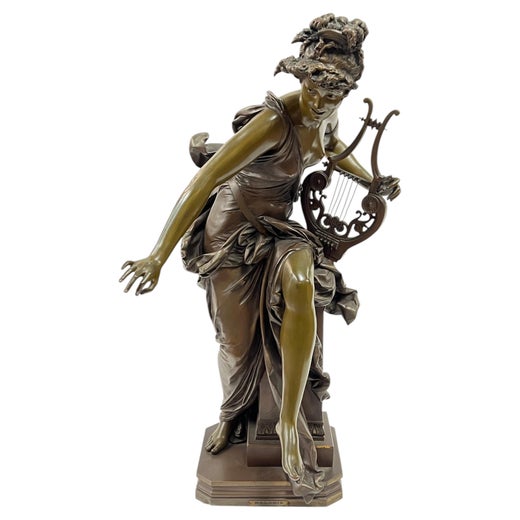
Carrier-Belleuse was a renowned French sculptor celebrated for his versatility and innovation in the 19th century. Born in Anizy-le-Château, France, he began his artistic journey as a goldsmith's apprentice and later studied under David d'Angers at the École des Beaux-Arts. Carrier-Belleuse's career spanned between applied arts and fine arts, with his works ranging from decorative sculptures to monumental public art.
He gained international acclaim for his sensuous female nudes and mythological subjects, such as La Bacchante (1863) and The Abduction of Hippodameia. His artistic style blended realism, neo-Baroque exuberance, and Rococo elegance, making his work highly distinctive. Carrier-Belleuse also served as the creative director at the Manufacture Nationale de Sèvres, where he contributed significantly to ceramic art.
An interesting aspect of his legacy is his mentorship of Auguste Rodin, who worked as his assistant between 1864 and 1870. Rodin's time with Carrier-Belleuse influenced his groundbreaking approach to sculpture.
Carrier-Belleuse was an innovator. Not only did he pioneer new treatments of traditional themes and develop original methods and techniques for the production of sculpture in his large studio, but he was also one of the first sculptors to organise public sales of his works at auction. His models are still among the most popular in the nineteenth-century sculpture market.
Of the three major sculptors of the Second Empire in France - Carrier-Belleuse, Carpeaux and Cordier - it is Carrier-Belleuse who stands out not only as the most prolific artist of his day, but as the one whose oeuvre touches upon every possible outlet available in the decorative arts. He used his prodigious talent in all mediums - from terra-cotta to bronze, marble and gold, creating works on many different scales and many different uses - from monumental works such as the Hebé Endormie at the Musée d'Orsay to trophies, clocks, statuettes, vases and jewelry.
Born in the provinces of Aisne in 1824, Carrier-Belleuse moved to Paris as a child, where he was soon apprenticed to the goldsmith Fauconnier, also the employer of Barye. With the assistance of the sculptor David d'Angers, Carrier-Belleuse entered the Ecole des Beaux-Arts in 1840 for a brief period, joining students such as Garnier, Chapu and Carpeaux.
Carrier-Belleuse's first official commission preceded his Salon debut. In 1848, the new Republic ordered a plaster of Madame Rachel Singing the Marseillaise for the sum of 1000 FF. Following his first Salon in 1850, Carrier-Belleuse left France to take the position of chief designer of the Minton china manufactory in England, a post he occupied until 1855. It is upon his return to France that the sculptor's career begins, particularly with the exhibition of his works in the annual Salons after 1857, the Paris of the Second Empire. His works were immediately noticed for their freshness and vitality, even winning praise from Baudelaire, who did not try to hide his 'assez vif plaisir... Comme les maîtres qu'il affectionne l'idélité antique, devenue trop banale dans la sculpture contemporaine.' (Baudelaire, 'Salon de 1859' from Oeuvres Complètes, Pléade ed. Paris 1961)
Although Carrier-Belleuse exhibited annually at the Salon throughout his lifetime and was awarded various medals, his first great success came with the purchase by the Emperor himself of the 1863 marble group Bacchante with a Herm of Dionysus purchased for the Tuileries Gardens. It was Napoleon III who referred to the sculptor as 'notre nouveau Clodion', remarking upon the obvious influence of the 18th century on the artist's work.
Contemporary and current art historians have used various terms in an attempt to describe the eclectic tendencies in Carrier-Belleuse's work - 'neo-Rococo', 'proto-Art Nouveau', 'Realist'. The wide-ranging variety of these terms is evidence of the sculptor's enormous versatility. His portrait busts - of which he executed over 200 (of the tout Paris) - are informal and naturalistic. Those of men, such as Honoré Daumier, c. 1865-70 or that of Alexander Dumas or Napoleon III himself, tend to be sober and more realistic than his more fanciful and coquettish portraits of women.
A thriving business and increased demand for sculptural ornament due to Haussman's rebuilding of Paris had Carrier-Belleuse simultaneously executing portraits, religious sculpture (such as the marble Messiah for the Church of Saint-Vincent-de-Paul), as well as some of the most important decorative commissions in Paris. The wealthy and notorious courtesan, the Marquise de Païva, employed him to work on her sumptuous Hôtel Païva - today the Travellers' Club on the Champs-Elysées. This was followed by work on the St. Augustin Church, the fountains of the Place du Théatre français, the caryatids of the Paris Opera house, and the Pavillon de Flore.