Want more images or videos?
Request additional images or videos from the seller
1 of 21

Four Late 19th Century Italian Scagliola Marble Specimens, circa 1890

Price:$12,800
$17,717.25List Price

You May Also Like

More From This Seller

View All
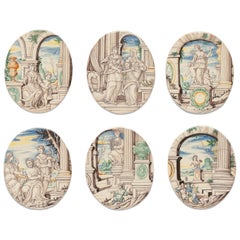
Ancient Maiolica Tiles, Ambrogette, Rampini Manufactory, Pavia, 1693-1704

Ancient Maiolica Tiles, Ambrogette, Rampini Manufactory, Pavia, 1693-1704

By Siro Antonio Africa

Located in Milano, IT

Six maiolica “ambrogette” (tiles) Rampini manufactory, painter probably Siro Antonio Africa Pavia, 1693-1704 a) 6.88 x 5.51 in (17.5 x 14 cm); 0.55 lb (252 g) b) 7.08 x 5.70 in (18 x 14.5 cm); 0.51 lb (233 g) c) 6.88 x 5.70 in (17.5 x 14.5 cm); 0.54 lb (245 g) d) 6.81 x 5.51 in (17.3 x 14 cm); 0.50 lb (230 g) e) 6.88 x 5.51 in (17.5 x 14 cm); 0.50 lb (229 g) f) 7.08 x 5.70 in (18 x 14.5 cm); 0.51 lb (233 g) State of conservation: intact. These six ”maiolica fina” small “ambrogette” belong to a family of ceramic works considered among the finest produced between the 17th and 18th centuries. For a long time, this type of maiolica was attributed to the Venetian village of Angarano, but later it was definitively attributed to the pottery factories in Pavia. A fundamental study ascribed this production specifically to Pavia through an analysis of Lombard collections and a comparison with archaeological remains found near the two main manufacturing sites in the city. (E. Pelizzoni - M. Forni - S. Nepoti, La maiolica di Pavia tra Seicento e Settecento, Milano 1997). The six small oval tiles have rounded edges and are decorated with a historiated motif. They were created using high-fired polychrome technique, with a predominance of cool tones and a dominance of gray and blue, interspersed with manganese, citrine yellow, orange-yellow, and green. The six small “ambrogette” are characterized by the same stylistic features, with a similar decorative design. The first tile (a) depicts a female figure, holding a stiletto and sitting near a pedestal supporting a relief-decorated baluster vase. Behind her, a child is holding a chalice, while through the arches of a portico, a glimpse of a mountainous landscape can be seen in the background. The female figure could possibly be Lucretia, an example of virtue in ancient Roman culture. In the second “ambrogetta” b), the Biblical episode of Judith and Holofernes is depicted through canonical iconography: the decapitated body of Holofernes lies on the bed in the background, while the protagonist, Judith, is seen placing his head into a sack held by a maidservant. Through an archway a shining slice of the moon gives the perception of nighttime. Surprisingly, within the narrative, there is the presence of a basin in the shape of a large shell, closely resembling the products of Pavia's factories. The third small plaque (c) depicts a female figure standing on a plinth and framed by an architectural arch with a vast mountainous landscape in the background. The woman, with her breasts exposed, is accompanied by two children: one approaching her as if wanting to be picked up, and the other seated with an apple in his hand. The protagonist lends herself to different interpretations: perhaps she represents Rea Silvia with the two twin founders of Rome, or perhaps she is an allegory for the Pietà, a common theme depicted on maiolica. In the fourth tile (d), three characters are depicted near a column. The main figure is an old man with a sad expression, holding a cup, while a woman, wearing a turban on her head, also holds a cup in her right hand and a pitcher in her left. A second woman with her hair bound holds another pitcher behind the old man: at his feet a traveller's bag can be seen, along with some apples and a slice of cheese on a rectangular base. It is likely the sad Biblical episode of Lot and his daughters...

Category

Antique Early 1700s Italian Baroque Ceramics

Materials

Maiolica

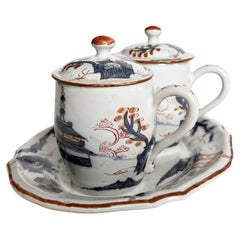
Two Ancient Maiolica Pot Mustard Set, Milan, 1745-1788 Circa

Two Ancient Maiolica Pot Mustard Set, Milan, 1745-1788 Circa

By Felice Clerici

Located in Milano, IT

Two pot mustard set Felice Clerici or Pasquale Rubati Factory Milan, 1745-1788 Circa Majolica polychrome decorated "a piccolo fuoco" (third fire) It measures: 3.94 in in height x...

Category

Antique 18th Century and Earlier Italian Rococo Ceramics

Materials

Maiolica

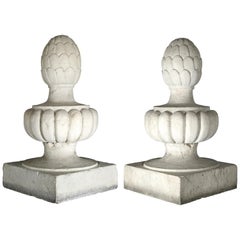
Botticino Marble Architectural Pinnacles, Northern Italy, Circa 1850

Botticino Marble Architectural Pinnacles, Northern Italy, Circa 1850

Located in Milano, IT

Pair of pinnacles Northern Italy, mid-19th century Botticino marble, carved They measure 33.1 inches in height x 17.7 x 17.7 (84 cm x 45 x 45) State of conservation: some visible cracks and various small gaps. The two twin architectural elements of sculpted Botticino marble have a quadrangular base from which a chalice-shaped foot extends. Resting on this, a round pod-like element swells up to support a large pine cone. This is the main decoration: however, the other ornamental details enhance and embellish it, while exalting its position above, whether observed from afar or up close. These aesthetic characteristics suggest that originally the pair of pinnacles were placed on columns or on architectural plinths...

Category

Antique 1850s Italian Other Architectural Elements

Materials

Marble

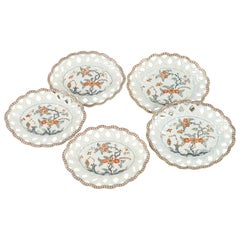
Five Oval Maiolica Dishes by Pasquale Rubati, Milan, Circa 1770-1780

Five Oval Maiolica Dishes by Pasquale Rubati, Milan, Circa 1770-1780

By Pasquale Rubati

Located in Milano, IT

Five oval maiolica dishes with pierced edge Manufacture of Pasquale Rubati Milan, 1770-1780 Three small oval dishes 10.23 in x 7.67 in (26 cm x 19.5 cm) Two large oval dishes 10.82 in x 8.85 in (27.5 x 22.5 cm) lb 3.5 (kg 1.8) State of conservation: intact The five dishes of different sizes have an oval shape, a mixtilinear edge and a molded polylobed shape with a surface enriched with a relief weave motif extending to the brim and forming a perforated basket...

Category

Antique 1770s Italian Rococo Ceramics

Materials

Maiolica

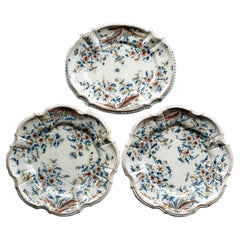
Three Dishes, Antonio Maria Coppellotti Factory, Lodi, Italy, Circa 1745

Three Dishes, Antonio Maria Coppellotti Factory, Lodi, Italy, Circa 1745

By Antonio Maria Coppellotti

Located in Milano, IT

Pair of round dishes and a small oval tray Antonio Maria Coppellotti factory Lodi, circa 1745 High fire polychrome majolica Dishes size: diameter 9.44 in, height 0.78 in (24 cm, 2 c...

Category

Antique 1740s Italian Rococo Delft and Faience

Materials

Maiolica

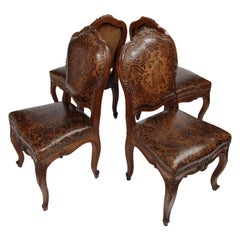
Set of Four Italian Walnut Chairs with Leather, Milan, Circa 1750

Set of Four Italian Walnut Chairs with Leather, Milan, Circa 1750

Located in Milano, IT

Four carved walnut chairs with leather covers Milan, circa 1750 They measure: 39.37” high, 18.30” to the seat, 21.65” deep x 19.29” (100 cm high, 46.5 cm to the seat, 55 cm deep x 49 cm) State of conservation: - the leather covers are not original; - some signs of use, especially on leather covers; - the rocailles at the height of the backrests have lost part of the carved elements. The four walnut chairs have a mixtilinear structure adorned with rocaille relief carvings; the legs are shaped and end with a curl. The backs and seats are padded and covered with impressed leather with figures and cartouche decorations from later production. Around the mid-eighteenth century in Milan it was very popular to cover seats with impressed leather. Mutton or cowhide was used which, suitably tanned, was then worked with heated irons (hot decoration) or with carved wooden molds (cold decoration). These were impressed on the leather until obtaining a darker brown color. Our group of chairs...

Category

Antique 1750s Italian Rococo Chairs

Materials

Leather, Walnut