Want more images or videos?
Request additional images or videos from the seller
1 of 21

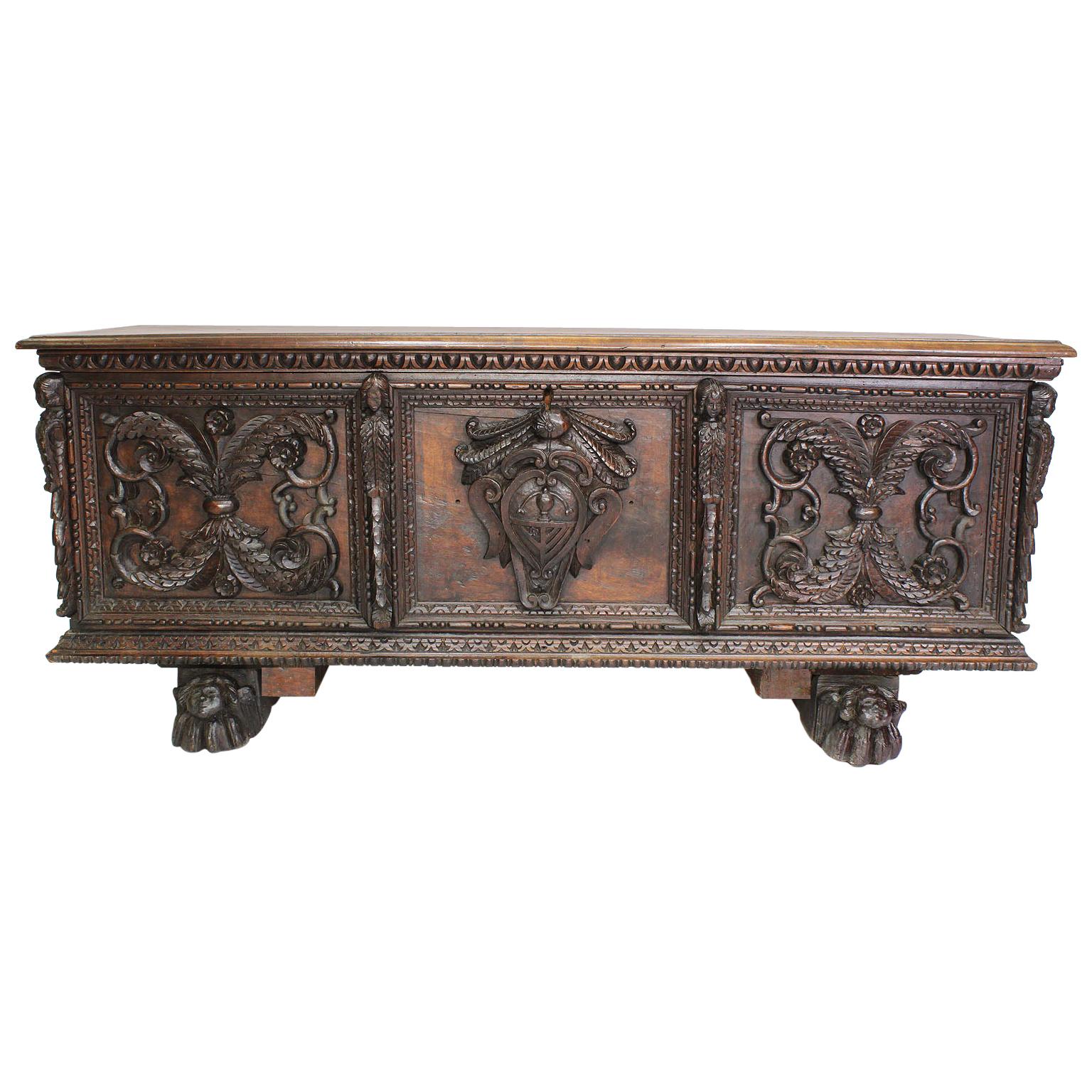
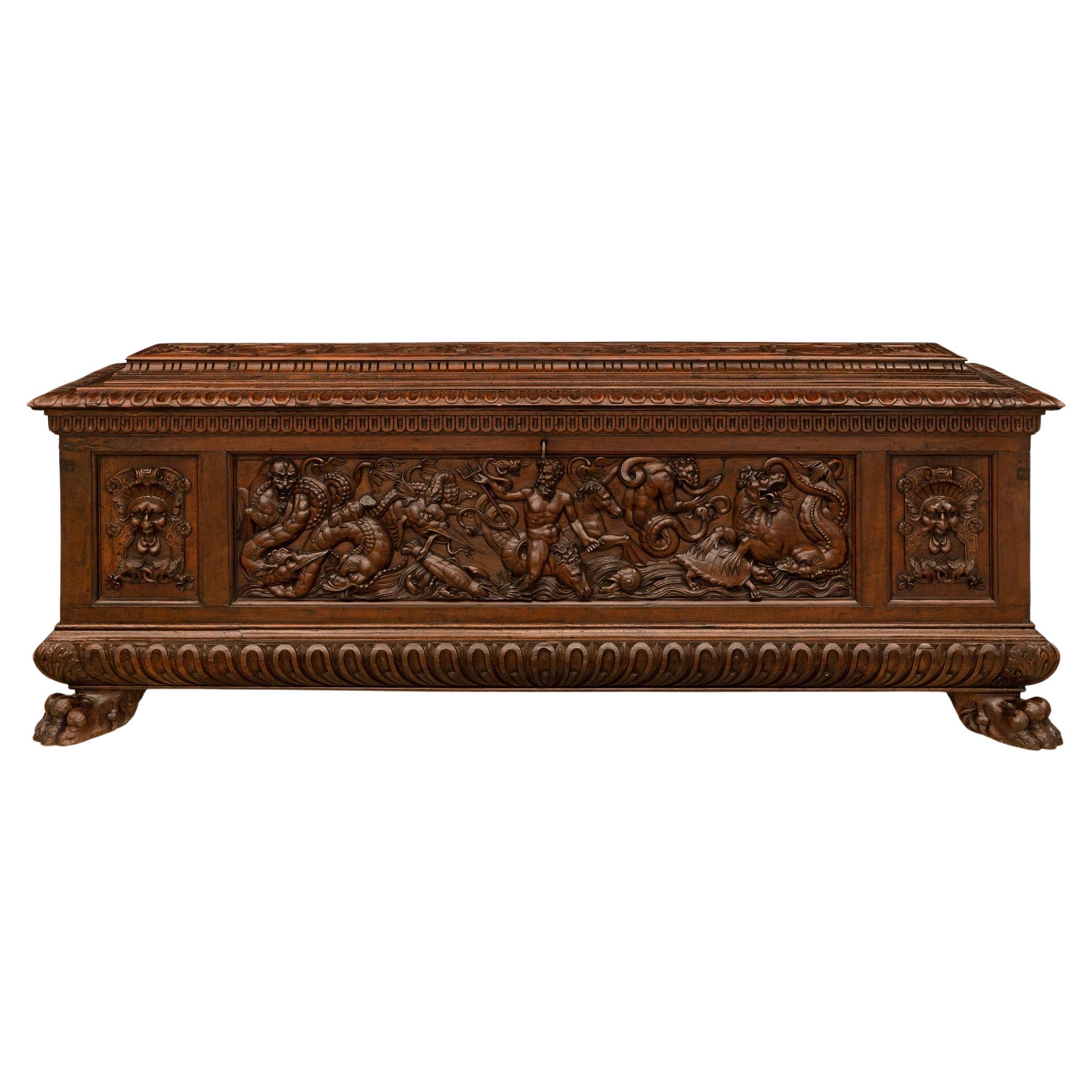
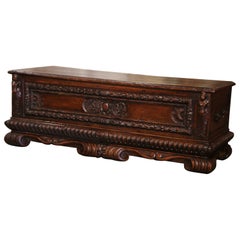
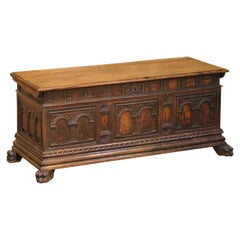
Italian 19th Century Carved Walnut Cassone Chest with Putti and Winged Dragons

$42,850
$64,85033% Off
£32,291.12
£48,87033% Off
€37,765.38
€57,154.8433% Off
CA$60,633.63
CA$91,764.0833% Off
A$61,532.03
A$93,123.7333% Off
CHF 35,471.90
CHF 53,683.8533% Off
MX$745,045.48
MX$1,127,565.9133% Off
NOK 411,716.79
NOK 623,099.9833% Off
SEK 416,120.32
SEK 629,764.3533% Off
DKK 282,320.56
DKK 427,269.2733% Off

About the Item

A Fine and Large Italian Florentine 19th Century Baroque Revival Style Carved Walnut Figural Cassone Chest on Stand. The ornately carved drop-front cassone with an allegorical in-relief carvings depicting playful Putti among satyrs, fruits and acorns, centered with a carved winged lion holding a shield, flanked on each side by pull-out drawer compartments, each with carvings of a single Putto. The swagged apron centered with carvings depicting two Putti resting on an allegorical male mask crowned with fruits and flanked by floral wreaths, ribbons and seashells, all raised with a pair of resting winged dragons. Circa: Florence, 1880-1890. A cassone (plural cassoni) or marriage chest is a rich and showy Italian type of chest, which may be inlaid or carved, prepared with gesso ground then painted and gilded. Pastiglia was decoration in low relief carved or moulded in gesso, and was very widely used. The cassone ("large chest") was one of the trophy furnishings of rich merchants and aristocrats in Italian culture, from the Late Middle Ages onward. The cassone was the most important piece of furniture of that time. It was given to a bride and placed in the bridal suite. It would be given to the bride during the wedding, and it was the bride's parents' contribution to the wedding. There are in fact a variety of different terms used in contemporary records for chests, and the attempts by modern scholars to distinguish between them remain speculative, and all decorated chests are today usually called cassoni, which was probably not the case at the time. For example, a forziere probably denoted a decorated chest with a lock. Since a cassone contained the personal goods of the bride, it was a natural vehicle for painted decoration commemorating the marriage in heraldry and, when figural painted panels began to be included in the decor from the early quattrocento, flattering allegory. The side panels offered a flat surface for a suitable painting, with subjects drawn from courtly romance or, much less often, religious subjects. By the 15th century subjects from classical mythology or history became the most popular. Great Florentine artists of the 15th century were called upon to decorate cassoni, though as Vasari complains, by his time in the 16th century, artists thought such work beneath them. Some Tuscan artists in Siena and Florence specialized in such cassone panels, which were preserved as autonomous works of art by 19th century collectors and dealers, who sometimes discarded the cassone itself. From the late 1850s, neo-Renaissance cassoni were confected for dealers like William Blundell Spence, Stefano Bardini or Elia Volpi in order to present surviving cassone panels to clients in a more "authentic" and glamorous presentation. A typical place for such a cassone was in a chamber at the foot of a bed that was enclosed in curtains. Such a situation is a familiar setting for depictions of the Annunciation or the Visitation of St. Anne to the Virgin Mary. A cassone was largely immovable. In a culture where chairs were reserved for important personages, often pillows scattered upon the floor of a chamber provided informal seating, and a cassone could provide both a backrest and a table surface. The symbolic "humility" that modern scholars read into Annunciations where the Virgin sits reading upon the floor, perhaps underestimates this familiar mode of seating. At the end of the 15th century, a new classicising style arose, and early Renaissance cassoni of central and northern Italy were carved and partly gilded, and given classical décor, with panels flanked by fluted corner pilasters, under friezes and cornices, or with sculptural panels in high or low relief. Some early to mid-sixteenth-century cassoni drew their inspiration from Roman sarcophagi (illustration, right). By the mid-sixteenth century Giorgio Vasari could remark on the old-fashioned cassoni with painted scenes, examples of which could be seen in the palazzi of Florentine families. A cassone that has been provided with a high panelled back and sometimes a footrest, for both hieratic and practical reasons, becomes a cassapanca ("chest-bench"). Cassapanche were immovably fixed in the main public room of a palazzo, the sala or salone. They were part of the immobili ("unmoveables"), perhaps even more than the removable glazed window casements, and might be left in place, even if the palazzo passed to another family. A similar Cassone, most likely by the same Florentine cabinetmaker, was acquired in Florence in the 1880's by Grand Duke Vladimir Alexandrovich, the younger brother of the Emperor Alexander III of Russia. The Cassone is currently on display in the Vladimir Palace (the former official residence of GD Vladimir Alexandrovich) in St.Petersburg, Russia. An image of the Cassone at The Vladimir Palace is available upon request. Jan's & Co. Fine French Antiques, Inc. would like to thank Nadia Smotkin in St. Petersburg, Russia, for providing us with this information. Overall height: 52 1/8 inches (132.4 cm) Overall width: 83 1/2 inches (212.1 cm) Overall depth: 29 3/4 inches (75.6 cm)
  • Dimensions:
    Height: 52.13 in (132.42 cm)Width: 83.5 in (212.09 cm)Depth: 29.75 in (75.57 cm)
  • Style:
    Baroque Revival (In the Style Of)
  • Materials and Techniques:
  • Place of Origin:
  • Period:
  • Date of Manufacture:
    Circa: Florence, 1880-1890
  • Condition:
    Repaired: Minor old touch ups and carving restorations. Wear consistent with age and use. Minor losses. Minor fading. A truly stunning carved cassone chest. Overall condition is very good with some age wear, minor carving losses/restorations, minor wood stress and fading. One key.
  • Seller Location:
    Los Angeles, CA
  • Reference Number:
    Seller: Ref.: A2726 - Lot 119681stDibs: LU1796237092312

More From This Seller

View All
Italian 19th Century Baroque Style Carved Walnut Figural Cassone Chest-Trunk

Italian 19th Century Baroque Style Carved Walnut Figural Cassone Chest-Trunk

Located in Los Angeles, CA

An Italian 19th century Baroque Revival style carved walnut figural Cassone chest-trunk. The ornately carved chest, also known as a marriage chest, with ...

Category

Antique 19th Century Italian Baroque Revival Commodes and Chests of Drawers

Materials

Wrought Iron

A French Baroque 19th Century Louis XV Style Finely Carved Walnut Server Console

A French Baroque 19th Century Louis XV Style Finely Carved Walnut Server Console

Located in Los Angeles, CA

French Baroque 19th century Louis XV style finely carved walnut figural buffet server console table with a variegated Rouge Royal marble top, the apron centered with a relief carved ...

Category

Antique 19th Century French Baroque Revival Console Tables

Materials

Marble, Bronze

A 17th-18th Century French/Italian Renaissance Walnut Carved Credenza Cabinet

A 17th-18th Century French/Italian Renaissance Walnut Carved Credenza Cabinet

Located in Los Angeles, CA

A 17th-18th Century French/Italian Renaissance Walnut Figural Carved Credenza Cabinet or Cupboard. The two-part cabinet with a pair of upper coffered doors with metal key-hole hardwa...

Category

Antique Late 17th Century Renaissance Cabinets

Materials

Metal

Large Italian 19th Century Baroque Style Oak-Carved Figural Credenza Cabinet

Large Italian 19th Century Baroque Style Oak-Carved Figural Credenza Cabinet

Located in Los Angeles, CA

A fine and rare Italian 19th century Baroque style oak-carved figural credenza cabinet. The upper part with a pair of colorful Vitreaux (Stained glass) panelled doors, surmounted on ...

Category

Antique 19th Century Italian Baroque Revival Buffets

Materials

Marble

French 19th Century Louis XIV Style Baroque Figural Carved Walnut Two-Door Vitri

French 19th Century Louis XIV Style Baroque Figural Carved Walnut Two-Door Vitri

Located in Los Angeles, CA

A Fine French 19th Century Louis XIV Style Baroque Revival Figural Carved Walnut Two-Door Vitrine. The finely carved body, crowned with a pair of male busts, the doors with symmetric...

Category

Antique Late 19th Century French Baroque Revival Vitrines

Materials

Glass, Walnut

You May Also Like

19th C. Italian Renaissance Revival Carved Walnut Credenza with Figural Panels

19th C. Italian Renaissance Revival Carved Walnut Credenza with Figural Panels

Located in Dallas, TX

Bring impressive scale and sculptural craftsmanship to a dining room, library, or grand entry with this exceptional antique Italian Renaissance Revival credenza, crafted circa 1870. ...

Category

Antique Mid-19th Century Italian Renaissance Credenzas

Materials

Walnut

19th Century Italian Renaissance Carved Walnut Cassone with Figural Detail

19th Century Italian Renaissance Carved Walnut Cassone with Figural Detail

Located in Dallas, TX

This exceptional antique cassone, or dowry chest, was crafted in Italy circa 1830 from richly patinated walnut. Standing on five deeply carved scrolled feet, the base features a shap...

Category

Antique Early 19th Century Italian Baroque Blanket Chests

Materials

Walnut

IMPORTANT ANTIQUE CIRCA 1850 FRENCH WALNUT ORNATELY CARVED BUFFET SiDEBOARD

IMPORTANT ANTIQUE CIRCA 1850 FRENCH WALNUT ORNATELY CARVED BUFFET SiDEBOARD

Located in West Sussex, Pulborough

Royal House Antiques Royal House Antiques is delighted to offer for sale this Important Circa 1850 French Walnut ornately carved Buffet sideboard Please note the delivery fee list...

Category

Antique 1850s French Early Victorian Sideboards

Materials

Walnut

19th-Century French Henri II Renaissance Revival Carved Walnut Buffet

19th-Century French Henri II Renaissance Revival Carved Walnut Buffet

Located in SEDLEC-PRČICE, CZ

This 19th-century French Henri II Renaissance Revival carved walnut buffet is an exceptional statement piece featuring masterfully sculpted mythological figures and chimera supports....

Category

Antique 1890s French Renaissance Cabinets

Materials

Walnut

17th/18th Century Heavily Carved Italian Walnut Three Drawer Chest or Cabinet

17th/18th Century Heavily Carved Italian Walnut Three Drawer Chest or Cabinet

Located in Milford, NH

A nice example of a heavily carved wooden three drawer chest or cabinet in its original finish, most likely walnut, with figural carved drawer fronts, carved face escutcheons, foliat...

Category

Antique Late 17th Century Italian Baroque Commodes and Chests of Drawers

Materials

Metal

Mid-18th Century Italian Baroque Carved Walnut Cassone Blanket Chest

Mid-18th Century Italian Baroque Carved Walnut Cassone Blanket Chest

Located in Dallas, TX

Crafted in Italy circa 1750, this impressive antique walnut cassone offers both architectural presence and practical storage. The rectangular coffer showcases a richly carved façade ...

Category

Antique Mid-18th Century Italian Gothic Blanket Chests

Materials

Walnut