Want more images or videos?
Request additional images or videos from the seller
1 of 11

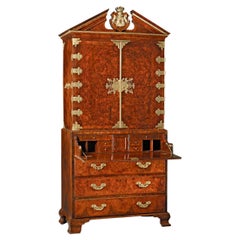
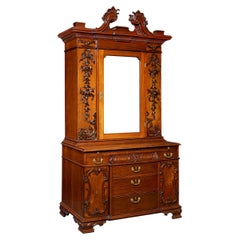
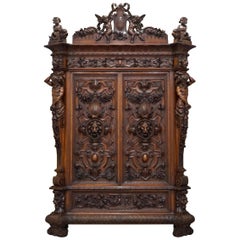
Tsar Nicholas II's Winter Palace Armoire

$348,500List Price

You May Also Like

Rare Moses Michelangelo Guggenheim & Pauly Cie Et Venice Antique Carved Armoire

Rare Moses Michelangelo Guggenheim & Pauly Cie Et Venice Antique Carved Armoire

By Pauly et Cie, Guggenheim Museum

Located in West Sussex, Pulborough

We are delighted to offer for sale this very rare one of a kind Pauly CIE Et stamped hand carved walnut armoire made by the genius that was Moses Michelangelo Guggenheim 1837-1910 Where to begin, this cabinet is stamped to the rear “Fabrique De Meubles Pauly & Cie Venise. Pauly & Cie” who were a world famous glass foundry and later equally famous furniture manufacturer. Their grotto furniture has an immense following across the world. This piece was most likely retailed through them as it was made by Moses Michelangelo Guggenheim who is a fellow venetian There is one other known example of his works which is very similar, it is currently retailing for no less than £900,000 however it is accompanied by a few other pieces from a drawing room suite. The suite came from Palazzo Papadopoli, a Renaissance palace on the Grand Canal in Venice built for the Coccini family by Giovanni de Grigi around 1560. I will include some further history below on both Pauly CIE ET and Moses Michelangelo Guggenheium On to the armoire, it is clearly the most ornate tour de force of carving you will ever see, I’m thankful it has managed to survive so long without being broken up by salvagers looking to reclaim the sculptures. You can see in the carving elements of Pauly’s inspiration in the form of shells. You also have Putti’s riding dolphins and so on. We have fully treated it as there were various signs of old worm, it’s then been cleaned waxed and polished. One of the hidden hinges has been replaced, otherwise it is in near perfect condition for the age. The insides houses three wood shelves Dimensions Height 255.5cm top to bottom, without the removable top carving 211cm Width 170cm arm to arm of the chaps on the outside, 172cm at the top, 166cm at the bottom Depth 63cm top, 55cm middle, 59cm bottom Please note all measurements are taken at the widest point Moses Michelangelo Guggenheim Leading expert of decorative arts in late 19th century Venice, Michelangelo Guggenheim (1831-1910) also was one of the greatest antiquarians and a modern furniture producer in the “City of Water”. His collections stored in the Balbi Palace on the Grand Canal were an outstanding sight, that art amateurs would recommend. At the age of 20, he founds a "Stabilimento d’arti decorative e industriali" which purpose is the industrial creation of objects bearing an artistic force. The furniture that made him worldwide famous re-imagines ancient styles, freeing their aesthetic powers to serve modern imagination. Often in walnut, his pieces of furniture sent to World Fairs impress people by the finesse of their sculptures. A prized designer as well, he reorganizes princely interiors in the same spirit. His most famous work is the Palazzo Papadopoli's design about 1874, where he unfolds the vocabulary of several periods. He conceives there a richly furnished Neo-Renaissance Cabinet that relived the Italian golden age. For the exceptional result he is awarded the Gold Medal of merit for science and arts by Ludwig II of Bavaria. Pauly & Cie Venise Since its foundation (1866), Pauly & C. has stood for elegance, creativity and Venetian luxury. The ancient Roman technique known as “murrine”, which today is the symbol of Murano glass, was reproduced for the first time in its workshops and was presented to the world at the Universal Exhibition in Paris in 1878. In 150 years of business Pauly & C. has produced unique works for royal palaces, public buildings, private villas and has served an international client base that includes some of the most prominent names from the world of culture and art, figures from the world of industry and finance, politicians and nobility. Pauly & C. - C.V.M. (compagnia Venezia Murano) works are currently held in many private collections and exhibited in some of the most prestigious museums in the world. In the last years of activity, Pauly has been active with three distinct brands: • Pauly & C. CVM, the time-honoured company that produces classic objects, recreating old designs and collections and offering modern reinterpretations of them. • Pauly Glass Factory, which continues its association with artists and designers to produce artistic works with modern lines. • MVM Interior operates throughout the world with architects, interior designers and design studios for the creation of prestigious personalized projects History Compagnia di Venezia e Murano C.V.M. began as Salviati &C. in London in 1866 under the direction of Vicenza attorney Antonio Salviati and with the backing of two British men: archaeologist Austen Henry Layard and antiquarian Sir William Drake. The company was dedicated to using ancient techniques and utilized master glassblowers in its efforts to do so. It called in specialists from other fields like goldsmithing and engraving to ensure authenticity and employed artist Giuseppe Devers to teach the techniques of enamelling and heat-applied glass gilding to company artisans. Archaeologist Layard was particularly interested in the mosaic glass techniques of Roman and pre-Roman artists, and he spent years personally overseeing the work of the company's technicians and glassblowers in attempting to revive those techniques. In 1872, the company was successful, managing to replicate the type of glass commonly known as "murrina". The company was renamed Venice and Murano Glass and Mosaic Company Limited in 1872, and, in 1877, Layard purchased Salviati's interest so that Salviati could pursue other interests. The company quickly earned a reputation for quality original glass art and reproductions as well as its many mural mosaics in Great Britain and elsewhere in Europe. In 1878, the murrine produced by Compagnia di Venezia e Murano was included in its exhibit at the International Exhibition in Paris, which was the chief attraction in Italian glass. In its observations of the display, the United States Commission to the Paris exposition commented not only on "Roman murrine glass", but also particularly on the mural glass mosaics, the "perfection of which" had "engaged the earnest attention of the company." Mosaics produced by the company during the time period are still in existence in diverse areas such as Gonville and Caius...

Category

Antique 19th Century Italian Victorian Wardrobes and Armoires

Materials

Walnut

French Renaissance Armoire

French Renaissance Armoire

$95,183

H 68.71 in W 56.3 in D 22.84 in

French Renaissance Armoire

Located in Saint-Ouen, FR

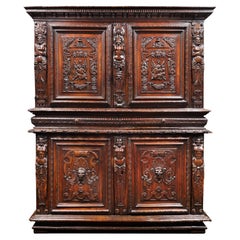
Original lock and key This piece of furniture shows no recess on its upper part. It opens with four folding-doors and two drawers within the belt. The key bears the date 1524 above cross motifs. Burgundy and Lyon regions subordinated themselves to architecture in a different manner than the other french schools. Rather than using particularly columns and pediments pieces of furniture from Lyon borrow architecture’s organization principles and rigorous designs. On the upper body a strong feeling of balance and symmetry appears with the folding doors reliefs. Swags of flowers and fruits held with knot cloth centered by a man seating on his arms. Here profiles, masks and chou de Bourgogne mingle with the structuring scrolls. The two lateral terms wear draperies and the goddess Diana in the center wears a belt of fruits similar to Hugue Sambin’s designs (Termes de Diane et de Venus, 1554, BNF). The two palm-leaves enriched drawers and the alternating scrolls belt balance the weight of the cornice with its alternatings consoles and tops. The lower body is also adorned by three terms with a feminine one in the center, all three are wearing fruits on their heads. The folding doors are centered upon a motif of cut cuirs by a mask in high relief. Wearing a feathered tiara...

Category

Antique 16th Century French Renaissance Wardrobes and Armoires

Materials

Walnut

17th Century Emblazoned Germanic Armoire

17th Century Emblazoned Germanic Armoire

$21,416

H 86.62 in W 68.9 in D 20.87 in

17th Century Emblazoned Germanic Armoire

Located in Saint-Ouen, FR

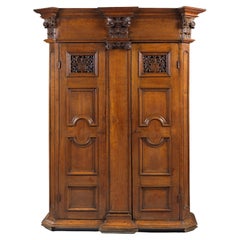
This interesting oak cabinet of germanic workmanship is a wedding furniture. The cabinet rests on a molded base, opens with two doors located on e...

Category

Antique 17th Century German Other Wardrobes and Armoires

Materials

Oak

Renaissance Style Wooden Cabinet Attributed to H.A. Fourdinois, France, 1893

Renaissance Style Wooden Cabinet Attributed to H.A. Fourdinois, France, 1893

$16,062Sale Price|38% Off

H 94.49 in W 48.82 in D 22.05 in

Renaissance Style Wooden Cabinet Attributed to H.A. Fourdinois, France, 1893

Located in PARIS, FR

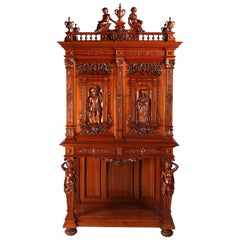
A wooden cupboard, elaborately carved throughout, dated "1893" on the crest and attributed to H.A. Fourdinois. The upper section with a pair of cherubs at the center of a balustrade ornamented with two-handled urns, two architectonic doors below, carved with lady and gentleman in niches surrounded by extensive carving with classical motifs. The lower section with two drawers above a standing female caryatid support at each front corner. The all reposing on four gadronned round feet. The Fourdinois company was founded in 1835 by Alexandre-Georges Fourdinois (1799-1871). The Universal Exhibition held in London in 1851 was undoubtedly their first great artistic and public success. Winning the Great medal for a neo-Renaissance buffet...

Category

Antique 1890s French Renaissance Cabinets

Materials

Wood

Historic cabinet, France, circa 1870.

Historic cabinet, France, circa 1870.

$11,659

H 100.01 in W 59.06 in D 24.41 in

Historic cabinet, France, circa 1870.

Located in Chorzów, PL

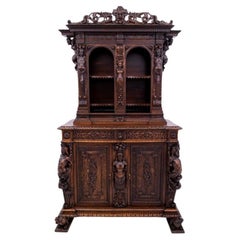
Historic cabinet, France, circa 1870. Very good condition. Wood: oak height 254 cm x width 150 cm x depth 62 cm

Category

Antique Late 19th Century French Renaissance Sideboards

Materials

Oak

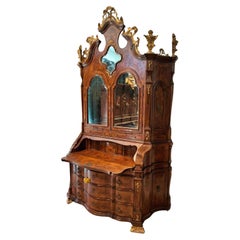
MAGNIFICENT ELEGANT VENETIAN TRUMEAU 19/20th Century

MAGNIFICENT ELEGANT VENETIAN TRUMEAU 19/20th Century

$26,175

H 110.24 in W 64.97 in D 29.53 in

MAGNIFICENT ELEGANT VENETIAN TRUMEAU 19/20th Century

Located in Madrid, ES

MAGNIFICENT ELEGANT ITALIAN VENETIAN TRUMEAU 19/20th Century in walnut briar, enriched with 19th Century Venetian craftsmanship gilded wood carvings in pure gold h 280 x 165 x 75 cm...

Category

Antique 19th Century Italian Baroque Wardrobes and Armoires

Materials

Wood

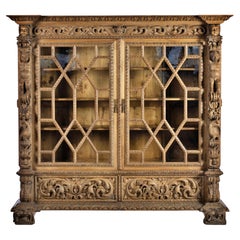
Large Display Cabinet Portuguese, 19th-Century Baroque Style

Large Display Cabinet Portuguese, 19th-Century Baroque Style

Located in Madrid, ES

Large Display Cabinet Portuguese, 19th-century Baroque style, In carved chestnut wood decorated with vegetal elements, birds, and putti. With two glass doors and two drawers. Int...

Category

Antique 19th Century Portuguese Baroque Cabinets

Materials

Wood

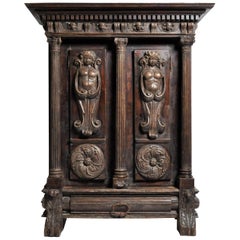
Impressive Renaissance Revival Armoire

Impressive Renaissance Revival Armoire

$12,400Sale Price|20% Off

H 79.5 in W 64 in D 31 in

Impressive Renaissance Revival Armoire

Located in Chicago, IL

This handsome, well-patinated piece hails from Alsace, France. The molded and dentil cornice sits above a cherub-decorated frieze and stepped architrave that is supported by three Cl...

Category

Antique 18th Century French Renaissance Revival Wardrobes and Armoires

Materials

Hardwood

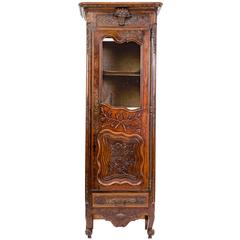
18th Century Louis XV Armoire

18th Century Louis XV Armoire

$14,600Sale Price|20% Off

H 93 in W 29 in D 22.5 in

18th Century Louis XV Armoire

Located in Dallas, TX

An extraordinarily tall mid-18th century Louis XV Provincial fruitwood narrow armoire/bonnetiere with a rectangular cornice. The frieze is centered by a...

Category

Antique 18th Century French Louis XV Wardrobes and Armoires

Materials

Fruitwood

19th Century, French Renaissance Walnut Cabinet

19th Century, French Renaissance Walnut Cabinet

Located in Hixson, TN

An astounding French Renaissance walnut cabinet with superb detailed carvings. This piece is not only striking but its large. The top has a v...

Category

Antique 1840s French Renaissance Cabinets

Materials

Walnut

More From This Seller

View All
French Provincial Double Door Armoire

French Provincial Double Door Armoire

Located in New Orleans, LA

This majestic French walnut armoire is a stunning example of the Provincial style. Standing nearly nine feet high, this rare armoire featuring splendid rocaille carvings above its do...

Category

Antique 18th Century French French Provincial Wardrobes and Armoires

Materials

Wood, Walnut

19th Century Dutch Bureau Bookcase

19th Century Dutch Bureau Bookcase

Located in New Orleans, LA

This magnificent and important Dutch mahogany bureau bookcase, exuberantly carved and adorned with superb figural carvings, impressive scrolled feet and elaborate applied decoration....

Category

Antique 19th Century Dutch Other Bookcases

Materials

Mahogany

John Henry Belter Rosewood Armoire

John Henry Belter Rosewood Armoire

By John Henry Belter

Located in New Orleans, LA

One of the rarest furniture forms created by John Henry Belter, this armoire is a testament to this legendary cabinet maker's talent. Recognized as a Pioneer in design and craftsmans...

Category

Antique 19th Century American Rococo Revival Wardrobes and Armoires

Materials

Rosewood

King George I Ambassadorial Secrétaire-Cabinet

King George I Ambassadorial Secrétaire-Cabinet

Located in New Orleans, LA

This highly important secrétaire-cabinet was crafted for and specially ordered by King George I for the British Ambassador to Russia. From its craftsmanship and materials to its exceptional artistry, it is a work of royal and historic significance that exudes power in each and every detail. The broken pediment at its apex features the simplified royal coat of arms bearing the king’s crown, while the interior is adorned by portraits of the British Royal Family. Placed within the ambassador’s St. Petersburg home, this entirely unique piece of furniture would have been a potent reminder of England's grandeur and political importance. Relations between England and Russia during this period were at an all-time high. Peter the Great had traveled to England in 1698 as part of his widely known “Grand Embassy” tour, wherein he attempted to gain foreign support against the Ottoman Empire. He spent a period of nearly four months there, meeting with King William III and his court on numerous occasions. Noted academic Arthur MacGregor wrote concerning the impact of the trip, “For two decades following Peter's visit, British influence in Russia reached a peak. It manifested itself in social custom, in craft practice and in ships and naval organization... it reached a significant sector of the population before relations cooled once again and the two nations pulled back from this era of unprecedented cordiality.” First and foremost, however, it is a reminder of British might and influence. By the reign of King George I, England had come into its own as a world power. Unique in its design, this cabinet is a reflection of the country’s might. It is crafted from the highest-quality solid walnut and burr walnut adorned by gilded lock plates and engraved hinges. The presence of ormolu at its apex and lining the doors was a rarity for this period, and its addition makes manifest the importance of the design. The outer doors open to reveal multiple interiors, including fifteen separate drawers around a central cupboard; the cupboard doors each bear mezzotint portraits of George I and his father, Ernest Augustus, Elector of Hanover. An etching after the portrait of George I dating to circa 1716 is in London’s Royal Academy. A second, inner pair of doors are adorned by mezzotints of the Prince and Princess of Wales (later Queen Caroline and George II), which are both after portraits by Sir Godfrey Kneller dated 1716 in the Royal Collection. A final portrait is revealed on the very interior of the cabinet, where a mezzotint of Frederick, Anne, Amelia and Caroline, children of the Prince of Wales, resides. An etching (circa 1715-1720) after this portrait can be found in the National Portrait Gallery (London). Apart from its abundance of royal portraiture, the cabinet features stunning painted decoration, including floral designs as well as clouds, birds and trees in a bucolic motif reminiscent of Eden. Its lower portion is a study in both form and function, featuring a fitted secrétaire-drawer above three additional drawers for storage. The cabinet appears in The Shorter Dictionary of English Furniture by R. Edwards from 1964, a text that is regarded as the bible of British furniture design. Edwards describes it as a “writing cabinet...given by George I to the British Ambassador at the Russian court.” The cabinet was likely made for the 18th-century German diplomat and writer Friedrich Christian Weber, who represented English interests at the Russian court from 1714 until 1719. Although Weber’s tenure as ambassador was relatively short, while in St. Petersburg, he authored his account entitled Das veraenderte Russland (The Present State of Russia), which was published in three volumes in 1721, 1739 and 1740. It may, however, also have been made for George Douglas, 2nd Earl of Dumbarton, who served as ambassador alongside Weber in 1716. Diplomatic relations ceased between the two countries in 1721. In 1928, the cabinet appeared for sale at the International Exhibition of Antiques & Works of Art in Olympia. It had previously been in the collection of the Woltner family of Bordeaux, the celebrated vintners who owned the estate Château Laville Haut-Brion and produced wine of the same name. According to the family, Monsieur Woltner was given the cabinet as a gift from an aunt who lived in Russia for many years. After leaving the Woltner collection, the cabinet was acquired by William Berry...

Category

Antique 18th Century English Georgian Secretaires

Materials

Brass

Mahogany Bureau Cabinet After Thomas Chippendale

Mahogany Bureau Cabinet After Thomas Chippendale

By Thomas Chippendale

Located in New Orleans, LA

This extraordinary Irish bureau cabinet was crafted based on a design for a desk and bookcase drawn from Thomas Chippendale’s famed 1762 edition of The Gentleman and Cabinet-Maker's ...

Category

Antique 18th Century Irish Chippendale Cabinets

Materials

Mirror, Mahogany

19th Century French Vitrine by Francois Linke

19th Century French Vitrine by Francois Linke

By François Linke

Located in New Orleans, LA

This rare and stunning vitrine was crafted by the illustrious French ébéniste François Linke. A master of the Louis XVI style, Linke was renowned for his highly original designs that...

Category

Antique 19th Century French Rococo Vitrines

Materials

Bronze