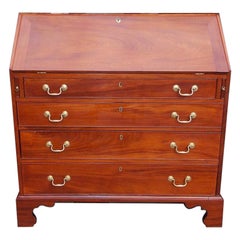
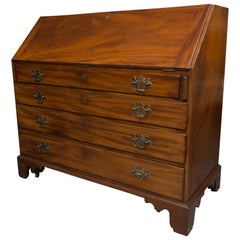
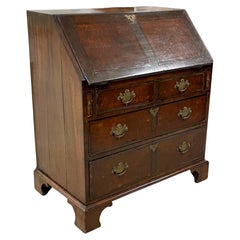
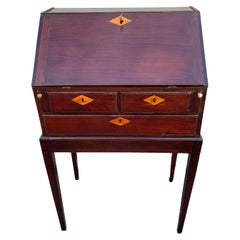
George III Mahogany Architect’s Desk attr. Gillows of Lancaster circa 1790
Located in Shippensburg, PA
GEORGE III MAHOGANY ARCHITECT'S DESK IN MANNER OF GILLOWS OF LANCASTER
England, circa 1790 with alphabetized rent drawers interior unmarked
Item # 405KYH28Z
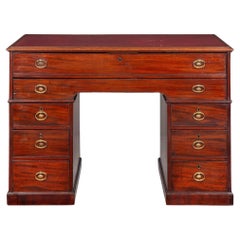
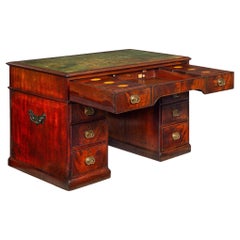
This remarkable architect's pedestal desk was almost certainly crafted by Gillows of Lancaster, London circa 1790. It features a rectangular top inlaid with maroon gilt-tooled leather bordered by a molded edge. Below this is situated a full-width frieze drawer which is decorated to appear as two false drawers over pedestals containing three graduated drawers on either side of an open kneehole. The desk stands on a molded plinth base fitted with casters.
The top drawer reveals a sliding gilt-tooled leather writing surface with a central panel that can be lifted on ratchet supports to hold and display documents. This surface slides back to uncover a lower compartment with an open storage area, flanked by three lidded compartments labeled alphabetically within oval reserves. The back of the desk is designed for a tidy appearance, making it suitable for placement in the center of a room, featuring two full-width faux drawers above faux cabinet doors in the pedestals.
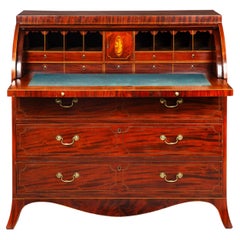
While the present example is not marked by Gillows, it is almost without question a product of their workshops and is firmly attributed to their design books. The alphabet inlaid drawers were inspired by designs popularized by Thomas Shearer’s The Cabinet Maker’s London Book of Prices (1788-1803). These were employed in designs published by Gillows, such as the 'bureau writing-table' with a double-ratcheted top made for the Earl of Shrewsbury in 1789 and a writing-table from 1794 (see Gillow Furniture Designs 1760-1800, L. Boynton, ed., 1995, pl. 24 and 41). A similar design appears in the firm’s 1798 Estimate Sketch Book (p.1481), preserved in the Westminster City Library. The drawer design is further seen on pedestal desks stamped by Gillows, including the library table provided by the firm in 1778 to Denton Hall (see C. Gilbert, The Life and Works of Thomas Chippendale, London, 1978, vol.II, p.246, pl.449).
Gillows produced many variations of this desk style, including those with ratcheting tops for standing use, enclosed kneehole designs, various types of pulls, and subtle dimensional adjustments. Examples can be seen well into the George IV period and the influence of this form on later desks by Gillows can be seen as the tastes changed into the second half of the nineteenth century.
Sir Walter Scott acquired a similar desk from Gillows for his Edinburgh house in Castle Street in 1810, later moving it to his study at Abbotsford in 1826. In a letter to J.B. Morritt of Rokeby Hall, Yorkshire, dated May 1810, Scott wrote: ‘You know I fell in love with your Library table and now the The Lady [The Lady of the Lake] has put crowns into my purse I would willingly treat myself unto the like...’ On 9 August, Scott wrote again to Morritt: 'I must not omit to tell you that Gillows table has arrived and gives great satisfaction. Everyone that sees it likes it so much I dare say I shall have some commissions to send him. His bill did not much exceed yours being about £30 ready money’. The Gillow archives from 1810 record: ‘pack for W.Scott Esq., Castle Street, Edinburgh, case containing mahogany bureau writing table Double Elevating tops cupboard in center complete writing drawers’. (See C. Wainwright, The Romantic Interior, Fig 162 & 163).
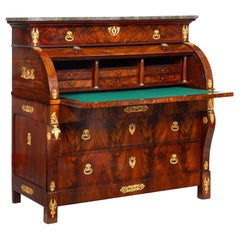
A few open-market examples of nearly identical desks...
Category
Antique 18th Century English George III Desks and Writing Tables
MaterialsLeather, Mahogany