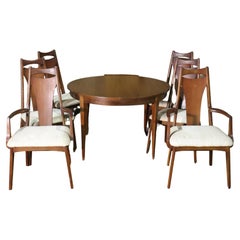
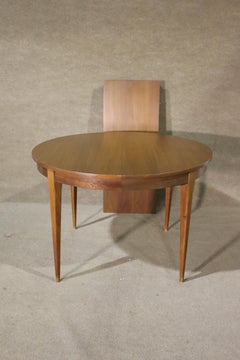
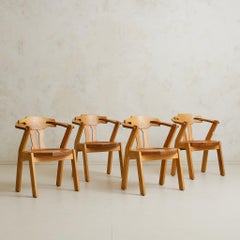
Mid-Century Modern Dining Room Sets

MID-CENTURY MODERN STYLE

Organically shaped, clean-lined and elegantly simple are three terms that well describe vintage mid-century modern furniture. The style, which emerged primarily in the years following World War II, is characterized by pieces that were conceived and made in an energetic, optimistic spirit by creators who believed that good design was an essential part of good living.

ORIGINS OF MID-CENTURY MODERN FURNITURE DESIGN

CHARACTERISTICS OF MID-CENTURY MODERN FURNITURE DESIGN

MID-CENTURY MODERN FURNITURE DESIGNERS TO KNOW

ICONIC MID-CENTURY MODERN FURNITURE DESIGNS

VINTAGE MID-CENTURY MODERN FURNITURE ON 1STDIBS

The mid-century modern era saw leagues of postwar American architects and designers animated by new ideas and new technology. The lean, functionalist International-style architecture of Le Corbusier and Bauhaus eminences Ludwig Mies van der Rohe and Walter Gropius had been promoted in the United States during the 1930s by Philip Johnson and others. New building techniques, such as “post-and-beam” construction, allowed the International-style schemes to be realized on a small scale in open-plan houses with long walls of glass.

Materials developed for wartime use became available for domestic goods and were incorporated into mid-century modern furniture designs. Charles and Ray Eames and Eero Saarinen, who had experimented extensively with molded plywood, eagerly embraced fiberglass for pieces such as the La Chaise and the Womb chair, respectively. 

Architect, writer and designer George Nelson created with his team shades for the Bubble lamp using a new translucent polymer skin and, as design director at Herman Miller, recruited the Eameses, Alexander Girard and others for projects at the legendary Michigan furniture manufacturer

Harry Bertoia and Isamu Noguchi devised chairs and tables built of wire mesh and wire struts. Materials were repurposed too: The Danish-born designer Jens Risom created a line of chairs using surplus parachute straps for webbed seats and backrests.

The Risom lounge chair was among the first pieces of furniture commissioned and produced by celebrated manufacturer Knoll, a chief influencer in the rise of modern design in the United States, thanks to the work of Florence Knoll, the pioneering architect and designer who made the firm a leader in its field. The seating that Knoll created for office spaces — as well as pieces designed by Florence initially for commercial clients — soon became desirable for the home.

As the demand for casual, uncluttered furnishings grew, more mid-century furniture designers caught the spirit.

Classically oriented creators such as Edward Wormley, house designer for Dunbar Inc., offered such pieces as the sinuous Listen to Me chaise; the British expatriate T.H. Robsjohn-Gibbings switched gears, creating items such as the tiered, biomorphic Mesa table. There were Young Turks such as Paul McCobb, who designed holistic groups of sleek, blond wood furniture, and Milo Baughman, who espoused a West Coast aesthetic in minimalist teak dining tables and lushly upholstered chairs and sofas with angular steel frames.

Generations turn over, and mid-century modern remains arguably the most popular style going. As the collection of vintage mid-century modern chairs, dressers, coffee tables and other furniture for the living room, dining room, bedroom and elsewhere on 1stDibs demonstrates, this period saw one of the most delightful and dramatic flowerings of creativity in design history.

to
41
Height
to
Width
to
Depth
to
244
166
407
16
2
87
77
50
24
18
16
11
10
9
8
6
5
5
4
4
4
3
2
405
18
1
277
89
2
9
73
81
70
9
1
259
172
93
86
61
215
157
145
75
46
425
416
421
9
8
8
8
7
Style: Mid-Century Modern
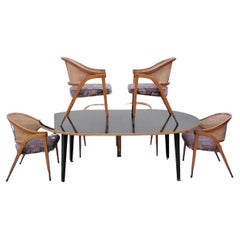
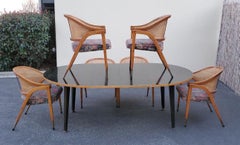
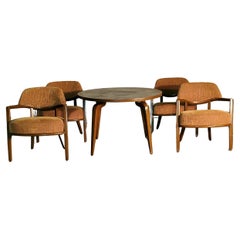
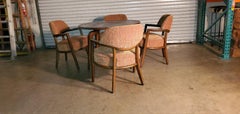
RARE 1950s Maurice Bailey Monteverdi Young Card Table & 4 Maurice Bailey Chairs

RARE 1950s Maurice Bailey Monteverdi Young Card Table & 4 Maurice Bailey Chairs

By Monteverdi-Young, Maurice Bailey

Located in Monrovia, CA

1950s Maurice Bailey Monteverdi Young Card Table And 4 Maurice Bailey Chairs Set. Maurice Bailey For Monteverdi Young Leather Top Card Table and 4 Upholstered Chairs. Leather Top Has Some Wear And Use Throughout The Years Of Gin Rummy. Original Upholstery Is In Excellent Vintage Condition. Construction And Sturdiness Of The Chairs and Card Table Are In Excellent Vintage Condition. FYI: This Maurice Bailey For Monteverdi Young Card Table Set (And Many Other Maurice Bailey Items At The Time) Was Once Owned by Famous Architect Maurice Fleishman Purchase At His Beautiful Home / Estate . As a practicing architect with an office in Beverly Hills, California until his "unofficial" retirement in 2002, Maury was best known for his "mid century" modern style of civic buildings most notable being the Santa Monica Municipal Courts (1968), Beverly Hills Municipal Courts (1970), Malibu Administrative Center (1970) and the Los Angeles Criminal Courts building (1973) And He designed the Marina Del Rey...

Category

Mid-20th Century American Mid-Century Modern Dining Room Sets

Materials

Upholstery, Wood

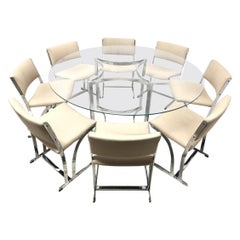
Richard Young Merrow Associates A Chrome Dining Table & a Set of 8, 160z Chairs

Richard Young Merrow Associates A Chrome Dining Table & a Set of 8, 160z Chairs

By Merrow Associates

Located in London, GB

Richard Young for Merrow Associates. A chrome dining table with the original smoked glass circular top and a set of eight rare 160Z Merrow chairs which are arguably the best-lookin...

Category

1970s English Vintage Mid-Century Modern Dining Room Sets

Materials

Steel, Chrome

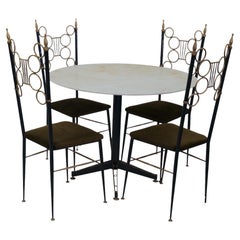
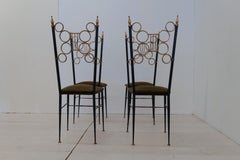
Italian Design Dining Room Set, Hollywood Regency, Vivai Del Sud Inspired, 1950s

Italian Design Dining Room Set, Hollywood Regency, Vivai Del Sud Inspired, 1950s

Located in Antwerp, BE

Mid-Century Modern; Hollywood Regency; Dining Room Set; Dining Area; Dining Chairs; Dining Table; Italian Design; 1970s, Vivai del Sud Inspired; Wood; Glass; Geometric Shape; 1950s; ...

Category

1950s Italian Vintage Mid-Century Modern Dining Room Sets

Materials

Glass, Wood

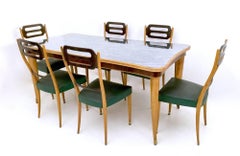
Walnut & Mohair Dining Set by Pier Luigi Colli for Fratelli Marelli, Italy, 1950

Walnut & Mohair Dining Set by Pier Luigi Colli for Fratelli Marelli, Italy, 1950

By Pier Luigi Colli, Fratelli Marelli

Located in bergen op zoom, NL

Stunning walnut dining table and six matching dining chairs by Pier Luigi Colli, handmade by the famed 'Fratelli Marelli' atelier in Cantu, Italy circa 1950. The dining table is ...

Category

1950s Italian Vintage Mid-Century Modern Dining Room Sets

Materials

Brass

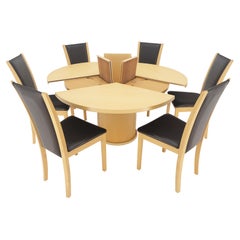
Mid-Century Modern 1960’s dining table and chairs set by Schreiber Furniture

Mid-Century Modern 1960’s dining table and chairs set by Schreiber Furniture

By Schreiber

Located in London, GB

Founded in 1957 by Chaim Schreiber, Schreiber furniture was a British success story. The company was one of the biggest names in furniture in the 70s, rivalling G Plan, White & ...

Category

Mid-20th Century British Mid-Century Modern Dining Room Sets

Materials

Faux Leather, Formica, Beech

1960s Rare Alan Fuchs Dining Set by ULUV, Czechoslovakia

1960s Rare Alan Fuchs Dining Set by ULUV, Czechoslovakia

By Alan Fuchs, Úľuv

Located in Praha, CZ

- Good original condition with some signs of use - Leather upholstery in good condition with some signs of use - The table dimensions : H: 74 W: 121 D: 77 cm

Category

1960s Czech Vintage Mid-Century Modern Dining Room Sets

Materials

Leather, Wood

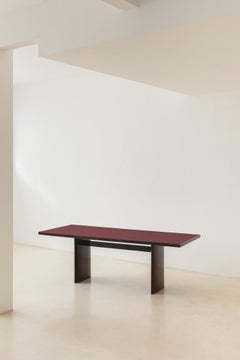
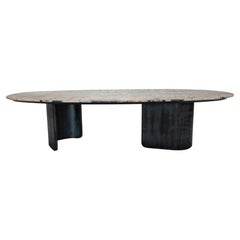
Modern Gimonde Quartz Dining Table, Patagonia Quartz, Handmade by Greenapple

Modern Gimonde Quartz Dining Table, Patagonia Quartz, Handmade by Greenapple

By Greenapple, Rute Martins

Located in Lisboa, PT

Modern Gimonde Quartz Dining Table, Contemporary Collection, Handcrafted in Portugal - Europe by Greenapple. The Gimonde quartz dining table is a bold expression of exclusive design...

Category

21st Century and Contemporary Portuguese Mid-Century Modern Dining Room Sets

Materials

Granite, Onyx, Quartz, Marble, Brass

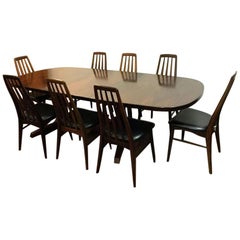
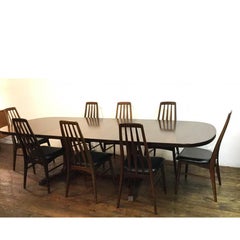
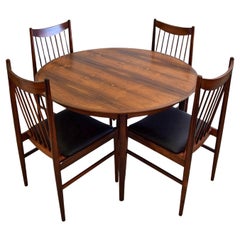
Danish Rosewood Dining Table Set Including 8 "Eva" Chairs by Niels Koefoed

Danish Rosewood Dining Table Set Including 8 "Eva" Chairs by Niels Koefoed

By Koefoeds Hornslet, Niels Koefoed

Located in London, GB

Danish extendable rosewood dining table with eight “Eva” chairs (Very comfortable seat and rare to find in rosewood) Designed by Niels Koefoed and manufactured by Koefoeds Hornslet...

Category

1960s Danish Vintage Mid-Century Modern Dining Room Sets

Materials

Rosewood

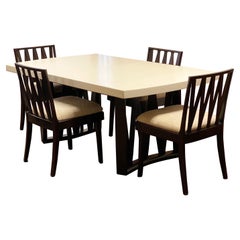
Paul Frankl for Johnson Furniture Mahogany and White Cork Dining Set, Set of 5

Paul Frankl for Johnson Furniture Mahogany and White Cork Dining Set, Set of 5

By Paul Frankl, Johnson Furniture Company

Located in Farmington Hills, MI

We are very pleased to offer a timeless dining set designed by Paul Frankl for The Johnson Furniture Company, circa the 1940s. Back in the day, Johnson company in Grand Rapids, Michigan was one of the largest furniture companies in the United States. In the early 1950s, Paul Frankl produced several lines for the furniture company, among them the “Contemporary” line, made from exquisite hardwoods with cork counter tops, and chairs with cutout backs that mimicked women’s fashions of the day. This complete dining set...

Category

1950s Vintage Mid-Century Modern Dining Room Sets

Materials

Mahogany, Cork

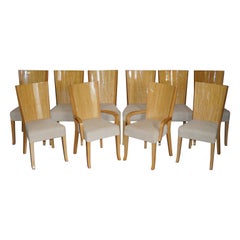
X10 Giorgio Collection Huge Burr Satinwood Dining Chairs Part Suite

X10 Giorgio Collection Huge Burr Satinwood Dining Chairs Part Suite

By Giorgio Collection

Located in West Sussex, Pulborough

We are delighted to offer for sale this very fine suite of ten original RRP £15,500 Burr Satinwood Giorgio Collection dining chairs This set is part of a monumental £50,000+ dining room suite which includes the extra large extending table...

Category

20th Century Italian Mid-Century Modern Dining Room Sets

Materials

Satinwood

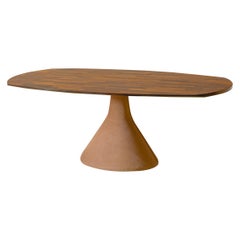
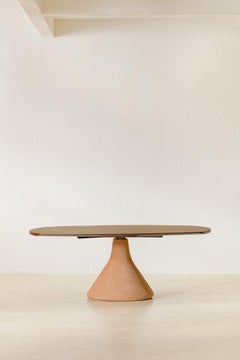
Jorge Zalszupin 'Guanabara' Rosewood Vintage Dining Table, 1960s, Brazil

Jorge Zalszupin 'Guanabara' Rosewood Vintage Dining Table, 1960s, Brazil

By Jorge Zalszupin

Located in New York, NY

The iconic Guanabara is a table designed by Jorge Zalszupin (1922-2020) in 1959 and produced by his company, L'atelier. A rosewood patchwork top rests over one concrete base finished...

Category

1950s Brazilian Vintage Mid-Century Modern Dining Room Sets

Materials

Leather, Wood

Stylish mid century Jatoba wood dining room set designed by Helge Sibast

Stylish mid century Jatoba wood dining room set designed by Helge Sibast

By Arne Vodder

Located in Weesp, NL

Stylish and elegant mid century modern Mahogany Helge Sibast Jatoba wood dining room set. Elegant early 1960s dining room table and chairs, model 422, designed by Helge Sibast for ...

Category

1960s Danish Vintage Mid-Century Modern Dining Room Sets

Materials

Leather, Wood

Carlo Scarpa Mid-Century Brown Walnut “Scuderia” Dining Table for Bernini, 1977

Carlo Scarpa Mid-Century Brown Walnut “Scuderia” Dining Table for Bernini, 1977

By Carlo Scarpa, Bernini

Located in Vicenza, IT

“Scuderia” dining table, designed by Carlo Scarpa and produced by the Italian manufacturer Bernini in 1977. Originally, Carlo Scarpa designed the table to restore the stable of Villa Valmarana in Vicenza in 1972. The table features a solid walnut structure. Available also five “Kentucky” dining...

Category

1970s Italian Vintage Mid-Century Modern Dining Room Sets

Materials

Walnut

Gangso Mobler Danish Mid-Century Modern Teak 4 Seater dining Table and Chairs

Gangso Mobler Danish Mid-Century Modern Teak 4 Seater dining Table and Chairs

Located in Bishop's Stortford, GB

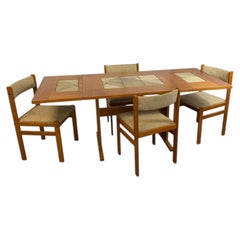
1970s Danish Mid-Century Modern dining suite.Crafted from warm teak wood, the set features an extendable dining table accompanied by four matching chairs. The central tabletop and bo...

Category

1970s Danish Vintage Mid-Century Modern Dining Room Sets

Materials

Ceramic, Teak

Midcentury Italian Set of 4 Chairs and Marble Table, 1980s

Midcentury Italian Set of 4 Chairs and Marble Table, 1980s

Located in Los Angeles, CA

The midcentury Italian set of four chairs and marble table from the 1980s offers a blend of sophistication and luxury. The chairs have been thoughtfully reupholstered in green suede,...

Category

1980s Italian Vintage Mid-Century Modern Dining Room Sets

Materials

Marble, Metal, Brass

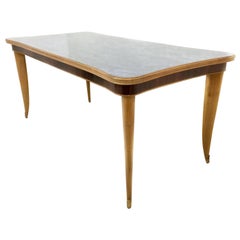
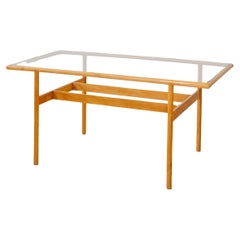
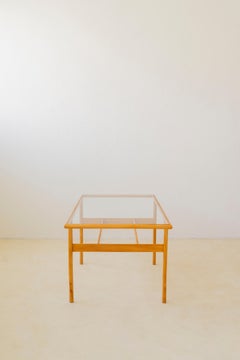
Vintage Beech and Maple Dining Table with a Patterned Blue Glass Top, Italy

Vintage Beech and Maple Dining Table with a Patterned Blue Glass Top, Italy

Located in Bresso, Lombardy

Made in Italy, 1950s. It features a maple and beech frame and brass feet caps. This table has a glass top that underneath has its original marble patterned film. It is a vintage pie...

Category

1950s Italian Vintage Mid-Century Modern Dining Room Sets

Materials

Brass

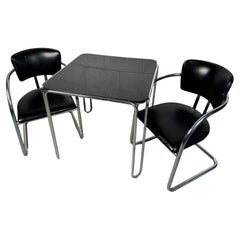
Sleek Bauhaus "B10" Table Set by Marcel Breuer

Sleek Bauhaus "B10" Table Set by Marcel Breuer

By Marcel Breuer, Chromcraft, Thonet

Located in Brooklyn, NY

Bring a rare fusion of historic design and modernist elegance into your space with this stunning vintage set. At its heart is the iconic "B10" Table, designed by Marcel Breuer—a pion...

Category

20th Century Czech Mid-Century Modern Dining Room Sets

Materials

Metal

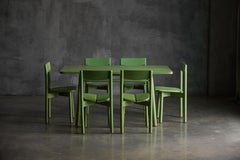
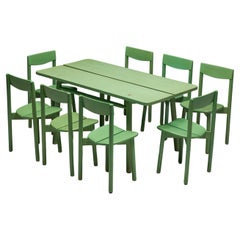
Green "Coffee Bean" Dining Set by Pierre Gautier Delaye, France, 1965

Green "Coffee Bean" Dining Set by Pierre Gautier Delaye, France, 1965

By Pierre Gautier-Delaye

Located in Antwerp, BE

This dining set by Pierre Gautier Delaye, circa 1965, pairs one green beechwood table with eight matching “Coffee Bean” chairs for a striking look. The table’s design features two el...

Category

1950s French Vintage Mid-Century Modern Dining Room Sets

Materials

Wood

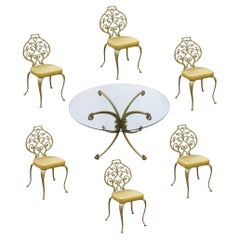
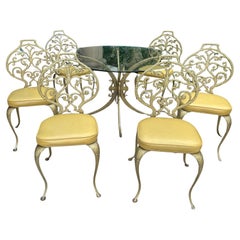
Thinline Dining Set: Cast Aluminum Table & 6 Chairs, 1960s USA

Thinline Dining Set: Cast Aluminum Table & 6 Chairs, 1960s USA

By Thinline

Located in Ross, CA

Set six chairs and one table made by made in California in the 1960's by Thinline. The cast aluminum set has the original gold paint and original vinyl seat cushions. The set would ...

Category

1960s American Vintage Mid-Century Modern Dining Room Sets

Materials

Aluminum

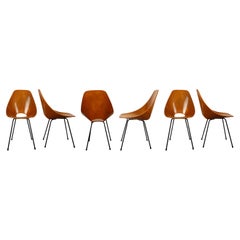
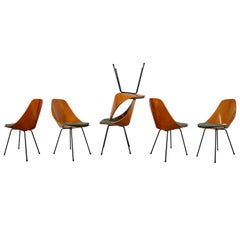
Vittorio Nobili Midcentury Beech Wood Medea Dining Room Chairs, 1956, Set of 6

Vittorio Nobili Midcentury Beech Wood Medea Dining Room Chairs, 1956, Set of 6

By Vittorio Nobili

Located in Vicenza, IT

Set of Six Medea Chairs Designed by Vittorio Nobili for Fratelli Tagliabue, 1956 This set of six Medea dining chairs features: - Elegant beech plywood shell construction - Sculptura...

Category

1950s Italian Vintage Mid-Century Modern Dining Room Sets

Materials

Iron

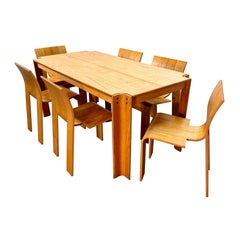
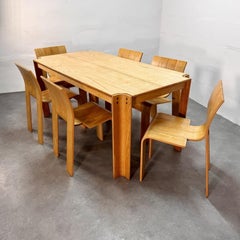
Gijs Bakker 'Strip' Dining Set, Ash Wood, Rectangular Table, 1970

Gijs Bakker 'Strip' Dining Set, Ash Wood, Rectangular Table, 1970

By Gijs Bakker

Located in CASTENRAY, NL

Gijs Bakker is actually best known for his jewelry. This ‘Strip’ table and 6 Chairs is one of the few known pieces of furniture that he designed. Perhaps that is also the reason wh...

Category

1970s Dutch Vintage Mid-Century Modern Dining Room Sets

Materials

Birch

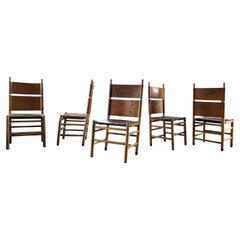
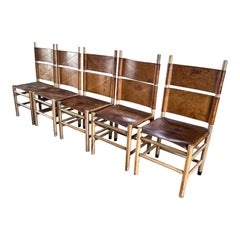
Carlo Scarpa Cognac Leather “Kentucky” Dining Chair for Bernini, 1977, Set of 5

Carlo Scarpa Cognac Leather “Kentucky” Dining Chair for Bernini, 1977, Set of 5

By Carlo Scarpa, Bernini

Located in Vicenza, IT

Set of 5 mod. 783 “Kentucky” dining chairs, designed by Carlo Scarpa for the Italian manufacturer Bernini in 1977. Structure made from oak and walnut timber. Seats and backrest made from cognac leather. Excellent vintage condition. Carlo Scarpa designed this chair for the “Scuderia” series., the last project he made for Bernini. The architect took inspiration from the “shaker” movement. He designed the chair slightly inclined at the front. This feature allows you to swing backward (until you lean on a wall) and remain in balance. Born in Venice on June 2nd, 1906, Carlo Scarpa began working at a very early age. A year after he had first qualified as an architect in 1926, he began working for the Murano glassmakers Cappellin & Co. in a consultative capacity. From 1927, Carlo Scarpa began to experiment with the Murano glass, and this research not only gave him excellent results here but would also inform his progress for many years to come. Between 1935 and 1937, as he entered his thirties, Carlo Scarpa accepted his first important commission, the renovation of Venice’s Cà Foscari. He adapted the spaces of this stately University building that stands on the Grand Canal banks, creating rooms for the Dean’s offices and a new hall for academic ceremonies; Mario Sironi and Mario De Luigi were charged with doing the restoration work on the frescos. After 1945, Carlo Scarpa found himself constantly busy with new commissions, including various furnishings and designs for the renovation of Venice’s Hotel Bauer and designing a tall building in Padua and a residential area in Feltre, all worth mentioning. One of his key works, despite its relatively modest diminished proportions, was the [bookshop known as the] Padiglione del Libro, which stands in Venice’s Giardini di Castello and clearly shows Scarpa’s passion for the works of Frank Lloyd Wright. In the years which were to follow, after he had met the American architect, Scarpa repeated similar experiments on other occasions, as can be seen, in particular, in the sketches he drew up in 1953 for villa Zoppas in Conegliano, which show some of his most promising work. However, this work unfortunately never came to fruition. Carlo Scarpa later created three museum layouts to prove pivotal in terms of how twentieth-century museums were set up from then on. Between 1955 and 1957, he completed extension work on Treviso’s Gipsoteca Canoviana [the museum that houses Canova’s sculptures] in Possagno, taking a similar experimental approach to the one he used for the Venezuelan Pavilion at [Venice’s] Giardini di Castello which he was building at the same time (1954-56). In Possagno Carlo Scarpa was to create one of his most significant ever works, which inevitably bears comparison with two other museum layouts that he was working on over the same period, those of: – Galleria Nazionale di Sicilia, housed in the Palazzo Abatellis in Palermo (1953-55) – Castelvecchio in Verona (1957- 1974), all of which were highly acclaimed, adding to his growing fame. Two other buildings, which are beautifully arranged in spatial terms, can be added to this long list of key works that were started and, in some cases, even completed during the nineteen fifties. After winning the Olivetti award for architecture in 1956, Scarpa began work in Venice’s Piazza San Marco on an area destined to house products made by the Industrial manufacturers Ivrea. Over the same period (1959-1963), he also worked on the renovation and restoration of the gardens and ground floor of the Fondazione Querini Stampalia in Venice, which many consider one of his greatest works. While he busied himself working on-site at the Fondazione Querini Stampalia, Carlo Scarpa also began work building a villa in Udine for the Veritti family. To shed some light on the extent to which his work evolved over the years, it may perhaps be useful to compare this work with that of his very last building, villa Ottolenghi Bardolino, which was near to completion at the time of his sudden death in 1978. Upon completion of villa Veritti over the next ten years, without ever letting up on his work on renovation and layouts, Scarpa accepted some highly challenging commissions, working on the Carlo Felice Theatre in Genoa and another theatre in Vicenza. Towards the end of this decade, in 1969, Rina Brion commissioned Carlo Scarpa to build the Brion Mausoleum in San Vito d’Altivole (Treviso), a piece he continued to work on right up until the moment of his death. Nevertheless, even though he was totally absorbed by work on this mausoleum, there are plenty of other episodes which can offer some insight into the final years of his career. As work on the San Vito d’Altivole Mausoleum began to lessen from 1973, Carlo Scarpa started building the new headquarters for the Banca Popolare di Verona. He drew up plans that were surprisingly different from the work he was carrying out at the same time on the villa Ottolenghi. However, the plans Carlo Scarpa drew up, at different times, for a monument in Brescia’s Piazza della Loggia commemorating victims of the terrorist attack on May 28th, 1974, make a sharp contrast to the work he carried out in Verona, almost as if there is a certain hesitation after so many mannered excesses. The same Pietas that informs his designs for the Piazza Della Loggia can also be seen in the presence of the water that flows through the Brion Mausoleum, almost as if to give a concrete manifestation of pity in this twentieth-century work of art. Carlo Scarpa has put together a highly sophisticated collection of structures, occupying the mausoleum’s L-shaped space stretching across both sides of the old San Vito d’Altivole cemetery. A myriad of different forms and an equally large number of different pieces, all of which are separate and yet inextricably linked to form a chain that seems to offer no promise of continuity, rising up out of these are those whose only justification for being there is to bear the warning “si vis vitam, para mortem,” [if you wish to experience life prepare for death] as if to tell a tale that suggests the circle of time, joining together the commemoration of the dead with a celebration of life. At the entrance of the Brion Mausoleum stand the “propylaea” followed by a cloister which ends by a small chapel, with an arcosolium bearing the family sarcophagi, the main pavilion, held in place on broken cast iron supports, stands over a mirror-shaped stretch of water and occupies one end of the family’s burial space. The musical sound of the walkways teamed with the luminosity of these harmoniously blended spaces shows how, in keeping with his strong sense of vision, Carlo Scarpa could make the most of all of his many skills to come up with this truly magnificent space. As well as a great commitment to architectural work, with the many projects which we have already seen punctuating his career, Carlo Scarpa also made many equally important forays into the world of applied arts. Between 1926 and 1931, he worked for the Murano glassmakers Cappellin, later taking what he had learned with him when he went to work for the glassmakers Venini from 1933 until the 1950s. The story of how he came to work on furniture design is different, however, and began with the furniture he designed to replace lost furnishings during his renovation of Cà Foscari. The later mass-produced furniture started differently, given that many pieces were originally one-off designs “made to measure.” Industrial manufacturing using these designs as prototypes came into being thanks to the continuity afforded him by Dino Gavina, who, as well as this, also invited Carlo Scarpa to become president of the company Gavina SpA, later to become SIMON, a company Gavina founded eight years on, in partnership with Maria Simoncini (whose own name accounts for the choice of company name). Carlo Scarpa and Gavina forged a strong bond in 1968 as they began to put various models of his into production for Simon, such as the “Doge” table, which also formed the basis for the “Sarpi” and “Florian” tables. In the early seventies, other tables that followed included “Valmarana,” “Quatour,” and “Orseolo.” While in 1974, they added couch and armchair “Cornaro” to the collection and the “Toledo” bed...

Category

1970s Italian Vintage Mid-Century Modern Dining Room Sets
Materials

Walnut, Leather, Plastic

Pierre Jeanneret PJ-TA-01-A Dining Table / Authentic Mid-Century Modern

Pierre Jeanneret PJ-TA-01-A Dining Table / Authentic Mid-Century Modern

By Pierre Jeanneret

Located in Zürich, CH

Here we see a decision to project the universal ideals of modernity onto Indian reality. However, this piece was inspired by North Indian culture, as well the cosmic and spiritual I...

Category

1960s Indian Vintage Mid-Century Modern Dining Room Sets

Materials

Wood

Extension Table & 6 Matching Chairs, Harry Østergaard, Randers, Denmark, 1960's

Extension Table & 6 Matching Chairs, Harry Østergaard, Randers, Denmark, 1960's

By Harry Østergaard

Located in Deland, FL

Introducing a rare matching dining set (one extension dining table and six matching Model 58 dining chairs) designed by the influential Harry Østergaard for Randers Møbelfabrik. Craf...

Category

1960s Danish Vintage Mid-Century Modern Dining Room Sets

Materials

Teak

Set of Six Arne Hovmand Olsen Dining Chairs in Teak

Set of Six Arne Hovmand Olsen Dining Chairs in Teak

By Arne Hovmand-Olsen

Located in Berkeley, CA

Origin: Denmark Designer: Arne Hovmand Olsen Manufacturer: Onsild Møbelfabrik Era: 1958 Materials: Teak Measurements: 19″ wide x 20″ deep x 33.75″ tall, Seat: 18"

Category

Mid-20th Century Danish Mid-Century Modern Dining Room Sets

Materials

Teak

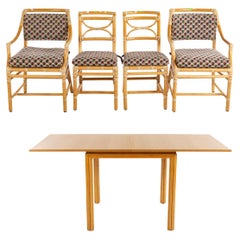
1970 McGuire Rattan Games Flip Top Extension Dining Table and Four Chairs

1970 McGuire Rattan Games Flip Top Extension Dining Table and Four Chairs

By McGuire

Located in Sheridan, CO

McGuire comprising revolving flip top games and dining table with two woven rattan side chairs and two armchairs. Chairs feature McGuire "M" logo inlay in back of each chair seat (se...

Category

1970s American Vintage Mid-Century Modern Dining Room Sets

Materials

Textile, Bamboo, Rattan

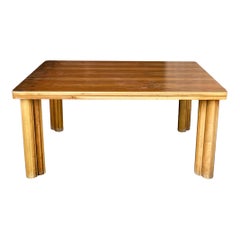
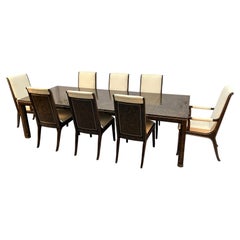
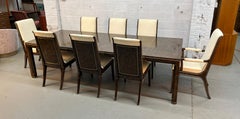
William Doezema for Mastercraft Mid-Century Burl Wood Extension Dining Table Set

William Doezema for Mastercraft Mid-Century Burl Wood Extension Dining Table Set

By Mastercraft, William Doezema

Located in Brooklyn, NY

An exceptional and highly sought-after Mid-Century Modern dining set designed by William Doezema for Mastercraft, showcasing the luxurious craftsmanship and timeless sophistication t...

Category

Mid-20th Century American Mid-Century Modern Dining Room Sets

Materials

Brass

20th Century American Dining Table & Four Chairs By McGuire

20th Century American Dining Table & Four Chairs By McGuire

By McGuire

Located in Royal Tunbridge Wells, Kent

Welcome to the timeless legacy of John and Elinor, the beloved founders of the iconic McGuire Furniture, a San Francisco-based institution that has been synonymous with craftsmanship and creativity since its inception in 1948. As a dynamic couple, their lifelong partnership laid the foundation for the distinctive McGuire style, a harmonious fusion of natural materials such as rattan and hide with the sleek lines inspired by Asian aesthetics. Discover the essence of their visionary work embodied in this exquisite dining table and matching chairs—a testament to their enduring impact on design. Crafted in the latter part of the 20th century, this McGuire dining set showcases the hallmark bamboo frame that is quintessentially McGuire. The table, adorned with a rectangular beveled glass top in pristine condition, stands as a testament to the timeless elegance of McGuire's craftsmanship. The bamboo base boasts a delightful warm hue, effortlessly infusing any modern interior with the inviting, relaxed ambiance reminiscent of California design. Immerse yourself in the classic beauty of McGuire Furniture, where each piece tells a story of innovation, craftsmanship, and the enduring allure of mid-century California style. Some history about the manufacturers: Like so many artists and designers, husband and wife John McGuire (1920–2013) and Elinor Stevenson (1914–2005) became masters in their trade by accident. The couple met just before the start of World War II (during which John was in the U.S. Navy and Elinor was a navigation instructor) and got married after it ended. They settled down in San Francisco where John held a couple of jobs — among them selling newspaper ads for the San Francisco Examiner while Elinor worked for Boeing Aircraft. Soon, an old Navy buddy of John’s asked him to help sell a bunch of rattan furniture and, needing the money, John agreed. His side business became so successful that John decided to quit his ad-sales job and work full-time in design. In 1948, McGuire Furniture Company was born. Alongside themed-century modern furniture designs then gaining popularity in the United States, John introduced an unconventional idea: traditional armchairs, stools and tables made of natural materials such as bamboo, which was strong yet could be rendered pliable when steamed, that were intended for the indoors rather than the front porch. The brand’s first success was the now famous Director’s X-Chair byLeonard Linden. The military-campaign-style solid oak folding chair launched in 1956 and saw rattan binded with rawhide strips and a high-grade leather slug seat and back that eliminated the need for a plush cushion. Elinor, too, designed some of the brand’s popular pieces, such as 1968’s Cracked Ice chair. With its rattan oval back a dazzling celebration of geometric forms that give it its charming moniker, the Cracked Ice chair was an instant classic and is one of the brand’s most recognisable designs. Today, McGuire and another American furniture manufacturer, Baker Furniture Company, comprise Baker Interiors Group. McGuire remains true to the founders’ ideals and commitment to crafting the kind of organic modern furnishings that are synonymous with the warm and relaxed feel of California design. The company has collaborated with interior designersSteven Volpe, Orlando Diaz-Azcuy and Nicole Hollis...

Category

20th Century French Mid-Century Modern Dining Room Sets

Materials

Glass, Fabric, Bamboo

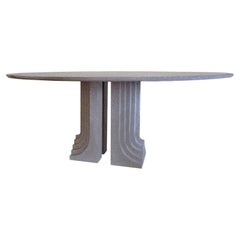
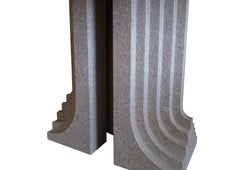
Studio Simon Granite Brutalist Samo Table in the Style of Carlo Scarpa, 1970

Studio Simon Granite Brutalist Samo Table in the Style of Carlo Scarpa, 1970

By Carlo Scarpa, Studio Simon

Located in Vicenza, IT

Dining table mod. ‘Samo’ by Studio Simon. Series ‘Ultrarazionale’. Italy, 1970. Made of granite. Literature: Giuliana Gramigna, Repertorio 1950-2000, Allemandi, Torino, 2003, p.180. Excellent vintage condition. The Samo table was designed in 1970 by the project office of Studio Simon. Carlo Scarpa was the brand's artistic director, and the Venetian architect's style inspired the shapes of this table. Born in Venice on June 2nd, 1906, Carlo Scarpa began working at a very early age. Only a year after he had first qualified as an architect in 1926, he began working for the Murano glassmakers Cappellin & Co. in a consultative capacity; from 1927, he began to experiment with the Murano glass, and this research not only gave him excellent results here but would also inform his progress for many years to come. Between 1935 and 1937, as he entered his thirties, Carlo Scarpa accepted his first important commission, the renovation of Venice’s Cà Foscari. He adapted the spaces of this stately University building which stands on the banks of the Grand Canal, creating rooms for the Dean’s offices and a new hall for academic ceremonies; Mario Sironi and Mario De Luigi were charged with doing the restoration work on the frescos. After 1945, Carlo Scarpa found himself constantly busy with new commissions, including various furnishings and designs for the renovation of Venice’s Hotel Bauer and designing a tall building in Padua and a residential area in Feltre, which are all worth mention. One of his key works, despite its relatively modest diminished proportions, was the first of many works which were to follow in the nineteen fifties: the [bookshop known as the] Padiglione del Libro, which stands in Venice’s Giardini di Castello and shows clearly Scarpa’s passion for the works of Frank Lloyd Wright. In the years which were to follow, after he had met the American architect, Scarpa repeated similar experiments on other occasions, as can be seen, in particular, in the sketches he drew up in 1953 for villa Zoppas in Conegliano, which show some of his most promising work. However, this work unfortunately never came to fruition. Carlo Scarpa later created three museum layouts to prove pivotal in terms of how 20th century museums were to be set up from then on. Between 1955 and 1957, he completed extension work on Treviso’s Gipsoteca Canoviana [the museum that houses Canova’s sculptures] in Possagno, taking a similar experimental approach to the one he used for the Venezuelan Pavilion at [Venice’s] Giardini di Castello which he was building at the same time (1954-56). In Possagno Carlo Scarpa was to create one of his greatest ever works, which inevitably bears comparison with two other museum layouts that he was working on over the same period, those of the Galleria Nazionale di Sicilia, housed in the Palazzo Abatellis in Palermo (1953-55) and at the Castelvecchio in Verona (1957- 1974), all of which were highly acclaimed, adding to his growing fame. Two other buildings, which are beautifully arranged in spatial terms, can be added to this long list of key works that were started and, in some cases, even completed during the nineteen fifties. After winning the Olivetti award for architecture in 1956, Scarpa began work in Venice’s Piazza San Marco on an area destined to house products made by the Industrial manufacturers Ivrea. Over the same period (1959-1963), he also worked on renovation and restoration of the gardens and ground floor of the Fondazione Querini Stampalia in Venice, which many consider being one of his greatest works. While he busied himself working on-site at the Fondazione Querini Stampalia, Carlo Scarpa also began work building a villa in Udine for the Veritti family. To shed some light on the extent to which his work evolved over the years, it may perhaps be useful to compare this work with that of his very last building, villa Ottolenghi Bardolino, which was near to completion at the time of his sudden death in 1978. Upon completion of villa Veritti over the next ten years, without ever letting up on his work on renovation and layouts, Scarpa accepted some highly challenging commissions which were to make the most of his formal skills, working on the Carlo Felice Theatre in Genoa as well as another theatre in Vicenza. Towards the end of this decade, in 1969, Rina Brion commissioned Carlo Scarpa to build the Brion Mausoleum in San Vito d’Altivole (Treviso), a piece he continued to work on right up until the moment of his death. Nevertheless, even though he was totally absorbed by work on this mausoleum, there are plenty of other episodes which can offer some insight into the final years of his career. As work on the San Vito d’Altivole Mausoleum began to lessen from 1973, Carlo Scarpa began work building the new headquarters for the Banca Popolare di Verona. He drew up plans that were surprisingly different from the work he was carrying out at the same time on the villa Ottolenghi. However, the plans Carlo Scarpa drew up, at different times, for a monument in Brescia’s Piazza della Loggia commemorating victims of the terrorist attack on May 28th, 1974, make a sharp contrast to the work he carried out in Verona, almost as if there is a certain hesitation after so many mannered excesses. The same Pietas that informs his designs for the Piazza Della Loggia can also be seen in the presence of the water that flows through the Brion Mausoleum, almost as if to give a concrete manifestation of pity in this 20th century work of art. Carlo Scarpa has put together a highly sophisticated collection of structures, occupying the mausoleum’s L-shaped space stretching across both sides of the old San Vito d’Altivole cemetery. A myriad of different forms and an equally large number of different pieces, all of which are separate and yet inextricably linked to form a chain that seems to offer no promise of continuity, rising up out of these are those whose only justification for being there is to bear the warning “si vis vitam, para mortem”, [if you wish to experience life prepare for death] as if to tell a tale that suggests the circle of time, joining together the commemoration of the dead with a celebration of life. At the entrance of the Brion Mausoleum stand the “propylaea” followed by a cloister which ends by a small chapel, with an arcosolium bearing the family sarcophagi, the main pavilion, held in place on broken cast iron supports, stands over a mirror-shaped stretch of water and occupies one end of the family’s burial space. The musical sound of the walkways teamed with the luminosity of these harmoniously blended spaces shows how, in keeping with his strong sense of vision, Carlo Scarpa could make the most of all of his many skills to come up with this truly magnificent space. As well as a great commitment to architectural work, with the many projects which we have already seen punctuating his career, Carlo Scarpa also made many equally important forays into the world of applied arts. Between 1926 and 1931, he worked for the Murano glassmakers Cappellin, later taking what he had learned with him when he went to work for the glassmakers Venini from 1933 until the 1950s. The story of how he came to work on furniture design is different, however, and began with the furniture he designed to replace lost furnishings during his renovation of Cà Foscari. The later mass-produced furniture started differently, given that many pieces were originally one-off designs “made to measure”. Industrial manufacturing using these designs as prototypes came into being thanks to the continuity afforded him by Dino Gavina, who, as well as this, also invited Carlo Scarpa to become president of the company Gavina SpA, later to become SIMON, a company Gavina founded 8 years on, in partnership with Maria Simoncini (whose own name accounts for the choice of company name). Carlo Scarpa and Gavina forged a strong bond in 1968 as they began to put various models of his into production for Simon, such as the “Doge” table, which also formed the basis for the “Sarpi” and “Florian” tables. In the early seventies, other tables that followed included “Valmarana”, “Quatour” and “Orseolo”. While in 1974, they added couch and armchair “Cornaro” to the collection and the “Toledo” bed...

Category

1970s Italian Vintage Mid-Century Modern Dining Room Sets
Materials

Granite

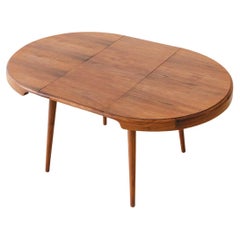
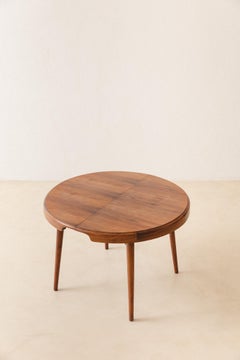
Mid-Century Modern Coffee and Dining Table by Carlo Hauner & Martin Eisler, 1950

Mid-Century Modern Coffee and Dining Table by Carlo Hauner & Martin Eisler, 1950

Designed by Carlo Hauner and Martin Eisler in the 1950s, this table was conceived to maximize space and functionality, assuming two distinct configurations. In its standard position,...

Category

1950s Brazilian Vintage Mid-Century Modern Dining Room Sets
Materials

Rosewood

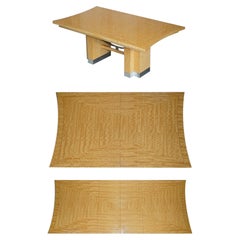
Giorgio Collection Huge Extending Burr Satinwood Dining Table Suite

Giorgio Collection Huge Extending Burr Satinwood Dining Table Suite

By Giorgio Collection

Located in West Sussex, Pulborough

We are delighted to offer this very fine original RRP £12,000 extra large Burr Satinwood Giorgio Collection extending dining table This piece is part of a monumental £50,000+ dining room suite which includes the extra large extending table...

Category

20th Century Italian Mid-Century Modern Dining Room Sets
Materials

Satinwood

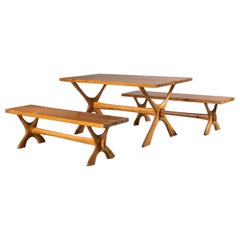
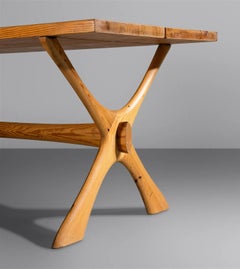
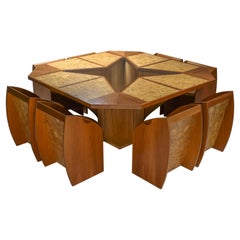
Scandinavian Table and Bench Set

Scandinavian Table and Bench Set

Located in New York, NY

Scandinavian Table and Bench set. The set is solid elm with an X stretcher base. Dining Room Set. Benches measures: 16.75H x 59W x 14.5D. Table Measures: 2...

Category

1960s Scandinavian Vintage Mid-Century Modern Dining Room Sets
Materials

Elm

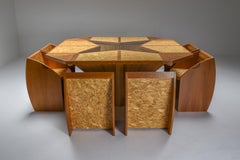
Italian Mid Century Modern Dining Table and Effezeta Chairs Set

Italian Mid Century Modern Dining Table and Effezeta Chairs Set

Located in Potters Bar, GB

On trend vintage Italian Mid Century Modern dining set Eight Effezeta chairs surround the sleek dining table Very comfortable to sit at, chairs are on m...

Category

1880s Antique Mid-Century Modern Dining Room Sets
Materials

Wood

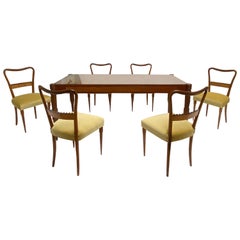
Vittorio Nobili Mid-Century Teak Medea Table, 1956

Vittorio Nobili Mid-Century Teak Medea Table, 1956

By Vittorio Nobili

Located in Vicenza, IT

Medea dining circular table, designed by Vittorio Nobili for Fratelli Tagliabue in 1954. Made of teak iron and brass, excellent vintage condition. Reported at “Compasso d’Oro Prize...

Category

1950s Italian Vintage Mid-Century Modern Dining Room Sets
Materials

Iron

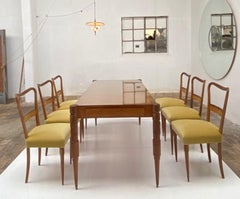
Mid-Century Modern Novalux Dining Set by Rudi Verelst, Belgium, 1970s

Mid-Century Modern Novalux Dining Set by Rudi Verelst, Belgium, 1970s

By Rudi Verelst

Located in Antwerp, BE

Extraordinary dining set created by Rudi Verelst for Novalux in 1970s Belgium. The set features swivel dining chairs crafted from gleaming chromed steel wire, elegantly complemented ...

Category

Late 20th Century Belgian Mid-Century Modern Dining Room Sets
Materials

Chrome

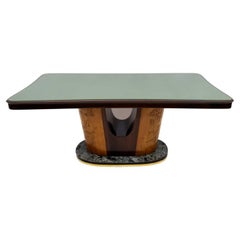
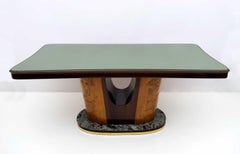
Vittorio Dassi Iconic Design Mid-Century Modern Italian Dining Table, 1950s

Vittorio Dassi Iconic Design Mid-Century Modern Italian Dining Table, 1950s

By Vittorio Dassi

Located in Puglia, Puglia

Beautiful table designed by the famous Italian Mid-Century Modern designer Vittorio Dassi, 1950. The exceptional woodwork is highlighted by the curved green glass top and the rounded...

Category

1950s Italian Vintage Mid-Century Modern Dining Room Sets
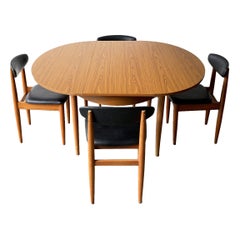
Materials

Marble

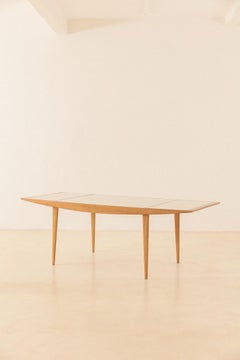
Expandable Dining Table in Caviuna by Carlo Hauner and Martin Eisler, circa 1955

Expandable Dining Table in Caviuna by Carlo Hauner and Martin Eisler, circa 1955

Carlo Hauner and Martin Eisler are most known for well-shaped armchairs made in iron, but the production is far more complex, handcrafted, and extensive. The wood pieces produced by ...

Category

1950s Brazilian Vintage Mid-Century Modern Dining Room Sets
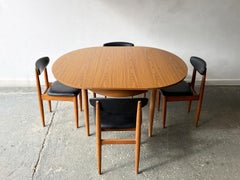
Materials

Wood

1970s Furniture suite, Horst Romanus Wanke

1970s Furniture suite, Horst Romanus Wanke

Located in Neuss, NW

Rare furniture suite by Horst Romanus Wanke from the 1970s consisting of two chairs and a table. High-quality solid beech wood frame and table top lacquered in white. The chairs have...

Category

1970s German Vintage Mid-Century Modern Dining Room Sets
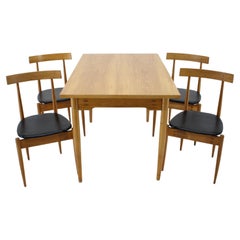
Materials

Beech

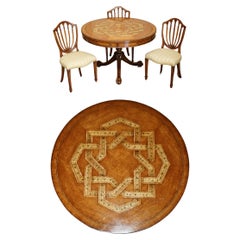
ViNTAGE CELTIC DESIGN BURR OAK & WALNUT DINING OCCASIONAL GAMES TABLE & CHAIRS

ViNTAGE CELTIC DESIGN BURR OAK & WALNUT DINING OCCASIONAL GAMES TABLE & CHAIRS

By George Hepplewhite

Located in West Sussex, Pulborough

Royal House Antiques Royal House Antiques is delighted to offer for sale this exquisitely designed, hand made in England occasional dining table with Celtic design top and three Geo...

Category

20th Century English Mid-Century Modern Dining Room Sets
Materials

Oak, Walnut

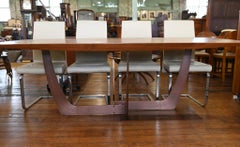
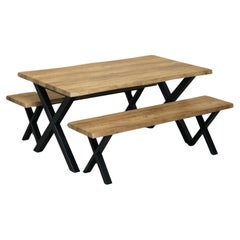
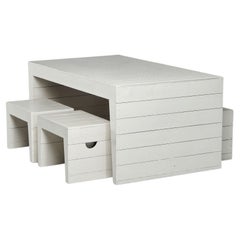
DECORATIVE CONTEMPORARY X FRAMED DINING TABLE & BENCHES PART OF A DiNING SUITE

DECORATIVE CONTEMPORARY X FRAMED DINING TABLE & BENCHES PART OF A DiNING SUITE

Located in West Sussex, Pulborough

Royal House Antiques Royal House Antiques is delighted to offer for sale this nice modern X Framed dining room table and matching pairs of benches which is part of a dining room sui...

Category

20th Century European Mid-Century Modern Dining Room Sets
Materials

Metal

Jacques Uppelschoten Bossche School Dining Set, 1978

Jacques Uppelschoten Bossche School Dining Set, 1978

By Dom Hans van der Laan

Located in Roosendaal, Noord Brabant

Rare and very nice example of the "Bossche school" furniture by architect Jacques Uppelschoten, made for his own house at the Raffendonkstraat 20 in Oirschot. Dom Hans van der Laan s...

Category

1970s Dutch Vintage Mid-Century Modern Dining Room Sets
Materials

Iron

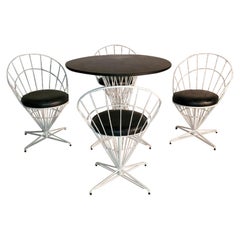
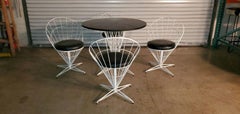
Mid 20th Century Modern Open Metal Wire Dining Table and Chairs, Set of 5

Mid 20th Century Modern Open Metal Wire Dining Table and Chairs, Set of 5

Located in Monrovia, CA

Vintage Mid-Century Modern 5 Piece Open Metal Wire Cone dining set In The Style Or Likeness of Verner Panton. This 5 Piece White And Black Open Metal Wire Cone Dining Set Is In Excellent Vintage Condition. Four White Open Metal Wire Cone Swivel Dining Chairs, White Open Metal Wire Cone Design With Black Leatherette Seat Cushions. The Dining Table Is A White Open Metal Wire Cone Base With Original Black Stone Like Table...

Category

Mid-20th Century American Mid-Century Modern Dining Room Sets
Materials

Stone, Wire

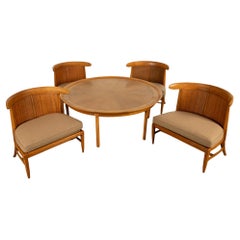
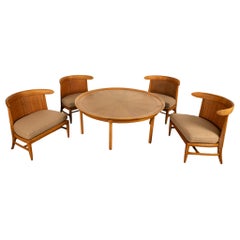
Mid Century Modern 54" Coffee Table Set 4 Slipper Chairs Signed Tomlinson 1959

Mid Century Modern 54" Coffee Table Set 4 Slipper Chairs Signed Tomlinson 1959

By John Lubberts and Lambert Mulder, Tomlinson

Located in Portland, OR

A fine Mid Century Modern 54" coffee table set with four slipper chairs, designed Tomlinson Lounge Chair by John Lubberts & Lambert Mulder for Tomlinson & signed "Tomlinson Sophisti...

Category

1950s Vintage Mid-Century Modern Dining Room Sets
Materials

Wood

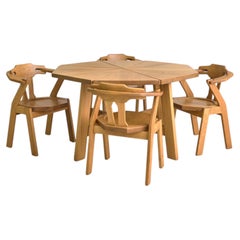
French Octagonal Oak Dining Table with Four Chairs, 1960s

French Octagonal Oak Dining Table with Four Chairs, 1960s

Located in Chicago, IL

A 1960s French dining set composed of an octagonal dining table and a matching set of four carved oak chairs. Unified by bold geometry and material weight, the set reflects the era’s...

Category

1960s French Vintage Mid-Century Modern Dining Room Sets
Materials

Oak

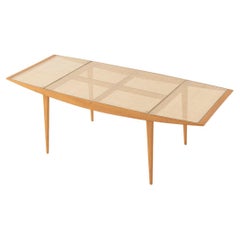
Dining Table with Cane Top by Carlo Hauner, Brazilian Midcentury, 1950s

Dining Table with Cane Top by Carlo Hauner, Brazilian Midcentury, 1950s

Carlo Hauner and Martin Eisler's pieces of furniture are highly designed and well-executed, with ingenious constructive details – very distinctive of any production of the time in Br...

Category

1950s Brazilian Vintage Mid-Century Modern Dining Room Sets
Materials

Wood, Cane

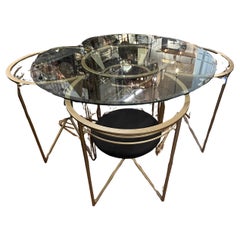
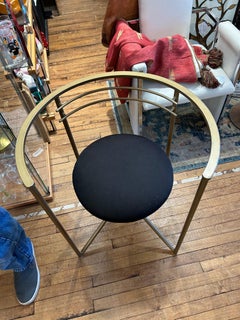
Minson Midcentury Modern Round Painted Metal Dining Table and 4 Chairs

Minson Midcentury Modern Round Painted Metal Dining Table and 4 Chairs

By Minson Corp.

Located in Hopewell, NJ

Metal super cool curved midcentury modern dining set with 4 curvy sexy chairs that are 29 h 25 w 20 d s/h is 20. We love the sculptural quality of them with martini glass triangula...

Category

1970s American Vintage Mid-Century Modern Dining Room Sets
Materials

Metal

Set of 3 Vintage Chess Coffee Table "Chess" in Work Iron by Luigi Colli, Italy

Set of 3 Vintage Chess Coffee Table "Chess" in Work Iron by Luigi Colli, Italy

By Colli Torino

Located in Biella, IT

Luigi Colli Italy set of chess glass coffee table in work iron years ’40 perfect and original condition, very rare. Top glass with work acid engraved the chessboard in the surface...

Category

1950s Italian Vintage Mid-Century Modern Dining Room Sets
Materials

Iron

Umberto Mascagni for Harrods London Mid-Century Modern Italian Dining Table, 50s

Umberto Mascagni for Harrods London Mid-Century Modern Italian Dining Table, 50s

By Umberto Mascagni

Located in Puglia, Puglia

Dining table designed by Umberto Mascagni of Bologna in the 1950s. The main body structure is in solid European wood, covered in brown veined vinyl and anodized aluminum. The legs ar...

Category

1950s Italian Vintage Mid-Century Modern Dining Room Sets
Materials

Aluminum

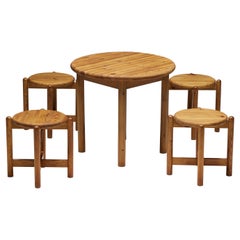
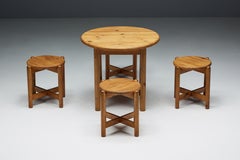
Pine Dining Set by Rainer Daumiller, Denmark, 1970s

Pine Dining Set by Rainer Daumiller, Denmark, 1970s

By Rainer Daumiller

Located in Antwerp, BE

1970s dining set by Rainer Daumiller, crafted entirely from solid pine. This timeless ensemble comprises a robust round dining table and four accompanying stools, each bearing the un...

Category

1970s Danish Vintage Mid-Century Modern Dining Room Sets
Materials

Pine

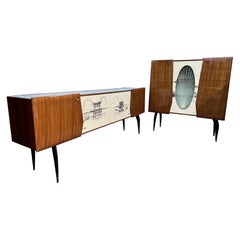
Vittorio Dassi Art Deco Display Cabinet and Buffet Set

Vittorio Dassi Art Deco Display Cabinet and Buffet Set

Located in Kraków, Małopolska

Olasz Vittorio Dassi díszlet 1960-ból Buffet Width: 224 cm Depth: 45 cm Height: 80 cm Display Cabinet Width: 140 cm Depth: 40 cm Height: 140 cm    

Category

1950s Italian Vintage Mid-Century Modern Dining Room Sets
Materials

Walnut

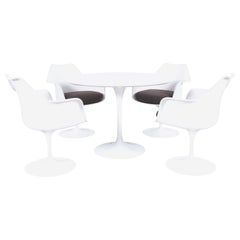
Mid-Century Modern "Tulip" Dining Room Set by Eero Saarinen for Knoll

Mid-Century Modern "Tulip" Dining Room Set by Eero Saarinen for Knoll

By Knoll, Eero Saarinen

Located in North Hollywood, CA

Designed by Eero Saarinen for Knoll International, this exceptional mid-century modern Tulip dining room set is one of the most celebrated furniture designs of the 20th century. Intr...

Category

1960s American Vintage Mid-Century Modern Dining Room Sets
Materials

Aluminum

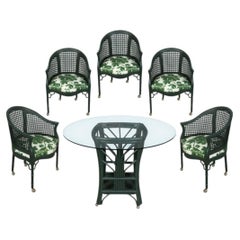
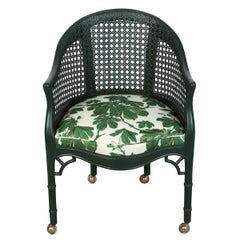
Bielecky Brothers Style Rattan Dining Table and Chairs Set

Bielecky Brothers Style Rattan Dining Table and Chairs Set

By Bielecky Brothers

Located in Locust Valley, NY

A forest green Bielecky style rattan dining set comprising a round glass top dining table and five barrel back armchairs. Crafted with woven cane panels and a painted dark green fini...

Category

Mid-20th Century Mid-Century Modern Dining Room Sets
Materials

Fabric, Rattan, Glass

Mid-century Modern dining room sets for sale on 1stDibs.
Find a broad range of unique Mid-Century Modern dining room sets for sale on 1stDibs. Many of these items were first offered in the 21st Century and Contemporary, but contemporary artisans have continued to produce works inspired by this style. If you’re looking to add vintage dining room sets created in this style to your space, the works available on 1stDibs include tables, seating, building and garden elements and other home furnishings, frequently crafted with wood, metal and other materials. If you’re shopping for used Mid-Century Modern dining room sets made in a specific country, there are Europe, North America, and United States pieces for sale on 1stDibs. While there are many designers and brands associated with original dining room sets, popular names associated with this style include Paul McCobb, Russell Woodard, Knoll, and Eero Saarinen. It’s true that these talented designers have at times inspired knockoffs, but our experienced specialists have partnered with only top vetted sellers to offer authentic pieces that come with a buyer protection guarantee. Prices for dining room sets differ depending upon multiple factors, including designer, materials, construction methods, condition and provenance. On 1stDibs, the price for these items starts at $137 and tops out at $220,500 while the average work can sell for $5,441.