Located in Valladolid, ES
Technical data
Materials: Porcelain tray, wooden legs
Period: Qing Dynasty
Country of origin: China
Good condition for its age and use, with some flaws in the wooden structure
Overall dimensions: 70 x 95 x 80 cm
Porcelain dimensions: 70 x 58 cm
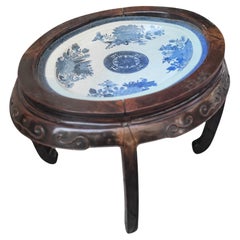
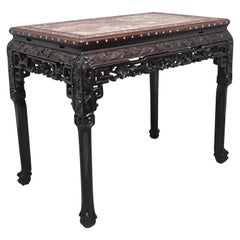
Exquisite Fitzhugh pattern porcelain plate or tray, inlaid in a cabinet that highlights its oval profile and raised on four slightly curved square legs.
The term "Fitzhugh" refers to a type of Chinese export porcelain produced primarily between 1780 and 1840, featuring blue and white designs. It originated with three members of two generations of the Fitzhugh family. Members of this family held important positions as ship captains and even as directors in the British East India Company. Within this company, high-ranking officials were allowed to engage in private trade. Between 1704 and the 1790s, porcelain pieces bearing this pattern were shipped to England.
The design usually includes a central medallion, although it is occasionally replaced by a coat of arms or monogram. The medallion is surrounded by four groupings of flowers representing the four seasons—peony for spring; lotus for summer; chrysanthemum for autumn; and prunus for winter—and symbols that typically represent the four virtues of the Chinese scholar: music, painting, logical thinking, and calligraphy. The design is framed with a decorative border that may be a lattice and spearhead pattern, sometimes known by the term "Nanking," or a more elaborate border featuring butterflies, honeycomb shapes, and floral ornamentation. The definition of the Fitzhugh porcelain...
Category
Antique 19th Century Chinese Chinese Export Antiquities