Want more images or videos?
Request additional images or videos from the seller
1 of 6

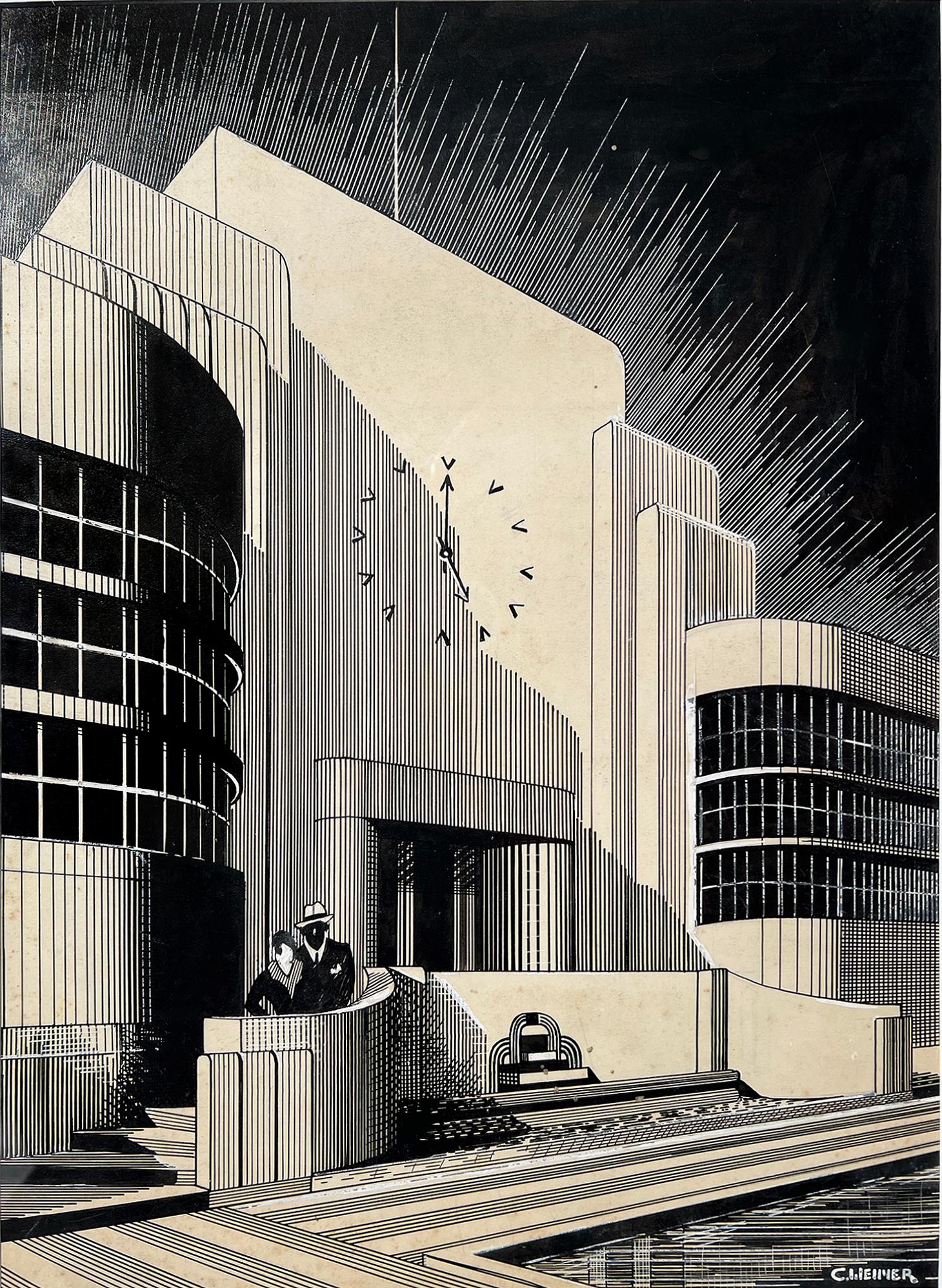
"Federal Building, Century of Progress", 1933 Art Deco Painting, Red & Black

$6,800
$8,50020% Off
£5,082.93
£6,405.4720% Off
€5,931.07
€7,491.3820% Off
CA$9,548.58
CA$12,027.6720% Off
A$9,712.92
A$12,205.8920% Off
CHF 5,546.22
CHF 7,036.4320% Off
MX$117,483.17
MX$147,791.9820% Off
NOK 64,671.83
NOK 81,670.7820% Off
SEK 65,662.73
SEK 82,544.2920% Off
DKK 44,339.10
DKK 56,002.9120% Off

About the Item

One of the most vivid and compelling accounts of the famed Century of Progress Exposition, which opened in Chicago in 1933, this view of the iconic Federal Building was painted in the second year of the fair by a Pennsylvania artist. The brilliantly-lit Art Deco dome and pylons of the building, framed by a web of searchlights in a panoply of colors, are all set off by a starlit sky. The overall style and elegance of the fair site was established by two renowned architects, Paul Cret and Raymond Hood and the Federal Building was designed by Bennet, Burnham and Holabird. (Dimensions include frame).
  • Creator:
    John H. Muth (Painter)
  • Dimensions:
    Height: 23 in (58.42 cm)Width: 16.75 in (42.55 cm)Depth: 1 in (2.54 cm)
  • Style:
    Art Deco (Of the Period)
  • Materials and Techniques:
  • Place of Origin:
  • Period:
  • Date of Manufacture:
    1934
  • Condition:
  • Seller Location:
    Philadelphia, PA
  • Reference Number:
    1stDibs: LU865113785562

More From This Seller

View All
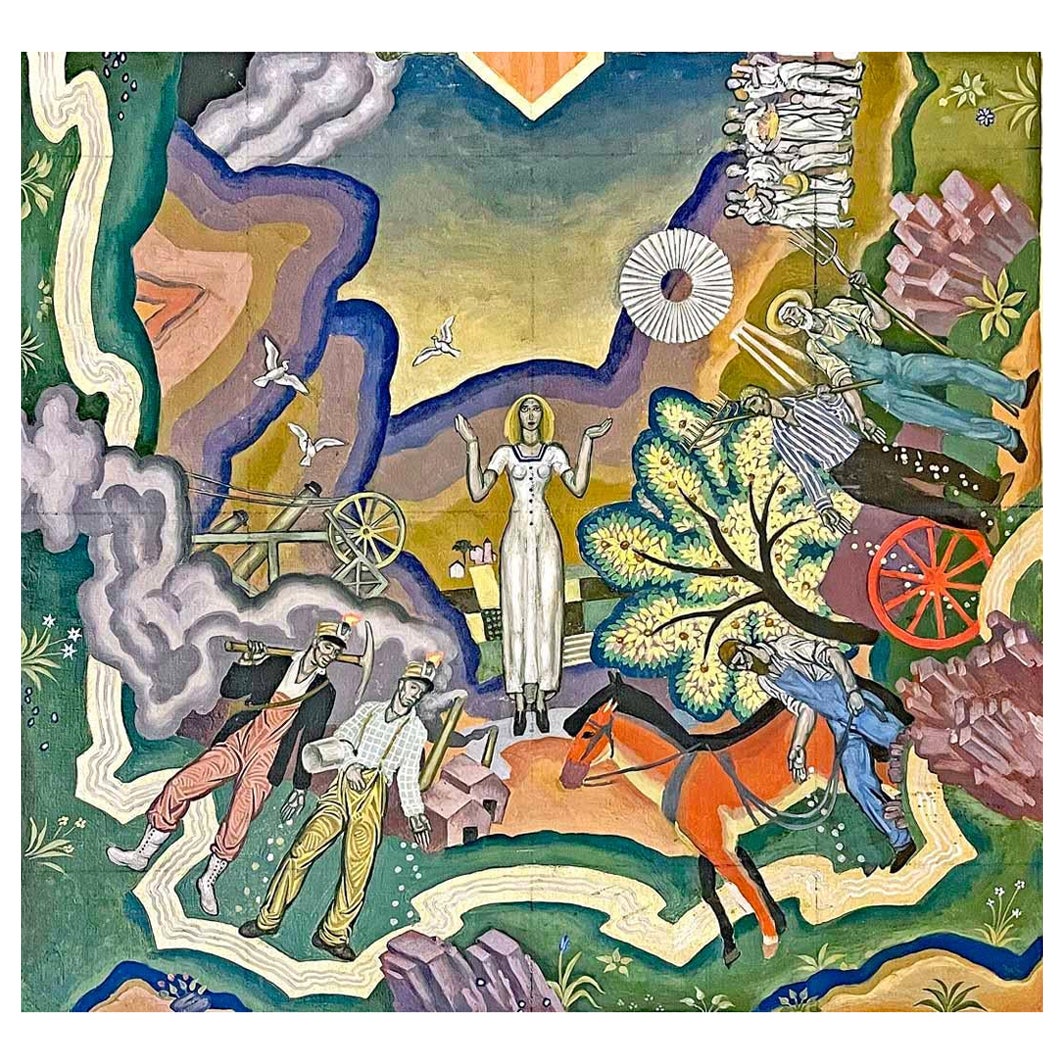
"Generation of Power", Remarkable 1931 Art Deco Mural Study, St. Paul, MN

"Generation of Power", Remarkable 1931 Art Deco Mural Study, St. Paul, MN

Located in Philadelphia, PA

Vivid and powerful, this large Art Deco mural study was painted by Elsa Jemne for the Northern States Power Building in St. Paul, Minnesota in 1930-31. The painting shows a nude mal...

Category

Vintage 1930s American Art Deco Paintings

Materials

Paint

"Story of Pennsylvania", Large Art Deco Masterpiece for Finance Bldg, PA Capitol

"Story of Pennsylvania", Large Art Deco Masterpiece for Finance Bldg, PA Capitol

By Eugene Francis Savage

Located in Philadelphia, PA

A large and remarkable masterpiece from the heyday of Art Deco mural painting, this colorful and detailed study was made by Eugene Savage in preparation for an enormous ceiling mural...

Category

Vintage 1940s American Art Deco Paintings

Materials

Paint

"NIKE at Waldemarsudde, " Depiction of Stockholm Landmark, Art Deco Masterpiece

"NIKE at Waldemarsudde, " Depiction of Stockholm Landmark, Art Deco Masterpiece

By Georg Pauli

Located in Philadelphia, PA

Arguably the greatest work of Georg Pauli, one of Sweden's leading Modernist painters in the 1920s, 30s and 40s, this Art Deco-Cubist work depicts the great Nike sculpture on the grounds of the home of Prince Eugens on Cape Waldemar in central Stockholm (known in Swedish as Prins Eugens Waldemarsudde). The Prince was a great collector of modern art in the early 20th century, and today his home is a museum and much-beloved landmark in Stockholm. This painting shows the sculpture in the foreground, and in the background is a jumble of houses, factory chimneys and institutional buildings, the Swedish flag...

Category

Vintage 1930s Swedish Art Deco Paintings

Materials

Paint

"Theatrical Scene, " Art Deco Painting with Tragedy, Comedy in Celestial Setting

"Theatrical Scene, " Art Deco Painting with Tragedy, Comedy in Celestial Setting

Located in Philadelphia, PA

This extraordinary, almost surreal scene by one of America's leading muralists in the Art Deco period, Eugene Savage, depicts a floating female nude on the stage, with figures of Com...

Category

Vintage 1940s American Art Deco Paintings

Materials

Paint

"Olympia", 1934 Moderne Theater Arch'l Rendering, Stile Littorio, Lakki, Greece

"Olympia", 1934 Moderne Theater Arch'l Rendering, Stile Littorio, Lakki, Greece

Located in Philadelphia, PA

A brilliant example of Stile Littorio or Italian Rationalist design promulgated by Mussolini in 1930s Italy, this original drawing by Armando Bernabiti depicts his proposal for a str...

Category

Vintage 1930s Italian Art Deco Drawings

Materials

Other

"The History of Los Angeles", Important Art Deco Mural Study w/ Major Landmarks

"The History of Los Angeles", Important Art Deco Mural Study w/ Major Landmarks

By Alexander Rosenfeld

Located in Philadelphia, PA

A late entry in America's string of public murals painted in the 1930s, 40s and 50s telling the story of various towns and regions, this 1962 Art Deco study b...

Category

Vintage 1960s American Art Deco Paintings

Materials

Paint

You May Also Like

Mid Century Cubist Painting of an Industrial Building

Mid Century Cubist Painting of an Industrial Building

Located in Redding, CT

Mid Century Cubist Painting of an Industrial Building. Painting on board and housed in a solid wooden frame. colors include greens, golds, and orange. Nice industrial vibe to this co...

Category

Mid-20th Century Mid-Century Modern Paintings

Materials

Wood, Masonite

1936 Painting of Berlin by Gordon Bunshaft of Skidmore Owings and Merrill (SOM)

1936 Painting of Berlin by Gordon Bunshaft of Skidmore Owings and Merrill (SOM)

By Gordon Bunshaft

Located in Philadelphia, PA

This is an original 1936 painting of Berlin by Gordon Bunshaft, the influential modernist architect best known for his work with Skidmore, Owings & Merrill (SOM). It is a rare and in...

Category

Vintage 1930s American Modern Paintings

Materials

Wood

Art Deco Stage Set Oil on Canvas Painting signed William Freed

Art Deco Stage Set Oil on Canvas Painting signed William Freed

By William Freed

Located in New York, NY

This extraordinary oil on canvas painting by American artist William Freed (1902–1984) captures the dynamic energy and stylized elegance of the Art Deco era. Painted circa 1937, the ...

Category

1930s Abstract Paintings

Materials

Oil

NYC Cityscape American Scene WPA Modern Realism Mid 20th Century Architectural

NYC Cityscape American Scene WPA Modern Realism Mid 20th Century Architectural

By Ernest Fiene

Located in New York, NY

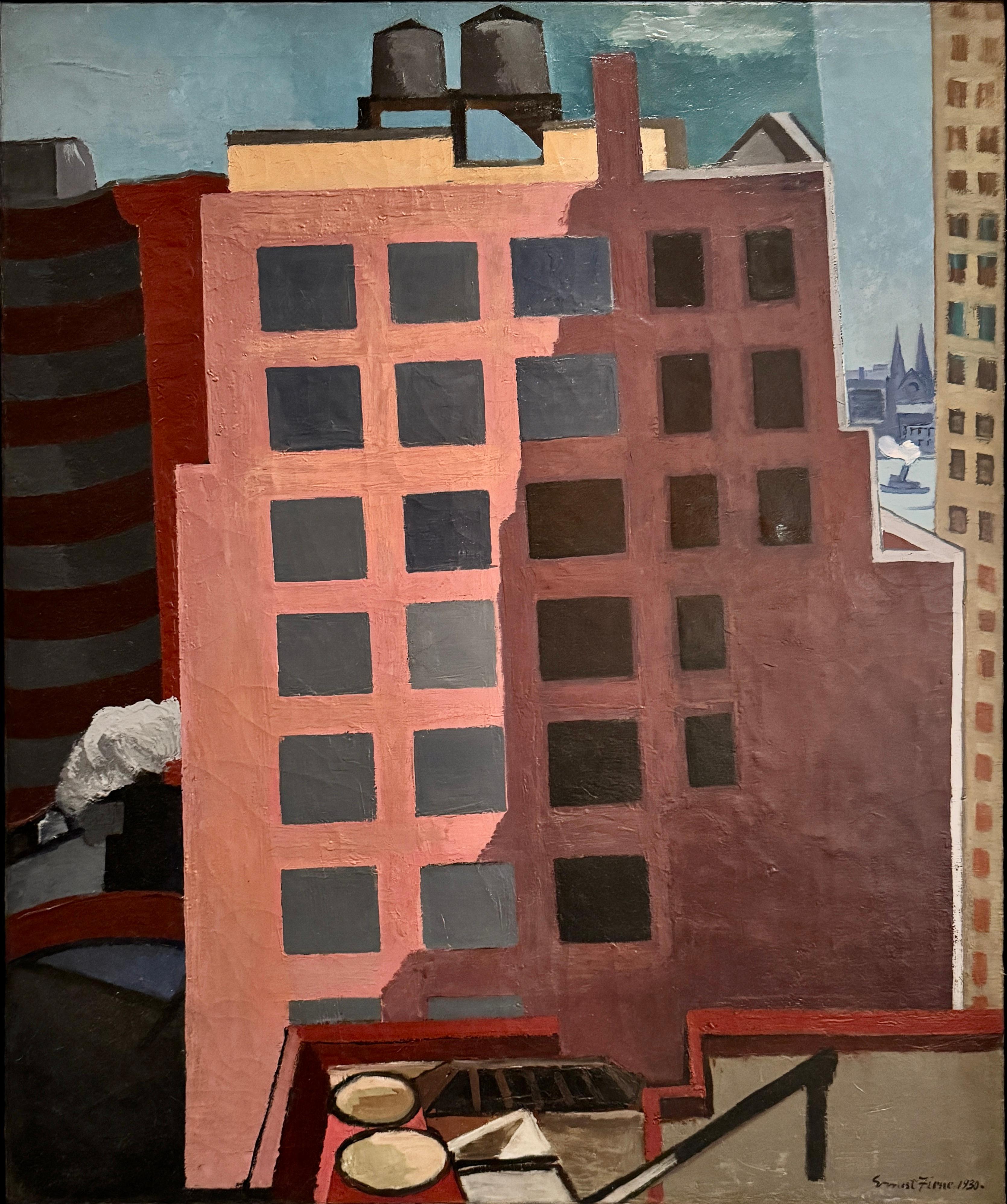
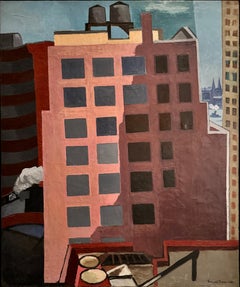
NYC Cityscape American Scene WPA Modern Realism Mid 20th Century Architectural Ernest Fiene (1894-1965) Cityscape 36 x 30 inches Oil on canvas Signed and dated 1930. lower right Provenance Estate of the artist. ACA Galleries, New York Exhibited New York, Frank Rehn Gallery, Changing Old New York, 1931. New York, ACA Galleries, Ernest Fiene: Art of the City, 1925-1955, May 2-23, 1981, n.p., no. 5. BIO Ernest Fiene was born in Elberfeld, Germany in 1894. As a teenager, Fiene immigrated to the United States in 1912. He studied art at the National Academy of Design in New York City from 1914 to 1918, taking day classes with Thomas Maynard and evening classes with Leon Kroll. Fiene continued his studies at the Beaux-Arts Institute of Design in New York from 1916 to 1918, adding classes in printmaking at the Art Students League in 1923. Fiene began his career as an artist in 1919 with his first exhibition of watercolors at the MacDowell Club arranged by his mentor Robert Henri. In 1923 the Whitney Studio Club mounted a large exhibition of his works. The following year he had an exhibition at the New Gallery in New York, which completely sold out all fifty-two works, including paintings, watercolors, drawings, and etchings. With the proceeds of sales from the New Gallery exhibition, Ernest Fiene and his younger brother Paul, a sculptor, built studios in Woodstock, New York in 1925. In the early Twenties Ernest Fiene painted mostly landscapes of Woodstock and both the Ramapo and Hudson River Valleys. The first monograph from the Younger Artists Series was published on Fiene in 1922. Published in Woodstock, the series went on to include Alexander Brook, Peggy Bacon, and Yasuo Kuniyoshi. The book reproduced 1 illustration in color and another 27 reproductions in black and white. Around 1925 Fiene became fascinated with the intensity, excitement, and opportunities for color harmonies New York City offered as a subject. His paintings shifted to urban and industrial themes with architecture, industry, and transportation becoming his subjects. By 1926 Fiene had attracted the dealer Frank K.M. Rehn, who gave him a one-man exhibition that year, which travelled to the Boston Arts Club. C.W. Kraushaar Galleries gave Fiene a one-man exhibition of urban, landscape, portrait, and still life paintings in 1927. Julianna Force, the director of the Whitney Studio Club and first director of the Whitney Museum of American Art, included two of Fiene’s paintings in a fall exhibition in 1928. The Whitney Studio Club showed Fiene’s paintings in a two-man exhibition with Glenn O. Coleman that year and acquired three of Fiene’s paintings. Also in 1928 Fiene became affiliated with Edith Halpert’s Downtown Gallery where he had an exhibition of 20 lithographs in the spring. Fiene sold his house in Woodstock in 1928 to spend more of his time in New York City. With so many successful exhibitions, Fiene returned to Paris in 1928-29 where he rented Jules Pascin's studio and studied at the Académie de la Grande Chaumière. In France, Fiene painted both landscape and urban subjects developed from ideas influenced by Cubist geometry and the use of flat areas of broad color. Upon returning to New York in 1930, Fiene used this new approach to continue to paint New York skyscraper and waterfront subjects, as well as to begin a series of paintings on changing old New York based on the excavations for Radio City Music Hall and the construction of the Empire State Building. Frank K.M. Rehn Galleries exhibited this series, titled “Changing Old New York,” in 1931. Fiene also has solo exhibitions at Rehn Galleries in 1930 and 1932. Fiene’s oil paintings are exhibited at the Chicago Arts Club in 1930 as well. Fiene was included in the Museum of Modern Art’s exhibition Painting and Sculpture by Living Americans in December of 1931. Visiting New York, Henri Matisse saw the exhibition and called Fiene’s Razing Buildings, West 49th Street the finest painting he had seen in New York. Fiene had two mural studies from his Mechanical Progress series exhibited at the Museum of Modern Art’s exhibition Murals by American Painters and Photographers in 1932. Fiene sent View from my Window which depicts Fiene working on a lithograph stone while looking out his window to the newly completed Empire State Building to the Carnegie International in 1931. In 1932 Fiene participated in the first Biennial of American Painting at the Whitney Museum and his prints were included in exhibitions at the Downtown Gallery and the Wehye Gallery. In the same year, Fiene was awarded a Guggenheim fellowship to further study mural painting in Florence, Italy. On his return from Italy in 1933 Fiene re-engaged himself in New York City life and won several public and private mural projects. Fiene resumed his active exhibition schedule, participating in two group exhibitions at the Whitney Museum and a one-man exhibition of recent paintings at the Downtown Gallery in January 1934. In 1933 he purchased a farm in Southbury, Connecticut, which added Connecticut scenes to his landscape subjects. This was also the year Fiene began to spend summers on Monhegan Island, Maine, where he painted seascapes, harbor scenes, and still lifes. Fiene’s landscape paintings attracted numerous commissions as part of the American Scene movement. Through the fall and winter of 1935-36, Fiene took an extended sketching trip through the urban, industrial, and farming areas of Pennsylvania and West Virginia. Most of the twenty-four Pennsylvania urban and rural paintings...

Category

1930s American Modern Landscape Paintings
Materials

Canvas, Oil