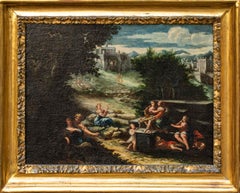
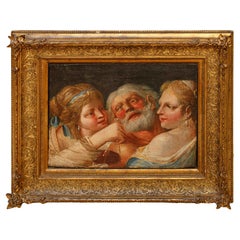
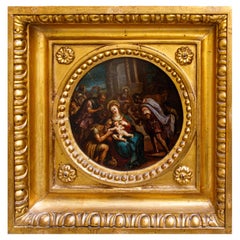
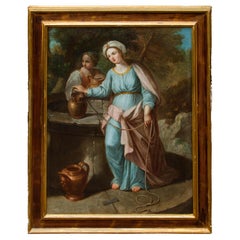
Neapolitan school of the 17th-18th centuries
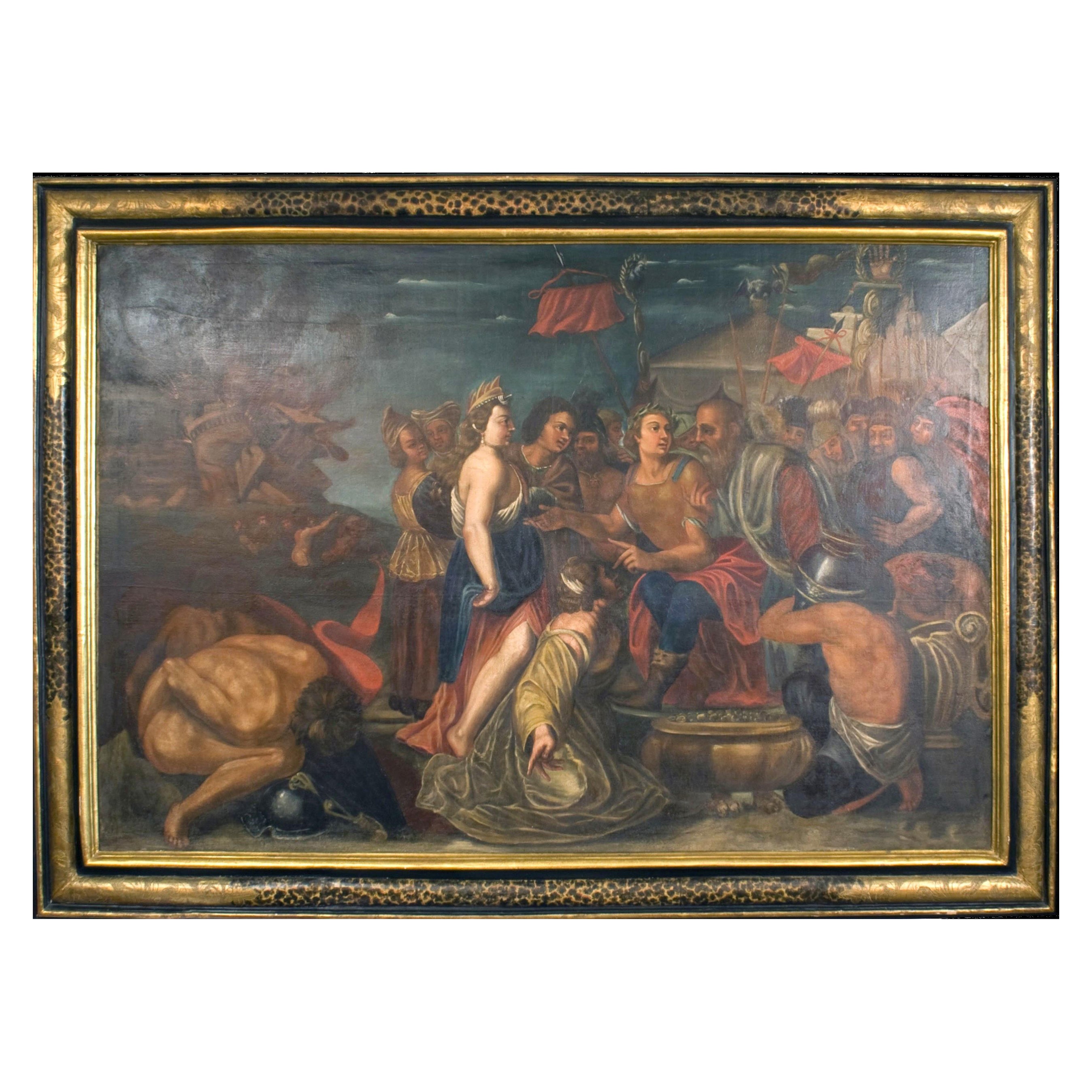
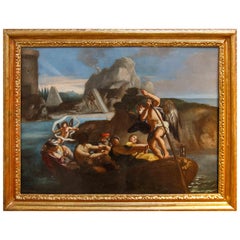
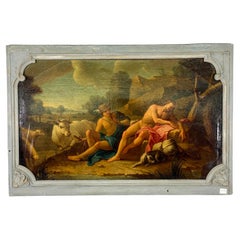
Bacchus and Ariadne abandoned by Theseus
Oil on canvas, 74 x 100 cm
Framed, 89 x 111 cm
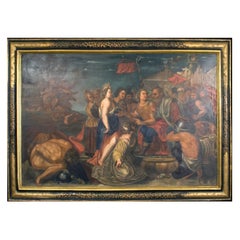
The painting under consideration, attributable to the hand of the same artist, depicts a well-known mythological episode and recognizable at first glance, full of hope and love.
Depicted is a mythological episode from the tales of Ovid and Catullus: the meeting between Bacchus and Ariadne, after the Cretan princess was abandoned on the beach of Naxos by Theseus. The Athenian hero, in fact, having killed the minotaur with the help of Ariadne, daughter of Minos, king of Crete, waited until the maiden fell asleep on the island of Naxos to depart with his ship and his companions. Upon awakening Ariadne, desperate and disappointed, began to weep, but suddenly came the triumphal Chariot of Bacchus (or Dionysus), who had just escaped from the sorceress Circe, accompanied by a procession of nymphs and fauns and a chariot drawn by leopards. As soon as he saw the young Ariadne, he fell in love with her, got out of his chariot, joined her, and gave her a marvelous golden crown created by Ephesus, which, thrown into the sky, went on to form the constellation of the Corona Borealis. Ariadne reciprocated her love for the god and followed him to heaven to join the other Olympian deities.
There are explicit references in the painting to an artist active in Naples, Francesco Solimena (1657-1747), among the greatest interpreters of late Baroque culture in Italy. The painter, in fact, seems to refer both in style, focused on characters characterized by strong shadows and light fabrics, and in compositions as much to Solimena as to Luca Giordano's chromatic experiments, to the vigorous and expressive painting of Mattia Preti, but also to the "chiaroscuro" painting of Caravaggio and Giovanni Battista Caracciolo, artists who left an indelible mark on 17th-century Naples, the European capital of Baroque painting.
The painting with Bacchus and Ariadne, on the other hand, echoes some of the figures devised by Solimena in his painting of the same name on the antiques market. Particularly resembling are the positions of Bacchus with his arm outstretched to indicate the clouds in the sky through which he will carry Ariadne to Olympus, the figure of the princess flanked by a winged putto with torch, the foreshortening of the prow of Theseus' departing ship, and the satyr behind the god as he caresses a leopard, as well as the putto kneeling before the Cretan maiden. A reinterpretation in which our artist decided to focus on the main characters of the scene, to whom he managed to give feelings and emotions very close to reality.