Located in Downingtown, PA
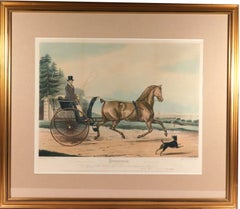
Hand-Coloured Aquatint of Large Size of The Celebrated Trotting Stallion Artaxerxes
After Francis Calcraft Turner (c. 1772–1846);
Engraved by Richard Gilson Reeve (1803–1889);
Published by I.W. Laird, 96 Marshall Street, London, April 1838
A large and impressive hand-coloured aquatint depicting the celebrated trotting stallion Artaxerxes, aged twelve years, shown in spirited action drawing a two-wheeled gig along an open road. The horse — a powerful, well-muscled chestnut rendered with the authority of a specialist sporting artist who knew his subjects intimately — is shown in full trot, his near foreleg advanced and his head slightly turned, the reins held with easy confidence by the top-hatted gentleman-driver seated in the gig behind him. A small black dog runs energetically at the horse’s heels in the right foreground, a lively incidental detail that animates the lower register of the composition. space
This vantage point of Blackheath, was a standard compositional choice for sporting prints of this period — Blackheath was itself a famous trotting ground, so the background is almost certainly a deliberate and accurate topographical reference placing the horse Artaxerxes in his actual racing environment. Trotting matches on Blackheath were well documented in the 1830s, which makes the landscape doubly purposeful as both setting and record.
The composition is characteristic of F.C. Turner’s best trotting-horse subjects: the horse is given full prominence against a spacious ground, the vehicle and driver subordinate to the animal’s energy and form. The hand-colouring is applied with skill and confidence, the chestnut of the horse’s coat and the harness rendered in warm browns and ochres, the gig’s red wheel spokes providing a sharp note of colour, and the driver’s dark coat and white-covered lap rug carefully differentiated. The landscape ground and sky are washed in the subdued greens and grey-blues characteristic of well-preserved examples of the type.
The lower margin carries the standard imprint information: to the left, “Painted by F.C. Turner”; to the right, “Engraved by R.G. Reeve”; centred,
"Artaxerxes.
AGED 12 YEARS.
The Property of Chas. Enderby, Esqr., to whom this Print with Permission is Dedicated by his Obedient Servant J. W. LAIRD.
London Pub'd by J. W. LAIRD, April, 1838, at N°1 Leadenhall Street.
This celebrated Horse was driven in the style as above shown from Aug't 1835 to Oct. 1837 when he was obliged to be destroyed, from having been unfortunately bitten by a Mad Dog."
The print is dedicated to Charles Enderby (the proprietor) as a mark of respect. Charles Enderby was a well-known London merchant and whaling entrepreneur.
Trotting — the competitive driving of horses at the trot, typically in lightweight gigs or sulkies — enjoyed a surge of popular enthusiasm in Britain in the 1820s and 1830s, attracting both aristocratic patrons and a wider sporting public. The subject of a named trotting horse in harness, driven by its owner-gentleman along a road, was a well-established formula in British sporting prints of the period.
Dimensions
Overall (framed):
30½ inches high
38 inches wide
(77.5 × 96.5 cm)
Condition: The condition is excellent with the color well retained. It is protected by Truview UV Glass.
Provenance
Private American collection.
Historical Context
Francis Calcraft Turner (c. 1772–1846) was one of the most prolific and commercially successful sporting artists of the Regency and early Victorian periods. A member of the Society of British Artists, he exhibited regularly at the Royal Academy, the British Institution, and the Suffolk Street Gallery between 1810 and 1846. Turner contributed extensively to the ‘Sporting Magazine’ and was celebrated for his authoritative draughtsmanship, rooted in a lifetime’s direct engagement with the sporting field. He wrote with characteristic immodesty in 1828 that he possessed more practical knowledge of “racing, shooting, and coursing” than any other artist of his time. His paintings entered the Royal Collection and major institutional holdings including the British Museum, the National Horse Racing Museum at Newmarket, and the Yale Center for British Art.
Richard Gilson Reeve (1803–1889) was the son and successor of the aquatint engraver Richard Reeve (fl. 1795–1820), and one of the most accomplished sporting print engravers of the second quarter of the nineteenth century. Active from 1825 — initially signing himself ‘Reeve Junior’ — he worked extensively with Turner and other sporting painters, producing hand-coloured aquatints that combined technical precision with expressive tonal range. His prints were published by the leading London houses of the period, including I.W. Laird of Marshall Street, a specialist publisher of sporting and equestrian subjects.
Selected Bibliography
Egerton, Judy. British Sporting and Animal Paintings, 1655–1867: The Paul Mellon Collection. London: Tate Gallery / Yale Center for British Art, 1978.
Gilbey, Sir Walter. Animal Painters of England from the Year 1650. 3 vols. London: Vinton & Co., 1900–1911.
Nevill, Ralph. Old English Sporting Prints...
Category
Antique 1830s English Country Prints