Video Loading
Want more images or videos?
Request additional images or videos from the seller
1 of 11

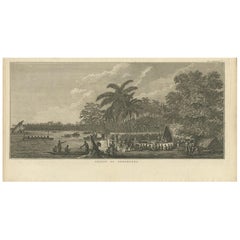
Antique Print of the Arrival of Captain Cook, 1803

$188.68
$235.5920% Off
£139.85
£175.0220% Off
€160VAT Included
€20020% Off
CA$263.21
CA$330.1520% Off
A$267.02
A$334.2920% Off
CHF 152.45
CHF 190.1820% Off
MX$3,233.20
MX$4,062.6720% Off
NOK 1,794.76
NOK 2,247.9820% Off
SEK 1,788.81
SEK 2,236.1720% Off
DKK 1,220.36
DKK 1,524.9520% Off

About the Item

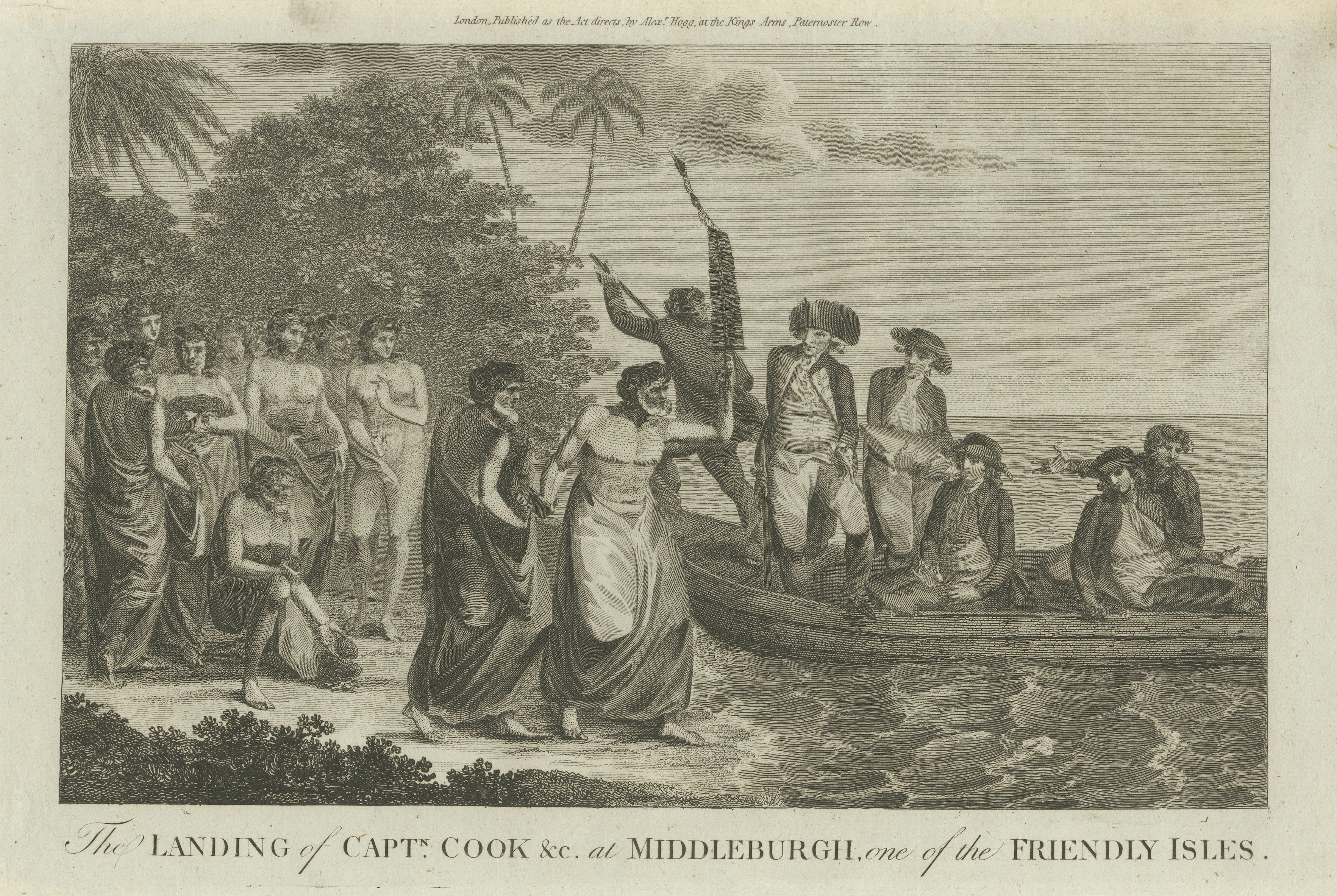
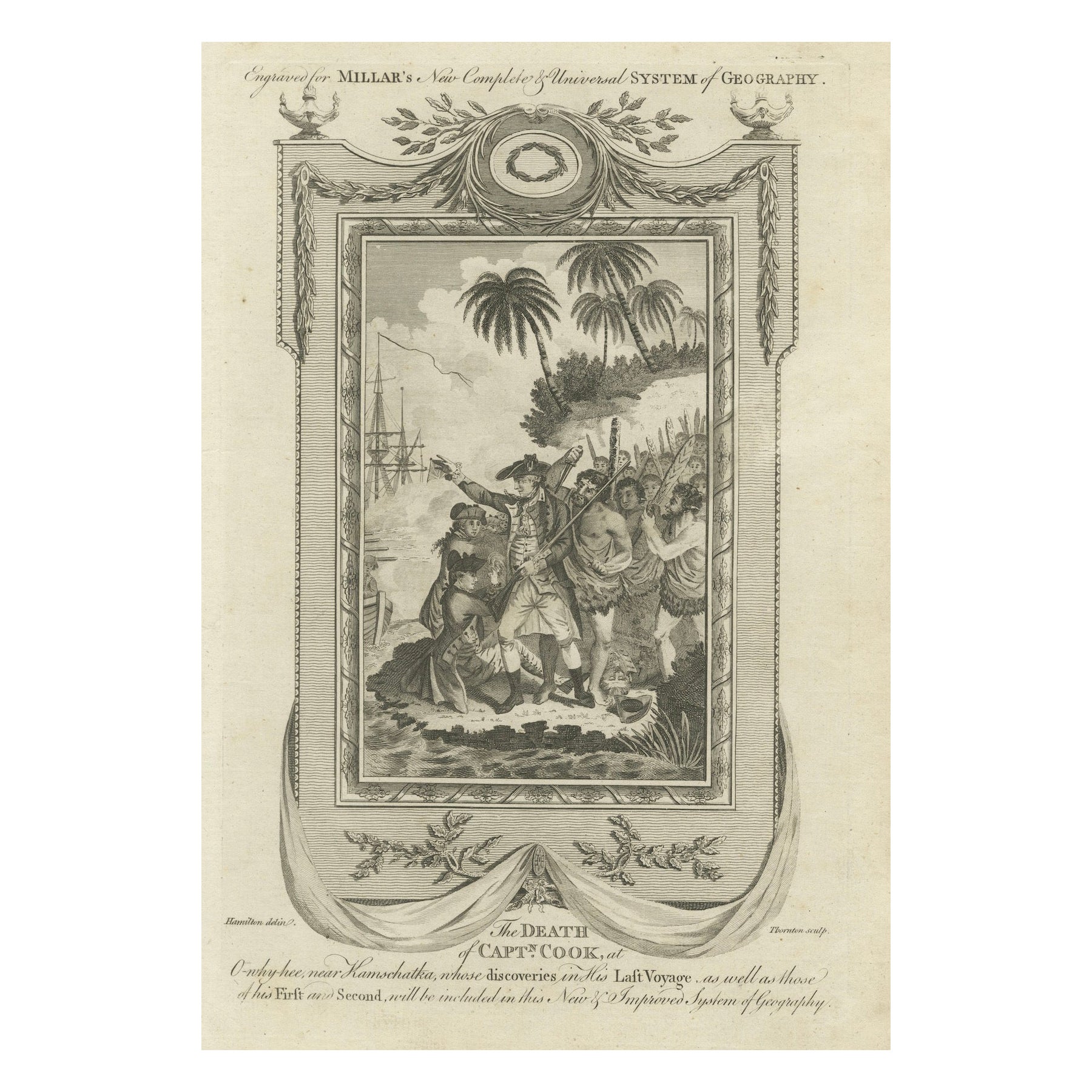
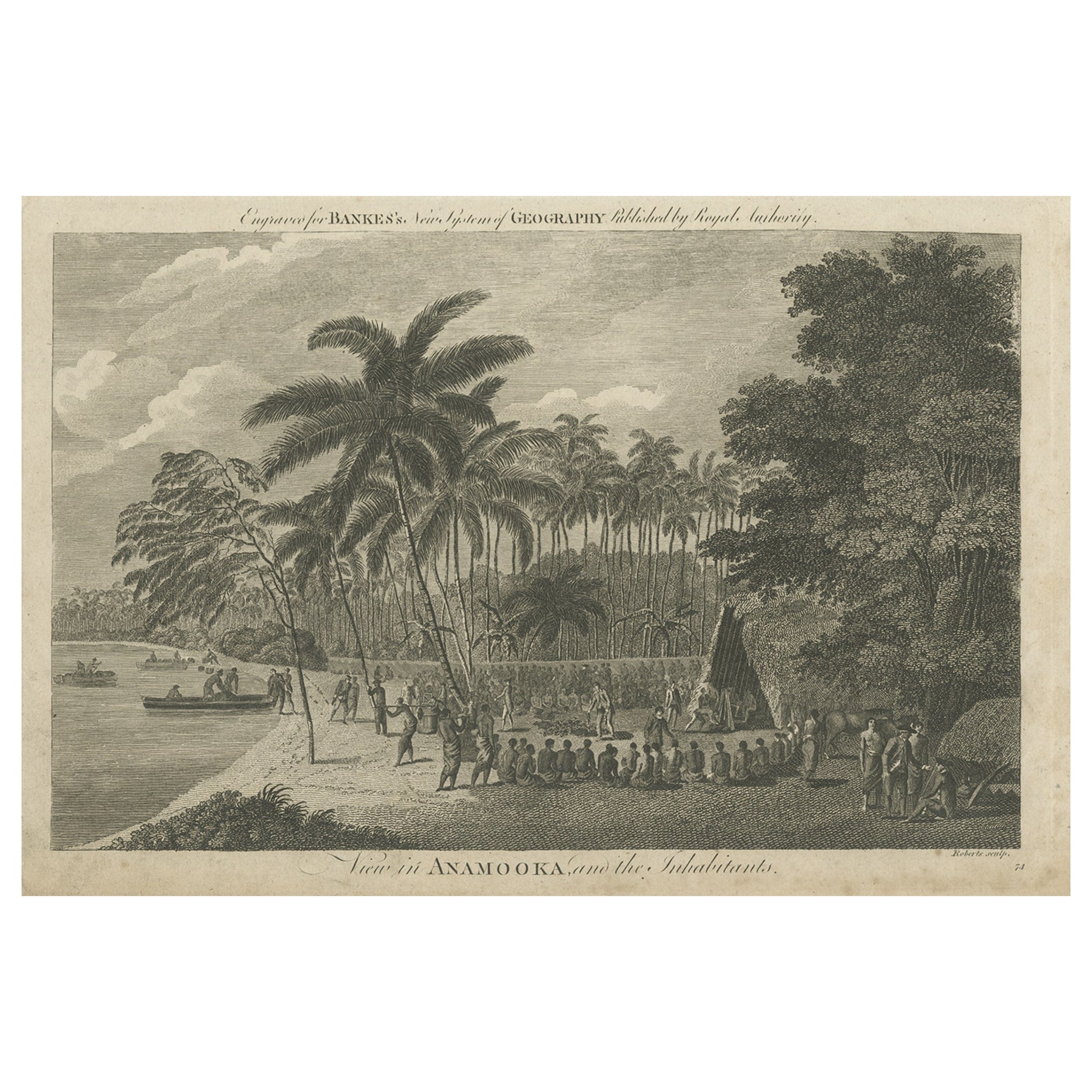
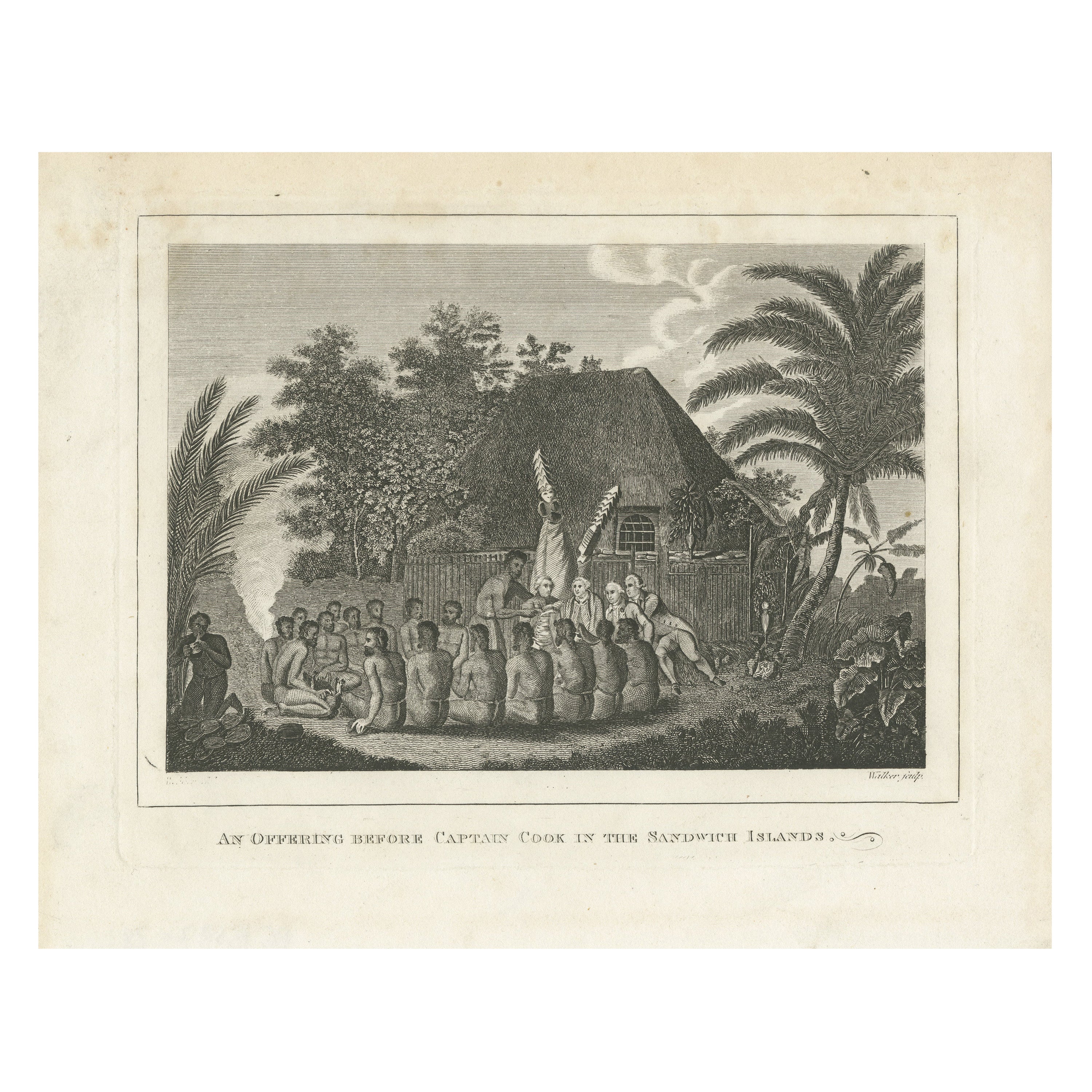
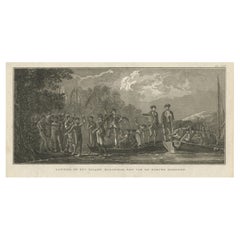
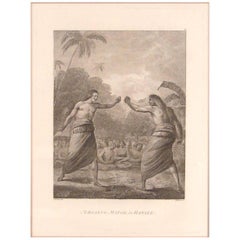
This antique print depicts the ceremonial welcome received by Captain James Cook upon his arrival at the island of Hapaee (Ha’apai) in Tonga during his third voyage in 1777. The engraving shows a large open area surrounded by palm trees and traditional thatched houses. In the centre, two wrestlers perform for the gathered community, while a large circle of people dressed in ceremonial attire watch intently, their ranks stretching around the performance ground. Smaller groups of spectators stand to the sides near huts, and musicians or attendants are depicted preparing offerings or instruments, emphasising the importance of Cook’s visit to local leaders. This engraving originates from ‘Reizen rondom de Waereld’ by James Cook, published in Dutch circa 1795. Cook’s visits to the Tongan islands were marked by elaborate feasts, dances, and wrestling competitions organised by the chiefs to demonstrate power, hospitality, and social structure. Such engravings provided European readers with vivid insights into Polynesian culture, customs, and ceremonial life in the late 18th century. The technique used is engraving, where artists meticulously incised the image onto metal plates to create detailed prints with strong linear clarity and tonal contrast. These prints remain important as early ethnographic records, produced before photography, and are valued for their documentary accuracy and artistic quality. Condition summary: Good condition with strong impressions and good paper strength. Some general age-toning and scattered foxing visible in the wide margins, with minor handling marks but no tears or repairs. Image area remains clean and crisp. Framing tips: A warm cream or light stone mount will harmonise with the sepia-grey tones of the engraving. For framing, consider dark oak, walnut, or a black frame with a slim gold or silver inner edge for a classic museum-quality presentation. UV-protective glass is recommended to maintain the engraving’s detail and prevent fading.
  • Creator:
    J. Cook (Artist)
  • Dimensions:
    Height: 13.98 in (35.5 cm)Width: 20.87 in (53 cm)Depth: 0.02 in (0.5 mm)
  • Materials and Techniques:
    Paper,Engraved
  • Place of Origin:
  • Period:
  • Date of Manufacture:
    1803
  • Condition:
    Condition summary: Good condition with strong impressions and good paper strength. Some general age-toning and scattered foxing visible in the wide margins, with minor handling marks but no tears or repairs. Image area remains clean and crisp.
  • Seller Location:
    Langweer, NL
  • Reference Number:
    Seller: BG-11487-601stDibs: LU3054313393131

More From This Seller

View All
Antique Print of Annamooka, Tonga Islands, by Cook '1803'

Antique Print of Annamooka, Tonga Islands, by Cook '1803'

Located in Langweer, NL

Antique print titled 'Gezigt op Annamooka'. This print depicts the Harbour of Annamooka, now Nomuka, part of the Ha’apai group of Tonga. Originates from 'Reizen rondom de Waereld' by...

Category

Antique Early 19th Century Dutch Prints

Materials

Paper

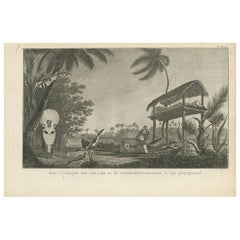
Antique Print of a Funeral Ritual by Cook, 1803

Antique Print of a Funeral Ritual by Cook, 1803

Located in Langweer, NL

Antique print titled 'Een Lijk-Huisjen met een Lijk en de Opper-Rouw-Draager in zijn plegtgewaad'. This print depicts a funeral ritual. Originates from 'Reizen rondom de Waereld' by ...

Category

Antique Early 19th Century Dutch Prints

Materials

Paper

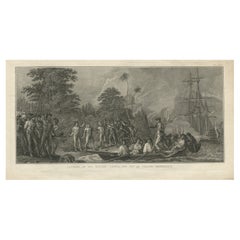
Antique Print of the Landing at Tanna Island by Cook, 1803

Antique Print of the Landing at Tanna Island by Cook, 1803

Located in Langweer, NL

Antique print New Hebrides titled 'Landing op het Eiland Tanna, een van de Nieuwe Hebriden'. Antique print depicting the landing at one of the islands of the New Hebrides, Vanuatu. O...

Category

Antique 19th Century Prints

Materials

Paper

1778 Engraving: Captain Cook's Second Voyage - Meeting the Tahitians

1778 Engraving: Captain Cook's Second Voyage - Meeting the Tahitians

Located in Langweer, NL

1778 Engraving of Captain Cook's Second Voyage: Meeting Tahitians This beautiful copper-line engraving from 1778, created by Charles Grignion (1717-1810) after a work by Samuel Wale...

Category

Antique 1770s British Prints

Materials

Paper

Antique Print of the Landing at Malakula Island, Vanuatu, by Cook, 1803

Antique Print of the Landing at Malakula Island, Vanuatu, by Cook, 1803

Located in Langweer, NL

Antique print New Hebrides titled 'Landing op het Eiland Mallicolo, een van de Nieuwe Hebriden'. Antique print depicting the landing at one of the islands of the New Hebrides, Vanuat...

Category

Antique 19th Century Prints

Materials

Paper

Antique Print of King Poulaho of the Friendly Islands by Cook, 1803

Antique Print of King Poulaho of the Friendly Islands by Cook, 1803

Located in Langweer, NL

Antique print titled 'Poulaho, Koning van de Vrienden-Eilanden, Kava drinkende'. This print depicts King Poulaho drinking Cava, Friendly Islands or nowadays Hawaii. Originates from '...

Category

Antique Early 19th Century Dutch Prints

Materials

Paper

You May Also Like

"King of the Friendly Islands" (Tonga); Engraving from Captain Cook's 3rd Voyage

"King of the Friendly Islands" (Tonga); Engraving from Captain Cook's 3rd Voyage

By John Webber

Located in Alamo, CA

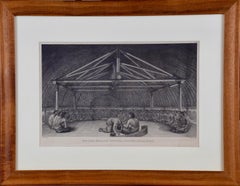
"Poulaho, King of the Friendly Islands, Drinking Kava" is an engraving created by William Sharp (1749-1824), from a drawing by John Webber (1752-1793), who was the artist on Captain James Cook's 3rd and final voyage of discovery. It was published in the atlas of "A Voyage to the Pacific Ocean Undertaken by the Command of His Majesty, for Making Discoveries in the Northern Hemisphere", the official British Admirality sanctioned journal published upon completion of the voyage in London in 1784 by Strahan & Cadell. Captain Cook visited Tonga on his 3rd voyage, which he named The Friendly Islands because of the warm welcome he and his crew received, unlike some of the other more hostile Pacific islands. The engraving depicts Cook and his men observed a kava ceremony at the village of Mu’a on Tongatapu. King Paulaho sits in the centre foreground, his back to the spectator with a man kneeling before him. The ceremonial mat depicted behind Paulaho indicates that nobody was allowed to sit behind him. The figure in the centre holds a single cup, referring to the Tongan custom of offering the cup to the king first. Kava is native to the islands of the South Pacific and was first described for English readers in 1768 by Captain James Cook. The kava root has been used for centuries as a central feature of ceremonies and celebrations because it was able to bring about a calming and pleasant social atmosphere. The root was crushed and processed into coconut milk to become the focal ceremonial beverage, simply referred to as kava. This engraving is presented in a Koa wood frame and a white mat. Koa wood is legendary in Hawaii. There are occasional faint spots, but the print is otherwise in very good condition. This amazing Koa wood is native to Hawaii and it is known for the deep rich colors and varied grain pattern. Koa has an honored heritage in Hawaii and is highly revered and sacred. The word “koa” means “warrior” in Hawaiian. The warriors of King Kamehameha the Great, created canoes and weapons from a wood plentiful on the Big Island of Hawaii. This wood became synonymous with the warriors themselves, and it became known as koa. There are three other engravings listed from the official journal of Captain Cook's 3rd voyage available that are presented in identical Koa wood frames and mats (LU117324682422, LU117324684052, LU117324684032). They would make a wonderful grouping for a display of 2, 3 or 4 prints. A discount is available for a grouping depending on the number of items included. Captain Cook is remembered as one of the greatest explorers and navigators in history. His explorations included Australia, New Zealand and islands of the South Pacific and the northwest coast of North America. Hawaii was discovered by Captain Cook during this voyage. Hawaii was originally called The Sandwich Islands in honor of The Earl of Sandwich...

Category

1780s Realist Figurative Prints
Materials

Engraving

Original Antique Ethnographical Print, Figures, New South Wales, Australia, 1809

Original Antique Ethnographical Print, Figures, New South Wales, Australia, 1809

Located in St Annes, Lancashire

Wonderful ethnographical print. A copper-plate engraving after Lesieur Published by Sherwood, Neely & Jones. Dated 1809 Unframed.  

Category

Antique Early 1800s English Folk Art Prints

Materials

Paper

Surrender of Tahiti to Captain Wallis: An Original 18th C. Engraving

Surrender of Tahiti to Captain Wallis: An Original 18th C. Engraving

By John Webber

Located in Alamo, CA

"A Representation of the Surrender of the Island of Otaheite to Capt.n Wallis, by the Supposed Queen of Oberea" is an original 18th century engraving created by Sparrow, from a drawi...

Category

1780s Landscape Prints

Materials

Engraving

"A Dance in Otaheite" (Tahiti), Engraving from Captain Cook's 3rd Voyage

"A Dance in Otaheite" (Tahiti), Engraving from Captain Cook's 3rd Voyage

By John Webber

Located in Alamo, CA

"A Dance in Otaheite" (Tahiti) is an engraving created by William Sharp (1749-1824), from a drawing by John Webber (1752-1793), who was the artist on Captain James Cook's 3rd and final voyage of discovery. It is a plate in the atlas of "A Voyage to the Pacific Ocean Undertaken by the Command of His Majesty, for Making Discoveries in the Northern Hemisphere", the official British Admirality sanctioned journal published upon completion of the voyage in London in 1784 by Strahan & Cadell. Two women and two men wearing ceremonial costumes, performing a dance outdoors standing on a mat. Three men are playing the drums in the background, in front of a thatched roof building. An audience of men are sitting on both sides of the stage. By the time Webber arrived in Tahiti, 'south sea' imagery had become familiar. Webber gave concentrated attention to dance. He had the opportunity to distinguish the Tahitian dance from the more formalized dancing of Tonga. Whereas they seem to have called to mind the more formal dances of antiquity, the Tahitian dancing aroused memories of peasant and folk dancing. This engraving is professionally framed in Koa wood. Koa wood is legendary in Hawaii. Not only is this amazing wood native to Hawaii, but it is known for the deep rich colors and varied grain pattern. Koa has an honored heritage in Hawaii and is highly revered and sacred. The word “koa” means “warrior” in Hawaiian. The warriors of King Kamehameha the Great, created canoes and weapons from a wood plentiful on the Big Island of Hawaii. This wood became synonymous with the warriors themselves, and it became known as koa. The print is in excellent condition. There are three other engravings listed from the official journal of Captain Cook's 3rd voyage available that are presented in identical Koa wood frames and double mats (LU117324682432, LU117324684052, LU117324684062). They would make a wonderful grouping for a display of 2, 3 or 4 prints. A discount is available for a grouping depending on the number of items included. Hawaii was discovered by Captain Cook during this voyage. Hawaii was originally called The Sandwich Islands in honor of The Earl of Sandwich...

Category

1780s Realist Landscape Prints

Materials

Engraving