Want more images or videos?
Request additional images or videos from the seller
1 of 9

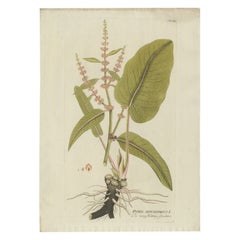
Detailed Engraved Botanical Study of Persicaria Bistorta or Common Bistort, 1822

$273.77
$341.6220% Off
£202.36
£253.3320% Off
€232VAT Included
€29020% Off
CA$379.90
CA$476.9820% Off
A$386.73
A$483.9620% Off
CHF 222.71
CHF 276.4720% Off
MX$4,660.50
MX$5,859.5020% Off
NOK 2,585.09
NOK 3,247.9520% Off
SEK 2,608.20
SEK 3,243.6520% Off
DKK 1,768.71
DKK 2,211.2320% Off

About the Item

Title: "Detailed Botanical Study of Persicaria bistorta (Common Bistort)" Description: This hand-colored copperplate engraving, created by F. Guimpel, illustrates the Persicaria bistorta, commonly known as Common Bistort. Featured in Dr. Friedrich Gottlob Hayne's 1822 publication, "Medical Botany," this detailed botanical representation showcases the entire plant, including its root system, stem, leaves, and the distinctively shaped inflorescence. The engraving also includes detailed dissections of the flower parts, showcasing the botanical precision necessary for medical and scientific study at the time. Maker and Condition: The engraving was made by F. Guimpel, a noted illustrator, under the direction of Dr. Friedrich Gottlob Hayne, a German botanist, apothecary, and professor at Berlin University. The condition of this particular engraving appears well-preserved with crisp lines and clear, muted coloration typical of the period's botanical illustrations. The paper shows some minor signs of aging, such as slight discoloration, which is common in archival materials but does not detract from the overall quality. Significance and Habitat: Persicaria bistorta is renowned for its medicinal properties, traditionally used in European herbal medicine to treat various ailments due to its astringent qualities. The plant is characterized by its snake-like, twisted root, which is depicted with accuracy in this engraving. Common Bistort can be found across Europe and parts of Asia, thriving in moist meadows and by waterways. This engraving not only serves as a scientific record but also as an example of early 19th-century botanical art, reflecting the intersection of art, science, and medicine during a period of significant botanical discovery and study.
  • Dimensions:
    Height: 10.83 in (27.5 cm)Width: 8.47 in (21.5 cm)Depth: 0.01 in (0.2 mm)
  • Materials and Techniques:
    Paper,Engraved
  • Place of Origin:
  • Period:
  • Date of Manufacture:
    1822
  • Condition:
    Excellent condition with minor signs of aging.. The paper exhibits a mild patina. General age-related toning and/or occasional minor defects from handling. Please study scan carefully.
  • Seller Location:
    Langweer, NL
  • Reference Number:
    Seller: BG-13747-261stDibs: LU3054341313462

More From This Seller

View All
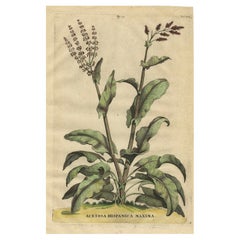
Botanical Illustration of Large Spanish Sorrel (Acetosa Hispanica Maxima), 1696

Botanical Illustration of Large Spanish Sorrel (Acetosa Hispanica Maxima), 1696

Located in Langweer, NL

This antique print, titled "Acetosa Hispanica Maxima," depicts the Acetosa plant, commonly known as Sorrel. It belongs to the Plantago or Rumex genus, known for their edible leaves w...

Category

Antique 1690s Prints

Materials

Paper

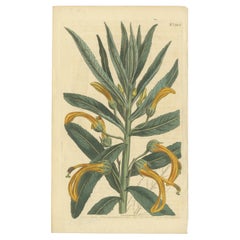
Antique Botany Print of Allium Cernuum by Curtis, 1810

Antique Botany Print of Allium Cernuum by Curtis, 1810

Located in Langweer, NL

Antique botany print of allium cernuum, also known as nodding onion or lady's leek. This print originates from 'Curtis's botanical magazine'. Artists and Engravers: Curtis's Botani...

Category

Antique 19th Century Prints

Materials

Paper

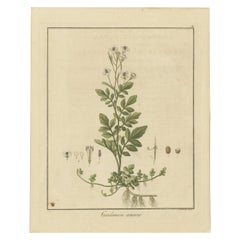
Detailed Engraved Botanical Study of Cardamine Amara or Bittercress, 1822

Detailed Engraved Botanical Study of Cardamine Amara or Bittercress, 1822

Located in Langweer, NL

"Botanical Illustration of Cardamine amara (Bittercress)" Description: This hand-colored copperplate engraving, created by F. Guimpel, depicts Cardamine amara, commonly known as Bi...

Category

Antique 1820s Prints

Materials

Paper

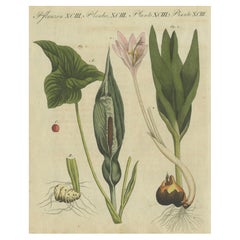
Elegant 1805 Hand-Colored Botanical Engraving of Bulbous Plants from Bertuch

Elegant 1805 Hand-Colored Botanical Engraving of Bulbous Plants from Bertuch

Located in Langweer, NL

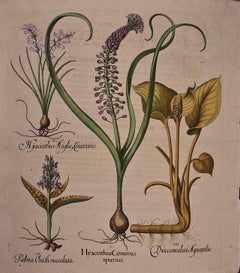
Title: Elegant 1805 Hand-Colored Botanical Engraving of Bulbous Plants from Bertuch Description: This detailed hand-colored botanical engraving is taken from Friedrich Justin Be...

Category

Antique Early 1800s German Prints

Materials

Paper

Engravings of European Wild Ginger, Prickly Lettuce, and Common Soapwort, 1819

Engravings of European Wild Ginger, Prickly Lettuce, and Common Soapwort, 1819

Located in Langweer, NL

Description of the Plants in the three original engravings on offer: 1. Asarum europaeum (Common Name: European Wild Ginger) - This engraving depicts Asarum europaeum, commonly k...

Category

Antique 1810s German Prints

Materials

Paper

You May Also Like

19th Century Botanical Drawing of Gymnostachyum Glabrum in Watercolor

19th Century Botanical Drawing of Gymnostachyum Glabrum in Watercolor

Located in Queens, NY

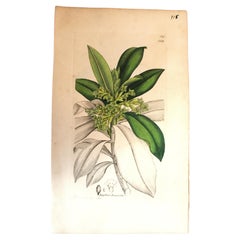
American Victorian (19th Century) watercolor, ink, and pencil botanical drawing depicting a Gymnostachyum Glabrum plant in green tones against a beige background, matted in a beveled...

Category

Antique 19th Century American Victorian Paintings

Materials

Paint

19th Century Watercolor Botanical Drawing of Aloysia Citriodora

19th Century Watercolor Botanical Drawing of Aloysia Citriodora

Located in Queens, NY

American Victorian (19th Century) watercolor, ink, and pencil botanical drawing depicting a Aloysia Citriodora plant in green tones against a beige background, matted in a beveled pa...

Category

Antique 19th Century American Victorian Paintings

Materials

Paint

Early 19th Century Botanical Engraving by John Curtis

Early 19th Century Botanical Engraving by John Curtis

Located in Seaford, GB

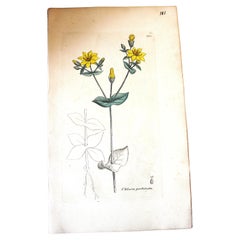
Early 19th Century Botanical Engraving by John Curtis – Hand Coloured Natural History Plate An original early 19th-century hand-coloured botanical engraving from the celebrated natural history publications of John Curtis (1791–1862), one of Britain’s most respected botanical and entomological illustrators. This beautifully detailed plate illustrates a flowering plant in scientific profile, showing bloom structure, leaves, buds, and root system with precision typical of early Victorian natural history illustration. Curtis’s work bridges science and art — created for study, yet prized today for its elegance and balance. These engravings formed part of the golden age of British botanical publishing, when artists collaborated with engravers and colourists to produce plates that were both accurate and visually refined. Each impression was printed from an engraved plate and then carefully coloured by hand, meaning no two examples are ever exactly identical. The composition has the clarity collectors seek: • Central botanical specimen • Naturalistic colour palette • Fine line engraving • Period scientific titling This makes it ideal as a single framed piece or as part of a gallery wall of antique botanical studies. About John Curtis John Curtis was a leading figure in British natural history illustration. He is best known for British Entomology and botanical works that combined taxonomic accuracy with graceful composition. His engravings are held in major museum collections and remain highly collectable in the decorative arts market. Period Early 19th century, circa 1820–1840. Technique Copperplate engraving with original hand colouring on laid paper. Condition Good antique condition consistent with age. Light toning and minor handling marks may be present, as expected with early 19th-century works on paper. Please see the images. Why Collect Curtis Botanical Prints...

Category

Antique Early 19th Century British George III Prints
Materials

Paper

Early 19th Century Botanical Engraving by John Curtis

Early 19th Century Botanical Engraving by John Curtis

Located in Seaford, GB

Early 19th Century Botanical Engraving by John Curtis – Hand Coloured Natural History Plate An original early 19th-century hand-coloured botanical engraving from the celebrated natural history publications of John Curtis (1791–1862), one of Britain’s most respected botanical and entomological illustrators. This beautifully detailed plate illustrates a flowering plant in scientific profile, showing bloom structure, leaves, buds, and root system with precision typical of early Victorian natural history illustration. Curtis’s work bridges science and art — created for study, yet prized today for its elegance and balance. These engravings formed part of the golden age of British botanical publishing, when artists collaborated with engravers and colourists to produce plates that were both accurate and visually refined. Each impression was printed from an engraved plate and then carefully coloured by hand, meaning no two examples are ever exactly identical. The composition has the clarity collectors seek: • Central botanical specimen • Naturalistic colour palette • Fine line engraving • Period scientific titling This makes it ideal as a single framed piece or as part of a gallery wall of antique botanical studies. About John Curtis John Curtis was a leading figure in British natural history illustration. He is best known for British Entomology and botanical works that combined taxonomic accuracy with graceful composition. His engravings are held in major museum collections and remain highly collectible in the decorative arts market. Period Early 19th century, circa 1820–1840. Technique Copperplate engraving with original hand colouring on laid paper. Condition Good antique condition consistent with age. Light toning and minor handling marks may be present, as expected with early 19th-century works on paper. Please see the images. Why Collect Curtis Botanical Prints...

Category

Antique Early 19th Century British George III Prints
Materials

Paper

Johann Weinmann: c18th Botanical Engravings in Decalcomania Frames

Johann Weinmann: c18th Botanical Engravings in Decalcomania Frames

By Johann Weinmann

Located in Richmond, GB

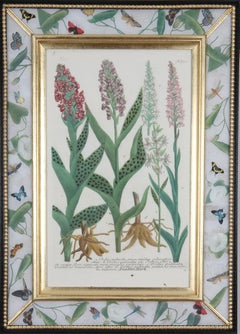
A wonderful selection of hand-coloured mezzotint engravings from: ""Phytanthoza Iconographia"", c1739, presented in hand- made parcel-gilt, ebonised and decalcomania frames. Joha...

Category

18th Century More Prints

Materials

Watercolor, Mezzotint