Art by Medium: Woodcut

to
467
3,505
506
333
166
253
Overall Width
to
Overall Height
to
63
656
3,465
585
29
117
439
320
162
217
389
153
163
105
33
2,298
558
231
215
213
104
60
45
45
32
9
3
1
1
3,382
1,238
120
2,332
1,213
901
808
617
468
457
392
353
288
276
267
238
222
207
183
171
152
135
108
4,770
187,297
99,466
82,162
79,485
170
150
57
54
51
431
2,138
2,747
1,896
Medium: Woodcut
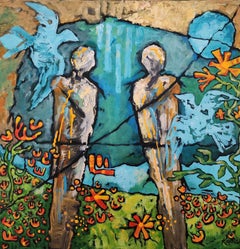
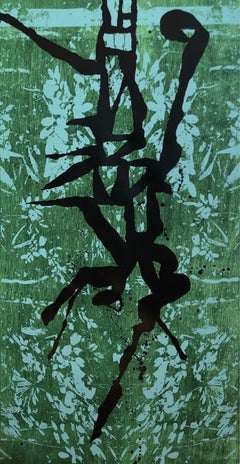
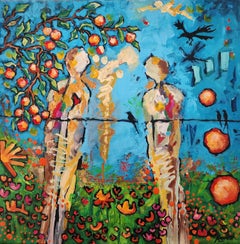
Sharing Abundant Space: Abstract Figurative, Acrylic Painting, Bold, Colorful

Sharing Abundant Space: Abstract Figurative, Acrylic Painting, Bold, Colorful

By Karnish Art

Located in Pretoria, Gauteng

Title: Sharing Abundant Space Sharing Abundant Space - Painting Figurative Maximalism Contemporary Floral Bold Invest In this one-of-a-kind abstract impressionism artwork by Karnis...

Category

2010s Abstract Impressionist Art by Medium: Woodcut

Materials

Gesso, Canvas, Wood, Acrylic, Woodcut, Stretcher Bars

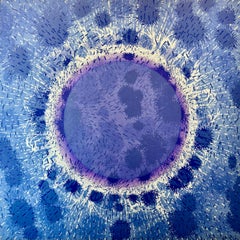
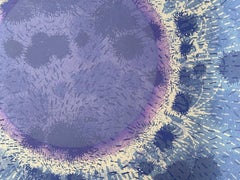
Burst Variation 156 - Abstract Woodcut Print Circle Pattern Blue, 2025

Burst Variation 156 - Abstract Woodcut Print Circle Pattern Blue, 2025

By Eve Stockton

Located in Kent, CT

This woodcut print on paper is composed of a central, circular shape in violet on a blue patterned background. The monotype brings to mind the tradition of Japanese printing while be...

Category

2010s Contemporary Art by Medium: Woodcut

Materials

Archival Ink, Archival Paper, Monotype, Woodcut

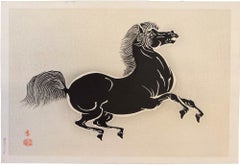
Black Horse
Black Horse

Black Horse

By Tokuriki Tomikichiro

Located in Middletown, NY

circa 1950. Woodblock print in black and gray ink on Japon laid paper, 10 1/4 x 15 3/4 inches (260 x 398 mm), full margins. With the artist's embossed chop mark in red ink in the l...

Category

Mid-20th Century Edo Art by Medium: Woodcut

Materials

Handmade Paper, Woodcut

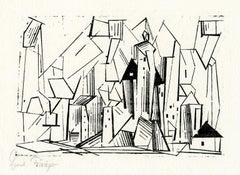
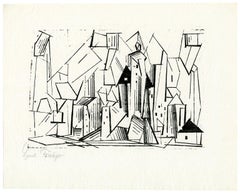
'Die Architektur' (Architecture) — Bauhaus Modernism

'Die Architektur' (Architecture) — Bauhaus Modernism

By Lyonel Feininger

Located in Myrtle Beach, SC

Lyonel Feininger, 'Die Architektur' (Architecture), also 'Stadtbild' (Cityscape), woodcut, edition proofs only in 1920; 50 in 1921. Prasse W 232. Signed in pencil. A fine, black impression, on off-white Japan, with full margins (1 1/4 to 2 1/8 inches), in excellent condition. Matted to museum standards, unframed. Image size 6 x 8 7/8 inches (152 x 229 mm); sheet size 9 1/2 x 11 7/8 inches (241 x 302 mm). No. 11 of the portfolio 'Zwolf Holzschnitte von Lyonel Feininger', 1921. Provenance: Peter Deitsch collection; exhibited Weimar Museum, 1968. Impressions of this work are in the permanent collection of: Busch-Reisinger Museum (Cambridge, Mass.), Bauhaus-Archiv (Germany), Hamburger Kunsthalie (Germany), Pfaizische Landesgewerbeanstalt (Germany), Kaiser Wilhelm Museum (Germany), Staatliche Graphische Sammlung (Germany), Philadelphia Museum of Art. ABOUT THE ARTIST Lyonel Feininger was born in New York City into a musical family—his father was a violinist and composer, his mother was a singer and pianist. He studied violin with his father, and by the age of 12, he was performing in public, but he also drew incessantly, most notably the steamboats and sailing ships on the Hudson and East Rivers, and the landscape around Sharon, Conn., where he spent time on a farm owned by a family friend. At the age of 16 he left New York to study music and art in Germany, from where his parents emigrated. Drawn more to the visual arts, he attended schools in Hamburg, Berlin, and Paris from 1887 to 1892. After completing his studies, Feininger began his artistic career as a cartoonist and illustrator, his originality leading him to great success. In 1906, after working for a dozen years in Germany, he was offered a job as a cartoonist at the Chicago Tribune, the largest circulation newspaper in the Midwest. He worked there for a year, inventing what became the standard design for the comic strip: in the words of John Carlin, “an overall pattern. . . that allowed the page to be read both as a series of elements one after the other, like language and as a group of juxtaposed images, like visual art.” His originality did not end there: he went on to become one of the great abstract painters. Like Kandinsky, music was his model, but Kandinsky only knew music from the outside—as a listener (inspired initially by Wagner, then by Schoenberg)—while Feininger knew it from the inside. He lived in Paris from 1906 to 1908, during which time he met and was influenced by the work of progressive painters Robert Delaunay and Jules Pascin, as well as that of Paul Cezanne and Vincent van Gogh. He began painting full-time, developing his distinctive Iyrical style based on Cubist and Expressionist idioms and a concern for the emotive qualities of light and color. He exhibited with the Der Blaue Reiter group in 1913, and in 1917, he had his first solo exhibition at Galerie Der Sturm in Berlin. One year after his solo exhibition, in 1918, Feininger began making woodcuts. He became enamored with the medium, producing an impressive 117 in his first year of exploring the printmaking medium. In 1919 at the invitation of the architect Walter Gropius, he was appointed the first master at the newly formed Staatliches Bauhaus in Weimar. His woodcut of a cathedral...

Category

1920s Bauhaus Art by Medium: Woodcut

Materials

Woodcut

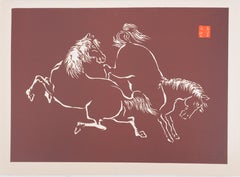
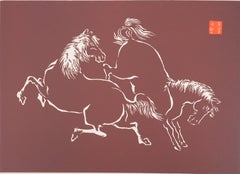
Japanese Print, Pair of horses playing (red) - Signed Woodcut

Japanese Print, Pair of horses playing (red) - Signed Woodcut

By Mokuchu URUSHIBARA

Located in Paris, IDF

Mokuchu URUSHIBARA Pair of horses playing (red), c. 1930 Woodcut after on an ink drawing Signed with the artist's stamp On paper 28 x 39 cm (c. 11.02 x 15.35 in) INFORMATION : Engr...

Category

1930s Modern Art by Medium: Woodcut

Materials

Woodcut

'Peking - Paifang Gate' — Mid-Century Watanabe Color Woodcut

'Peking - Paifang Gate' — Mid-Century Watanabe Color Woodcut

By Cyrus Le Roy Baldridge

Located in Myrtle Beach, SC

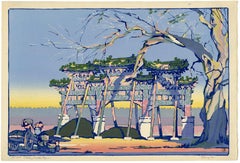
Cyrus Le Roy Baldridge, 'Peking '25', woodblock print, published 1926. Signed, titled, dated, and annotated 'No 124' in pencil. A fine impression, with fresh, undiminished colors; the full sheet, in excellent condition. Watanabe 6 mm seal, lower right, indicating an impression printed between 1945 and 1957. Archivally sleeved, unmatted. Image size 9 5/8 x 14 5/16 inches; sheet size 10 7/16 x 15 3/8 inches. ABOUT THE IMAGE A 'paifang', also known as a 'pailou', is a traditional style of Chinese architectural arch or gateway structure. It has been theorized that the paifang gate architecture was influenced by Buddhist torana temple gates. Paifang are designed with traditional Chinese architectural motifs including multi-tiered roofs, prominent supporting posts, and gracefully arched openings. This is an unusual ukiyo-e or 'floating world' woodcut published by Watanabe Shozaburo, Tokyo, in that the subject is of an early 20th-century scene in Peking, China. ABOUT THE ARTIST Cyrus Leroy Baldridge...

Category

1920s Showa Art by Medium: Woodcut

Materials

Woodcut

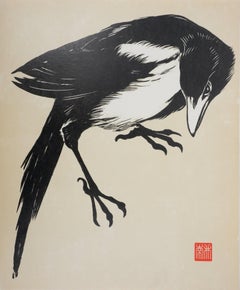
Japanese Print, White-billed Pie - Signed Woodcut

Japanese Print, White-billed Pie - Signed Woodcut

By Mokuchu URUSHIBARA

Located in Paris, IDF

Mokuchu URUSHIBARA White-billed Pie, c. 1930 Woodcut after on an ink drawing Signed with the artist's stamp On paper 32 x 26.5 cm (c. 12.59 x 10.23 in) INFORMATION : Engraving pub...

Category

1930s Modern Art by Medium: Woodcut

Materials

Woodcut

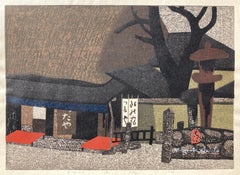
KYOTO (B)
KYOTO (B)

KYOTO (B)

By Kiyoshi Saitō

Located in Santa Monica, CA

KIYOSHI SAITO (Japanese 1907 - 1997) KYOTO (B) 1966 Color woodcut, signed, titled, dated and no. 5/100 in pencil. Edition 100. Image 14 3/4 x 20 5/8 inches. Full margins with deckle...

Category

1960s Modern Art by Medium: Woodcut

Materials

Woodcut, Color

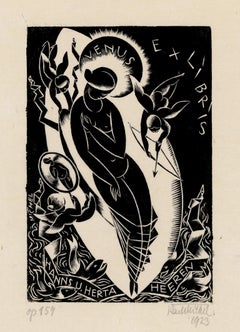
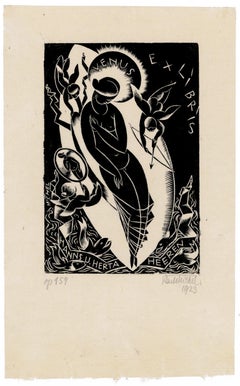
'Venus'  — German Expressionism

'Venus' — German Expressionism

By Karl Michel

Located in Myrtle Beach, SC

Karl Michel, 'Venus, Ex Libris - Hanns U. Herta Heeren', woodcut, 1923, edition not stated but small. Signed, dated, and numbered 'op.154' in pencil. Signed in the block, lower left. A fine impression, on cream Japan paper, with full margins (15/16 to 2 11/16 inches), in good condition. Printed by the artist. Matted to museum standards (unframed). . Translation: Venus Ex Libris for Hanns and Herta Heeren. Image size 5 15/16 x 4 inches (156 x 102 mm); sheet size 9 5/8 x 6 inches (245 x 152 mm). ABOUT THE ARTIST Karl Michel (1889-1984) was a noted graphic designer and expressionist printmaker during Germany's pre-Nazi Weimar Republic (1919-1933). Michel’s work was the subject of a feature article in the influential German graphic design magazine Das Plakat (The Poster) in 1920. An anti-war advocate, Michel created a suite of 12 wood engravings depicting his impressions of the humanitarian toll of WWII entitled ‘Humanitas’ (Humanity). The German publishing house Greifenverlag published the series in a reduced folio of unsigned prints. Michel’s graphic work is held in the permanent collections of the Auckland War Memorial Museum (New Zealand), Frederikshavn Kunstmuseum & Exlibrissamling (Denmark), Museum of Applied Arts (Budapest), The Robert Gore Rifkind Center for German Expressionist Studies at the Los Angeles County Museum of Art, and the German Expressionism...

Category

1920s Expressionist Art by Medium: Woodcut

Materials

Woodcut

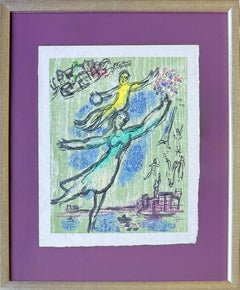
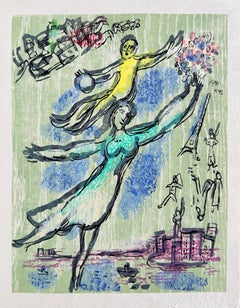
Poèmes, Planche IX, Original Woodcut, 1968, Japon Paper

Poèmes, Planche IX, Original Woodcut, 1968, Japon Paper

By Marc Chagall

Located in OPOLE, PL

Marc Chagall (1887-1985) - Poèmes, Planche IX Woodcut print from 1968. An unnumbered and unsigned impression from the total edition of 238; this impression is on Japon paper, one o...

Category

1960s Modern Art by Medium: Woodcut

Materials

Woodcut

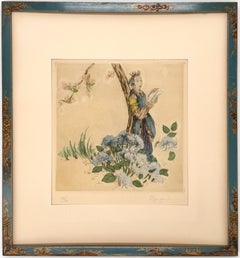
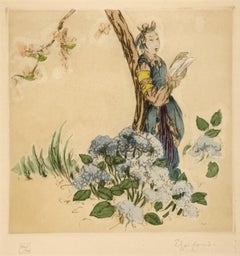
Blue Hydrangea
Blue Hydrangea

Blue Hydrangea

By Elyse Ashe Lord

Located in Middletown, NY

A lively image by a female artist who was part of a vibrant generation of British printmakers who were pushing the boundaries of color and technique during the early 20th century. N...

Category

Early 20th Century English School Art by Medium: Woodcut

Materials

Gouache, Handmade Paper, Drypoint, Woodcut

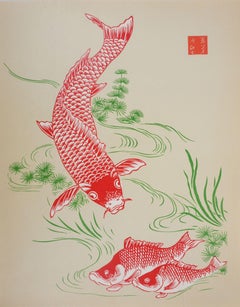
Japanese Print, Koi Carp - Signed Woodcut

Japanese Print, Koi Carp - Signed Woodcut

By Mokuchu URUSHIBARA

Located in Paris, IDF

Mokuchu URUSHIBARA Koi Carp, c. 1930 Woodcut after on an ink drawing Signed with the artist's stamp On paper 30 x 24 cm (c. 11.81 x 9.44 in) INFORMATION : Engraving published by Mo...

Category

1930s Modern Art by Medium: Woodcut

Materials

Woodcut

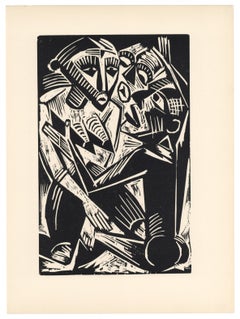
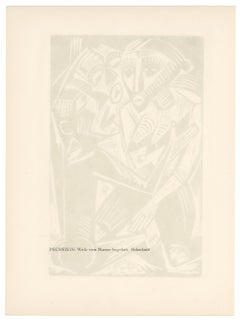
"Woman Desired by Man" original woodcut

"Woman Desired by Man" original woodcut

By Max Pechstein

Located in Henderson, NV

Medium: original woodcut. Printed in 1920 for the Deutsche Graphiker der Gegenwart portfolio, and published in Leipzig by Klinkhardt & Biermann in an edition of 500. Catalogue re...

Category

1920s Expressionist Art by Medium: Woodcut

Materials

Woodcut

Jose Luis Cuevas original artist proof signed woodcut Ghosts of downtown V paper

Jose Luis Cuevas original artist proof signed woodcut Ghosts of downtown V paper

By José Luis Cuevas

Located in Miami, FL

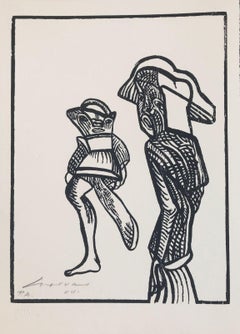
Jose Luis Cuevas (Mexico, 1934-2017) Artist Proof 'Fantasmas del Centro Histórico V', 2004 woodcut on paper Guarro Biblos 250g. 20.9 x 16 in. (53 x 40.5 cm.) Edition of 60 Unframed I...

Category

Early 2000s Contemporary Art by Medium: Woodcut

Materials

Paper, Woodcut, Ink

Wood Cut on Rice Paper "The Cicada Shell (Utsusemi)" by Gekko Ogata

Wood Cut on Rice Paper "The Cicada Shell (Utsusemi)" by Gekko Ogata

Located in Soquel, CA

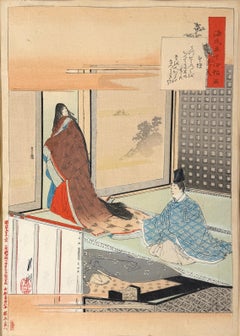
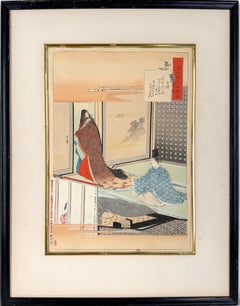
Wood Cut on Rice Paper "The Cicada Shell (Utsusemi)" by Gekko Ogata Woodcut is a striking 1892 woodblock print by Meiji-era master Ogata Gekko (Japanese, 1859–1920). It references T...

Category

Late 19th Century Impressionist Art by Medium: Woodcut

Materials

Printer's Ink, Rice Paper, Woodcut

Famous Japanese woodcut artist Kitagawa Utamaro festival in the Yoshiwara

Famous Japanese woodcut artist Kitagawa Utamaro festival in the Yoshiwara

By Kitagawa Utamaro 1

Located in Fairlawn, OH

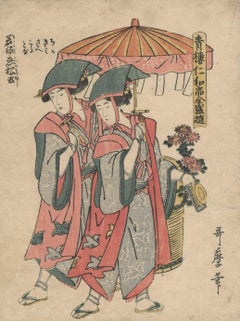
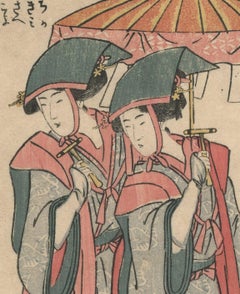
Kitagawa Utamaro (1750-1806) Wakamurasaki, Matsukaze ("Young Murasaki" and "Wind in the Pines.") Color woodcut, c. 1800 Signed in the block, Utamaro fude (see photo) Series: Seirō Niwaka Zensei Asobi ( "Popular Entertainment at the Niwaka Festival, Yoshiwara".) (Green Houses) is a poetic term for the pleasure quarters, specifically the Yoshiwara district."Niwaka" refers to amateur theatrical performances and parades held during the Niwaka festival Format: chuban Fresh colors and condition Housed in an 8 ply rag mat with OP3 Acrylic in a rounded corner Hackman 1" metal leaf frame Image size: 9 x 7 inches Frame size: 14-1/4 x 16-7/8 x 3/4" These are names of chapters from the classic 11th-century novel The Tale of Genji (Genji monogatari). The women in the print are likely performing a parody (mitate) or "modern" version of these classic themes. The print depicts two beauties in elaborate costumes, carrying umbrellas and flowers, typical of the processions held during the Niwaka festival in the Yoshiwara. Kitagawa Utamaro (1750-1806) Kitagawa Utamaro is highly appreciated as the dominating ukiyo-e artist of the late eighteenth century. Yet little is known about his life. Neither the precise date of Utamaro's birth, his birthplace, nor any substantial information about his parents are known. Utamaro’s original name was Ichitaro Kitagawa. It is generally agreed that he started his career as a pupil of the painter Toriyama Sekien. His early known works are actor portraits and theater programs, published under the name of Utagawa Toyoaki. In 1781/82 he changed his name to Kitagawa Utamaro. Around 1783 Utamaro started a successful cooperation with the publisher Tsutaya Juzaburo. Together they published several book illustrations. The early works of Utamaro were influenced by Torii Kiyonaga and Harunobu Suzuki...

Category

Early 1800s Other Art Style Art by Medium: Woodcut

Materials

Woodcut

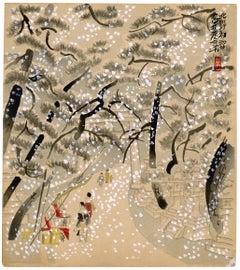
SNOWBOUND

SNOWBOUND

By Frances H. Gearhart

Located in Santa Monica, CA

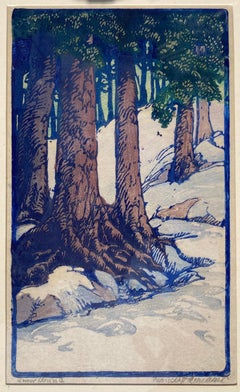
FRANCES H. GEARHART (1869-1958) SNOWBOUND c.1928 Color block print, Signed and titled in pencil. 11 x 6 ½” sheet c. 14 x 9” Laid down on backing board. The usual slight browning a...

Category

1920s American Impressionist Art by Medium: Woodcut

Materials

Color, Linocut, Woodcut

Japanese Artisans - Silk Dying -Japanese Woodblock Print

Japanese Artisans - Silk Dying -Japanese Woodblock Print

By Tosa Mitsuyoshi

Located in Soquel, CA

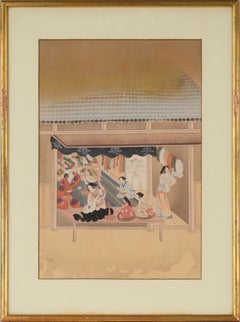
Japanese Artisans - Japanese Woodblock Print J Japanese woodblock depicting six women, all wearing vibrant kimonos, working on crafts by Tosa Mitsuoki (Japanese, 1617-1691). Japanese,c. 1600. Handcraft depiction (dye works).Section from a painted screen with presentations of handcraft.Kita-in, Saitama. Stamped lower left. Presented in a white mat and giltwood frame. Frame: 19"H x 14"W Mat: 18.25"H x 13.25"W Image: 14.5"H x 9.5"W Tosa Mitsuoki was a Japanese painter, reinvigorating the Yamato style of classical Japanese painting. Yamato-e originated from interest in reproducing early Tang dynasty paintings, and was later reinvented and further refined to fit Japanese cultural perceptions in the late Heian period. Yamato, sometimes referred to as wa or kazu had become synonymous with the Tosa-ha by the Muromachi period as a way for Japanese artist to distinguish their works from those of mainland Chinese paintings, kara-e. Yamato-e incorporated various visual and literary techniques for establishing narrative. Works were not always accompanied with text and may rely on heavily on period specific visual motifs, icons, and symbols to relay a story or theme. Tosa style by the time of Mitsuoki focused heavily on depicting themes of plants and nature, famous places, meisho, the four seasons, shik, bird-and-flower, kacho. Many of these popular symbols and icons from mimicking Chinese practices, treating the original Chinese masterwork as a sort of prototype to improve upon. Popular formats for Mitsuoki's pictures were wall scrolls kakemono, or handscrolls that would be read from right to left with the accompanied story, sliding doors fusuma and folding screen panels byobu that featured up to six panels. Mitsuoki's style incorporated the depth and calligraphy techniques of ink wash brushwork similar to Song dynasty and Yuan dynasty Chinese court paintings...

Category

1920s Edo Art by Medium: Woodcut

Materials

Paper, Ink, Woodcut

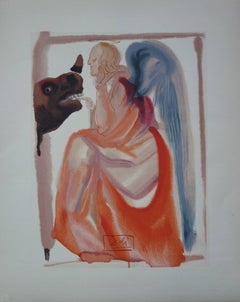
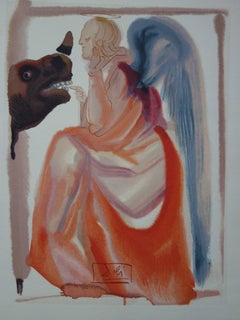
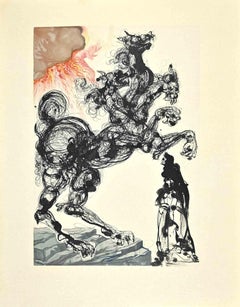
Cerberus - Woodcut print - 1963

Cerberus - Woodcut print - 1963

By Salvador Dalí­

Located in Roma, IT

Cerberus - Hell  plate 6 is a woodcut print realized in 1963 for a series illustrating the Medieval poem of the "Divine Comedy" by Dante Alighieri. Good conditions. Limited editio...

Category

1960s Surrealist Art by Medium: Woodcut

Materials

Woodcut

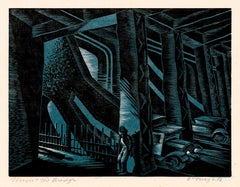
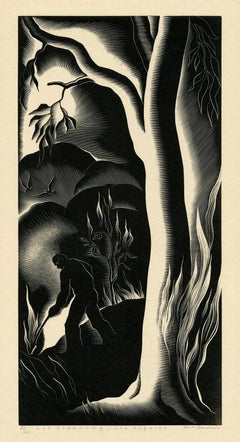
'Lot Cleaning, Los Angeles' — 1930s Modernism

'Lot Cleaning, Los Angeles' — 1930s Modernism

By Paul Landacre

Located in Myrtle Beach, SC

'Lot Cleaning, Los Angeles', wood engraving, edition 60, Zeitlin & Ver Brugge 69. Signed, titled and numbered '51/60' in pencil. A brilliant, black impression, on Kitakata Japan pape...

Category

1930s American Modern Art by Medium: Woodcut

Materials

Woodcut

'The Beach at Kaiganji in Sanuki Province'  — Lifetime Impression

'The Beach at Kaiganji in Sanuki Province' — Lifetime Impression

By Kawase Hasui

Located in Myrtle Beach, SC

Kawase Hasui, 'The Beach at Kaiganji in Sanuki Province (Sanuki Kaiganji no hama),' from the series Collected Views of Japan II, Kansai Edition (Nihon fûkei shû II Kansai hen), woodblock print, 1934. A very fine, atmospheric impression, with fresh colors; the full sheet, in excellent condition. Signed 'Hasui' with the artist’s seal 'Kawase', lower left. Published by Watanabe Shozaburo with the Watanabe ‘D’ seal indicating an early impression printed between 1931 - 1941. Stamped faintly 'Made in Japan' in the bottom center margin, verso. Horizontal ôban; image size 9 3/8 x 14 1/4 inches (238 x 362 mm); sheet size approximately 10 5/16 x 15 1/2 inches ( 262 x 394 mm). Collections: Art Institute of Chicago; Austrian Museum of Applied Arts (Vienna); Honolulu Museum of Art; Museum of Fine Arts, Boston; National Museum in Warsaw; University of Wisconsin-Madison. ABOUT THE ARTIST “I do not paint subjective impressions. My work is based on reality...I can not falsify...(but) I can simplify…I make mental impressions of the light and color at the time of sketching. While coloring the sketch, I am already imagining the effects in a woodblock print.” — Kawase Hasui Hasui Kawase...

Category

1930s Showa Art by Medium: Woodcut

Materials

Woodcut

Composition - Woodcut by Luigi Spacal - 1970s

Composition - Woodcut by Luigi Spacal - 1970s

By Luigi Spacal

Located in Roma, IT

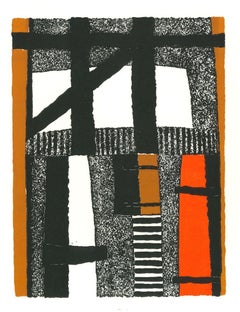
Composition is a contemporary artwork realized by Luigi Spacal (Trieste, 1907 - Trieste, 2000) in the 1970s. Original Colored woodcut print on cardboard. Image Dimensions: 18 x 14 cm Good conditions. Lojze Spacal...

Category

1970s Abstract Art by Medium: Woodcut

Materials

Woodcut

Shunga - Woodcut by Katsukawa Schuncho - Mid-18th Century

Shunga - Woodcut by Katsukawa Schuncho - Mid-18th Century

By Katsukawa Shunshō

Located in Roma, IT

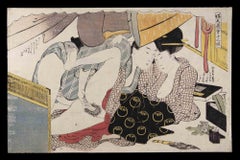
Shunga is an original modern artwork realized by Katsukawa Schuncho (1726 – 1793) in the half of the 18th Century. Erotic scene from the series "Koshuko zue juni ko". A courtesan with a customer under a kimono stand...

Category

Mid-18th Century Modern Art by Medium: Woodcut

Materials

Paper, Woodcut

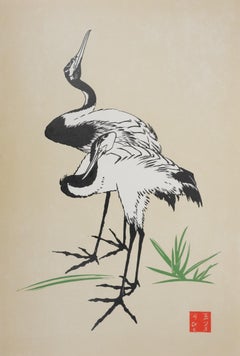
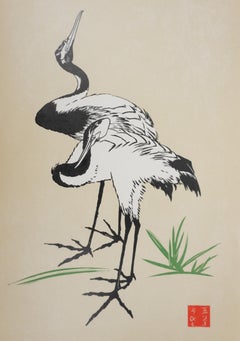
Japanese Print, Herons - Signed Woodcut

Japanese Print, Herons - Signed Woodcut

By Mokuchu URUSHIBARA

Located in Paris, IDF

Mokuchu URUSHIBARA Herons, c. 1930 Woodcut after on an ink drawing Signed with the artist's stamp On paper 32.5 x 22 cm (c. 12.59 x 8.66 in) INFORMATION : Engraving published by Mo...

Category

1930s Modern Art by Medium: Woodcut

Materials

Woodcut

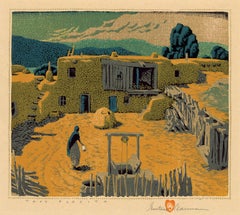
'Taos Placita' — American Southwest Regionalist Masterwork

'Taos Placita' — American Southwest Regionalist Masterwork

By Gustave Baumann

Located in Myrtle Beach, SC

Gustave Baumann, 'Taos Placita', color woodcut, 1947, edition 125. Baumann 132. Signed, titled, and numbered '20-125' in pencil; with the artist’s Hand-in-Heart chop. A superb, richly-inked impression, with fresh colors, on fibrous oatmeal wove paper; the full sheet with margins (2 to 3 1/8 inches); slight rippling at the left sheet edge, in excellent condition. Matted to museum standards, unframed. Image size 9 5/8 x 11 1/4 inches (244 x 286 mm); sheet size 13 1/4 x 17 inches (337 x 432 mm). Collections: Harwood Museum of Art, New Mexico Museum of Art, Phoenix Art Museum, Scottsdale Art Museum, Wichita Art Museum. ABOUT THE ARTIST Gustave Baumann (1881-1971) was a renowned printmaker and a leading figure of the American color woodcut revival whose exquisite craftsmanship and vibrant imagery captured the essence of the Southwest. "A brilliant printmaker, Baumann brought to the medium a full mastery of the craft of woodworking that he acquired from his father, a German cabinetmaker. This craftsmanship was coupled with a strong artistic training that resulted in the handsome objects we see in the exhibition today. After discovering New Mexico in 1918, Baumann began to explore in his woodblock prints of this period the light. color, and architectural forms of that landscape. His prints of this period are among the most beautiful and poetic images of the American West." —Lewis I. Sharp, Director, Denver Art Museum Baumann, the son of a craftsman, immigrated to the United States from Germany with his family when he was ten, settling in Chicago. From 1897 to 1904, he studied in the evenings at the Art Institute of Chicago, working in a commercial printmaking shop during the day. In 1905, he returned to Germany to attend the Kunstwerbe Schule in Munich, where he decided on a career in printmaking. He returned to Chicago in 1906 and worked for a few years as a graphic designer of labels. Baumann made his first prints in 1909 and exhibited them at the Art Institute of Chicago the following year. In 1910, he moved to the artists’ colony in Nashville, Indiana, where he explored the creative and commercial possibilities of a career as a printmaker. In 1915, he exhibited his color woodcuts at the Panama-Pacific International Exposition in San Francisco, winning the gold medal. Among Baumann’s ongoing commercial activities was his work for the Packard Motor Car Company from 1914 to 1920 where he produced designs, illustrations, and color woodcuts until 1923. In 1919, Baumann’s printmaking work dominated the important exhibition of American color woodcuts at the Detroit Institute of Arts. Twenty-six of his prints were included, far more than the works of any other artist. A set of his blocks, a preparatory drawing, and seven progressive proofs complemented the exhibition. That same year, Baumann worked in New York and, over the summer, in Provincetown, Massachusetts. His airy images of Cape Cod employed soft, pastel colors and occasionally showed the influence of the white-line woodcut technique. Many of his Chicago artist friends had traveled to the southwest, and Baumann became intrigued by their paintings, souvenirs, and stories of an exotic place named Taos, New Mexico. In the summer of 1918, he spent the summer in Taos sketching and painting before visiting Santa Fe. Paul Walter, the director of the Museum of New Mexico, offered him a studio in the museum's basement. Inspired by the rugged beauty of the Southwest—the vibrant colors and dramatic landscapes of the region became a central theme in his work, influencing his artistic style and subject matter for the remainder of his career. Later in the decade, he traveled to the West Coast and made prints of California landscape. Baumann's prints became synonymous with the Southwest, capturing the spirit of its place in America's identity with a unique sense of authenticity and reverence. His iconic images of desert vistas, pueblo villages, and indigenous cultures served as visual tributes to the region's rich cultural heritage, earning him a dedicated following among collectors and curators alike. A true craftsman and artist, Baumann completed every step of the printmaking process himself, cutting each block, mixing the inks, and printing every impression on the handmade paper he selected. His dedication to true craftsmanship and his commitment to preserving the integrity of his artistic vision earned him widespread acclaim and recognition within the art world. About the vibrant colors he produced, Baumann stated, “A knowledge of color needs to be acquired since they don’t all behave the same way when ground or mixed...careful chemistry goes into the making of colors, with meticulous testing for permanence. While complicated formulae evolve new colors, those derived from Earth and metal bases are still the most reliable.” In the 1930s, Baumann became interested in puppet theater. He designed and carved his own marionettes and established a little traveling company. From 1943 to 1945, the artist carved an altarpiece for the Episcopal Church of the Holy Faith in Santa Fe. In 1952, a retrospective exhibition of his prints was mounted at the New Mexico Museum of Fine Arts. Throughout his prolific career, Baumann executed nearly four hundred color woodcuts. Baumann’s woodcuts...

Category

1940s American Modern Art by Medium: Woodcut
Materials

Woodcut

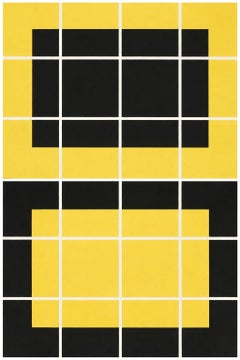
Donald Judd -- Untitled (Schellmann 265/266)

Donald Judd -- Untitled (Schellmann 265/266)

By Donald Judd

Located in BRUCE, ACT

Donald Judd Untitled (Schellmann 265/266), 1992-1993 Woodcut on Japanese Echizen Kozo paper Signed and numbered to verso: 1/30 Judd (concealed) Sheet size 59 x 79cm Frame size 65 x 8...

Category

1990s Art by Medium: Woodcut

Materials

Woodcut

Japanese Print, Horse Bowing - Signed Woodcut

Japanese Print, Horse Bowing - Signed Woodcut

By Mokuchu URUSHIBARA

Located in Paris, IDF

Mokuchu URUSHIBARA Horse bowing, c. 1930 Woodcut after on an ink drawing Signed with the artist's stamp On paper 26 x 35 cm (c. 10.2 x 13.7 in) INFORMATION : Engraving published by...

Category

1930s Modern Art by Medium: Woodcut
Materials

Woodcut

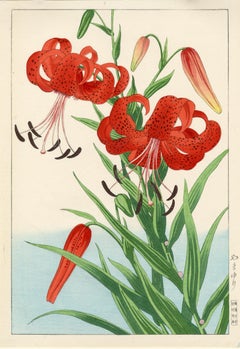
Tiger Lily
Tiger Lily

Tiger Lily

By Nishimura Hodo

Located in Fairlawn, OH

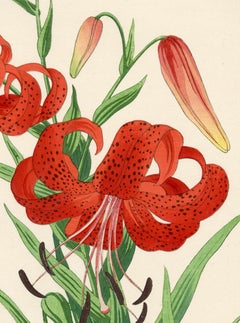
Tiger Lily Color woodcut, 1939 Unsigned (as usual) Publisher: Takemura Hideo (active Yokohama 1926-1940) Condition: Excellent Image/sheet size: 15 3/8 x 10 7/8 inches Provenance: Robert O. Muller Estate Biography Hodo Nishimura...

Category

1930s Modern Art by Medium: Woodcut
Materials

Woodcut
Woodcut art for sale on 1stDibs.
Find a wide variety of authentic Woodcut art available on 1stDibs. While artists have worked in this medium across a range of time periods, art made with this material during the 21st Century is especially popular. If you’re looking to add art created with this material to introduce a provocative pop of color and texture to an otherwise neutral space in your home, the works available on 1stDibs include elements of orange, yellow, purple, blue and other colors. There are many well-known artists whose body of work includes ceramic sculptures. Popular artists on 1stDibs associated with pieces like this include Mino Maccari, Utagawa Kunisada (Toyokuni III), Eric Gill, and Utagawa Hiroshige. Frequently made by artists working in the Modern, Contemporary, all of these pieces for sale are unique and many will draw the attention of guests in your home. Not every interior allows for large Woodcut art, so small editions measuring 0.04 inches across are also available