Located in Edinburgh, Scotland
Henry Wigstead (1760-1800)
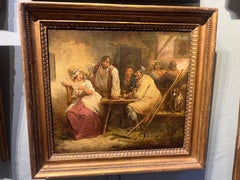
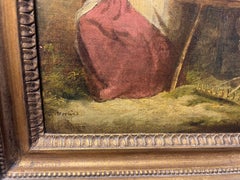
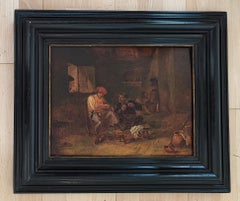
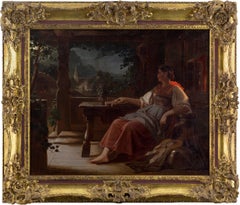
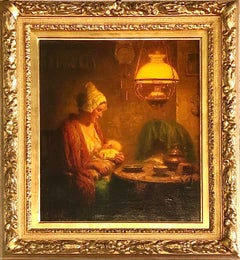
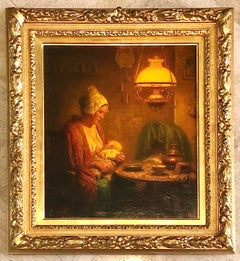
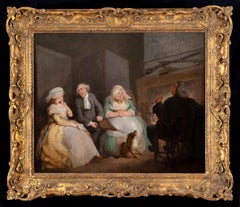
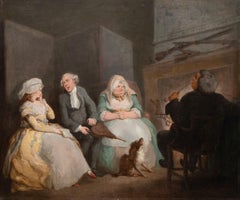
The Country Vicar’s Fireside, c. 1786
Oil on canvas
In a period carved and gilded swept frame
63.5 x 76.1 cm.; (within frame) 81 x 93.8 cm.
Provenance:
Christie’s, King Street, where consigned on 20 March 1957; 3 May 1957, lot 81, as William Hogarth, ‘Figures before a fireplace’;
Private Collection, United States;
Sotheby’s, New York, Old Master & 19th Century European Art, 27 January 2012, lot 486;
Private Collection, United Kingdom.
Exhibition history:
The Royal Academy, London, 1786, no. 59
Literature:
Algernon Graves, The Royal Academy of Arts: A Complete Dictionary of Contributors and Their Work from Its Foundation in 1769 to 1904, 8 vols. (London: H. Graves and Company Ltd., 1905), p. 265
George Paston, Social Caricature in the Eighteenth Century (London: Methuen & Co., 1906), p. 137
The Royal Academy, The Exhibition of the Royal Academy of Arts, M.DCC.LXXXVI, The Eighteenth (London: T. Cadell, 1786), p. 4
Exhibited at the Royal Academy of 1786 and likely produced that same year, The Country Vicar’s Fireside is an exceedingly rare work in oil by the British caricaturist Henry Wigstead, belonging to the considerably small body of paintings produced by the artist, of which few remain. The work was conceived during the height of British caricature, culminating between the American Revolution and Waterloo, and typifies Wigstead’s ‘great feeling for ridiculous contrasts and the droll side of human relationships’, being a talented exponent of the art of ridicule that was satire (Old Print Shop, p. 223). The painting was engraved by E. Wilkins in 1788, though alterations in reproduction diverted from the original scheme: for example, whereas the Wilkins print shows a ‘Plan of the Parish of Barn’ over the hearth, Wigstead’s oil identifies it as that of Wakefield – an allusion to the 1766 novel, The Vicar of Wakefield. The work was until recently unknown, and was previously misattributed to the towering William Hogarth. It thus represents an important addition to the sparing oeuvre of an artist who, further to being a magistrate, publisher, and businessman, enjoyed royal patronage and friendships with the leading caricaturists, which placed him at the centre of London’s effervescent satire market.
A considered description of The Country Vicar’s Fireside is given by the literary critic George Paston (Emily Morse Symonds) in her 1906 commentary on 18th century caricature, who regards it as a fine example of Wigstead’s gentler mode of social satire. Paston writes, ‘In front of a roaring fire sits...
Category
Old Masters Late 18th Century Interior Paintings