Engraving Still-life Prints

to
22
211
89
55
8
2
Overall Width
to
Overall Height
to
69
35
23
14
5
4
3
2
2
1
1
1
33
14
14
12
12
111
77
126
51
1
1
2
3
1
3
5
24
31
26
93
270
89
6
129
84
70
56
41
40
37
36
34
32
29
17
15
15
13
12
12
12
11
11
1,307
972
620
610
74
71
286
38
Medium: Engraving
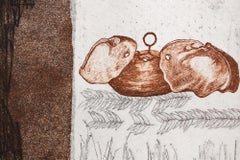
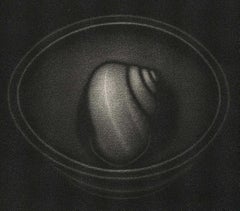
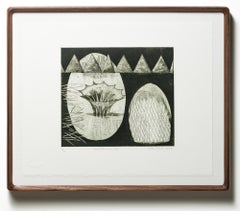
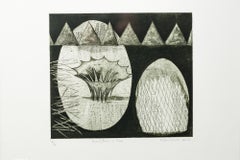
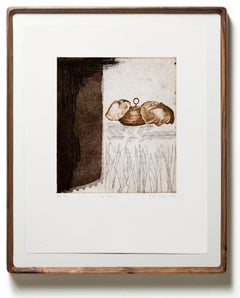
"La Mer VE 3/8" Intaglio, hand colored, seashell motif

"La Mer VE 3/8" Intaglio, hand colored, seashell motif

By Katie VanVliet

Located in Philadelphia, PA

This piece titled "La Mer VE 3/8" is a variable edition piece by Kate VanVliet and is made from two-plate intaglio with drypoint, aquatint, and soft ground on Rives BFK. This piece i...

Category

21st Century and Contemporary Contemporary Engraving Still-life Prints

Materials

Archival Paper, Color, Drypoint, Etching, Aquatint, Intaglio

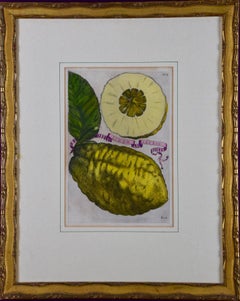
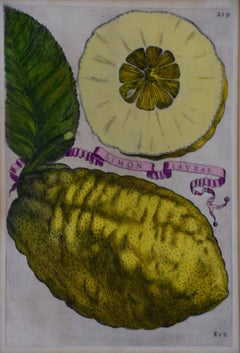
Limon Lavrae: A 17th C. Hand-colored Engraving of Lemon Anatomy by G. Ferrari

Limon Lavrae: A 17th C. Hand-colored Engraving of Lemon Anatomy by G. Ferrari

By Giovanni Battista Ferrari

Located in Alamo, CA

This 17th century hand-colored engraving of a lemon entitled "Limon Lavrae", plate 219 from Giovanni Baptista Ferrari's publication "Hesperides, sive, De Malorum Aureorum Cultura Etu...

Category

17th Century Old Masters Engraving Still-life Prints

Materials

Engraving

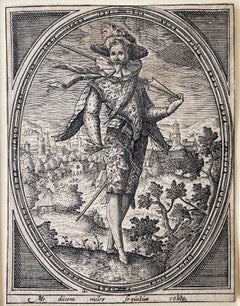
Jean Racine Portrait: 17th C. Engraving by Edelinck in Perrault's Les Hommes

Jean Racine Portrait: 17th C. Engraving by Edelinck in Perrault's Les Hommes

By Gerard Edelinck

Located in Alamo, CA

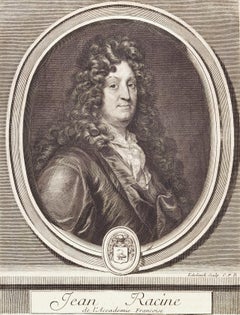
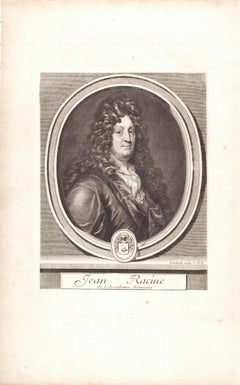
This is a 17th century portrait engraving of Jean-Baptiste Racine by Gerard Edelinck (1640-1707), published in Charles Perrault's 'Les Hommes Illustres' in Paris in 1696. Jean Racine (1639-1699) was a French dramatist, one of the three great playwrights of 17th-century France, along with Molière and Corneille. Racine's works were primarily tragedies. He wrote Phèdre, Andromaque, and Athalie. He did write one comedy, Les Plaideurs, and a muted tragedy, Esther for young readers. His writing is renowned for its elegance, purity, speed, and fury. The American poet Robert Lowell described his style as a "diamond-edge" and the "glory of its hard, electric rage". Racine's works often displayed his psychological insight, the passion of his characters, and the stark reality of his plots and stage descriptions. In 1672, he was elected to the Académie Française, and two years later he achieved the title of "treasurer of France", and later the honorary title of an "ordinary gentleman of the king" to King Louis XIV, and subsequently a secretary of the king . This beautiful engraved portrait is printed on chain-linked, laid paper with wide margins. The sheet measures 17.13" high by 10.75" wide. There is a small spot in the lower margin and a few tiny faint spots in the margins, but the print is otherwise in very good condition. The original descriptive text pages, 81 & 82, are included. Provenance: This engraving was owned by Arthur Pomeroy, 1st Baron Harberton and the Viscount Harberton (1723-1798). He was an Irish politician, who represented County Kildare in the Irish House...

Category

Late 17th Century Old Masters Engraving Still-life Prints

Materials

Engraving

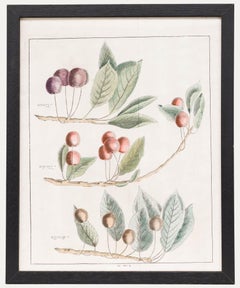
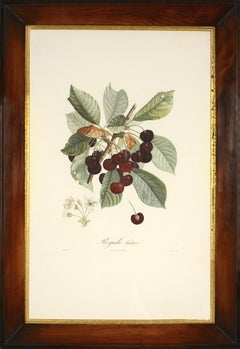
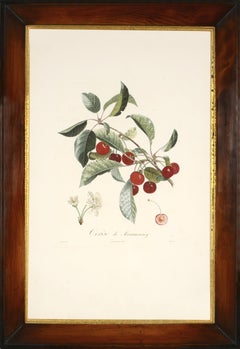
POITEAU/ TURPIN. Traité des arbres fruitiers: A Set of Four Cherries.

POITEAU/ TURPIN. Traité des arbres fruitiers: A Set of Four Cherries.

Located in London, London

A set of four stipple-engraved plates printed in colours and finished by hand. Four plates from 'One of the finest and rarest books on fruit' (Dunthorne p.192). This series takes it...

Category

Early 1800s Naturalistic Engraving Still-life Prints

Materials

Color, Engraving, Handmade Paper

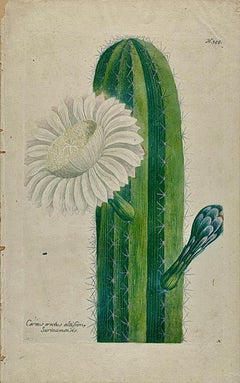
A Flowering Cactus Plant: 18th C. Hand-colored Botanical Engraving by Weinmann

A Flowering Cactus Plant: 18th C. Hand-colored Botanical Engraving by Weinmann

By Johann Wilhelm Weinmann

Located in Alamo, CA

This hand-colored botanical mezzotint and line engraving by Johann Wilhelm Weinmann (1683-1741) is entitled "Cereus Erectus Altissimo Surinamensis (Cereus Cactus Plant)". It is plate...

Category

Mid-18th Century Naturalistic Engraving Still-life Prints

Materials

Engraving, Mezzotint

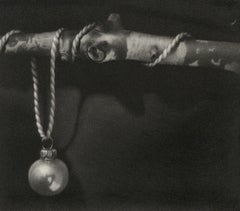
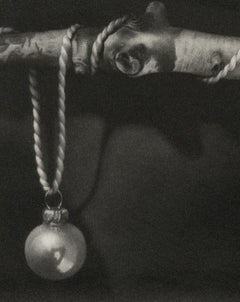
Bambalina (Are ornaments, decorations mere backdrop for true Christmas story)

Bambalina (Are ornaments, decorations mere backdrop for true Christmas story)

By Francisco Souto

Located in New Orleans, LA

Souto named this image Bambalina (backstage). It is an exclusive publication of Stone and Press Gallery. Francisco Souto was born in Venezuela. He received a BFA from Herron Schoo...

Category

21st Century and Contemporary American Modern Engraving Still-life Prints

Materials

Mezzotint

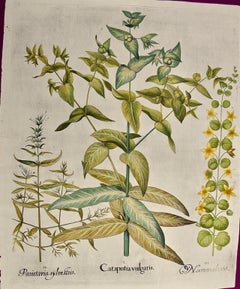
Chamomile & Safflower: A 17th-18th C. Besler Hand-colored Botanical Engraving

Chamomile & Safflower: A 17th-18th C. Besler Hand-colored Botanical Engraving

By Basilius Besler 1

Located in Alamo, CA

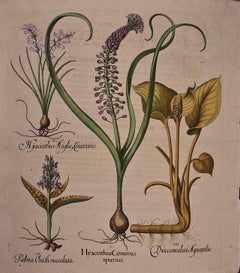
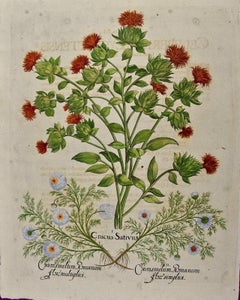
This is a hand-colored copper plate engraving entitled "Chamemelum Romanum flore simplici (Chamomile), Cincus Sativus (False saffron, Safflower), Chamaemelum Romanum Flore (Roman Chamomile)", depicting flowering Chamomile, Safflower and Roman Chamomile plants respectively from Basilius Besler's landmark work, Hortus Eystettensis (Garden at Eichstatt), first published in 1613 in Eichstatt, Germany near Nuremberg and later in 1640 and 1713. This beautiful colorful engraving is printed on thin laid chain-linked paper with wide margins. There are a few small spots and some irregularity of the lower edge. There is some bleed-through of text from the verso. The print is otherwise in excellent condition with striking hand-coloring. The sheet measures 22.25" high and 17.38" wide. Basilius Besler (1561–1629) was an apothecary and botanist. He was curator of the Willibaldsburg Castle garden of Johann Konrad von Gemmingen, prince bishop...

Category

Early 18th Century Academic Engraving Still-life Prints

Materials

Engraving

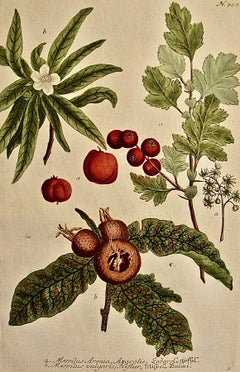
Flowering Medlar Tree: An 18th C. Hand-colored Botanical Engraving by Weinmann

Flowering Medlar Tree: An 18th C. Hand-colored Botanical Engraving by Weinmann

By Johann Wilhelm Weinmann

Located in Alamo, CA

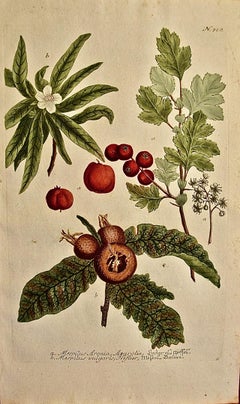
This hand-colored botanical mezzotint and line engraving by Johann Wilhelm Weinmann (1683-1741) is entitled "A. Mespilus Aronia Azarolie B. Mespilus Vulgaris Neflier". It is plate 7...

Category

Mid-18th Century Naturalistic Engraving Still-life Prints

Materials

Engraving, Mezzotint

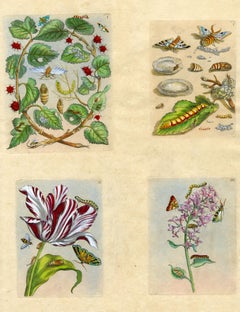
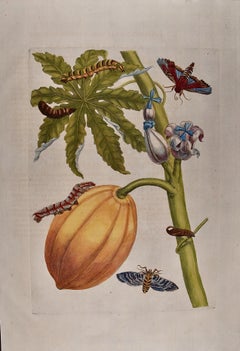
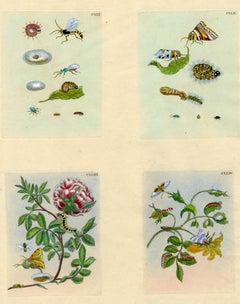
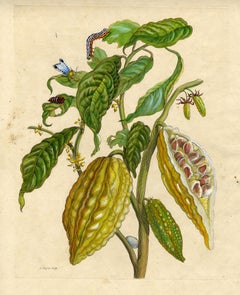
4 plates from The Wondrous Transformation of Caterpillars & their Strange Diet..

4 plates from The Wondrous Transformation of Caterpillars & their Strange Diet..

By Maria Sibylla Merian

Located in Middletown, NY

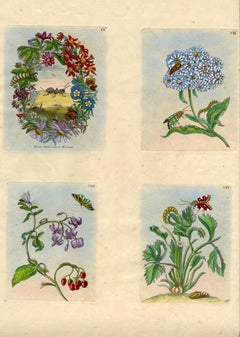
Four plates from The Wondrous Transformation of Caterpillars and their Strange Diet of Flowers. “Wolfsmelk Rupsen;" “Wolfsmilch, Raupe und Schmetterling" Amsterdam: J F Bernard, 1730. Each an engraving with hand coloring in watercolor and gouache printed on one sheet of watermarked Honig cream laid paper, each measures 6 1/4 x 5 inches (157 x 121 mm), sheet measures 20 5/8 x 14 inches (522 x 355 mm), full margins. With handling creases in the lower right sheet quadrant, as well as minor, loose cockling, otherwise in very good condition. The colors are superb with exceptionally fresh and bright saturation. Engraved between 1679 and 1683, printed 1730. Plates included: CI; CII; CIII & CIV. MARIA SIBYLLA MERIAN was one of the most highly respected entomologists of the 17th century, and remains today one of the field's most significant figures. A German-born naturalist and scientific illustrator, she reared herself on the study of caterpillars, and made tremendous contributions to the knowledge of the life cycles of numerous species. Until her detailed and careful study of the process of metamorphosis it was thought that insects were "born of mud," through spontaneous generation. Trained as a miniature painter by her stepfather, she published her first book of illustrations in 1675, at the age of 28. In 1679, Merian published the first volume of the two-volume series on caterpillars, The Wondrous Transformation of Caterpillars and their Strange Diet of Flowers; the second volume followed in 1683. Each volume contained 50 plates that she engraved and etched. In 1699, Merian traveled to Dutch Guiana...

Category

Early 18th Century Naturalistic Engraving Still-life Prints

Materials

Watercolor, Engraving

4 plates from The Wondrous Transformation of Caterpillars & their Strange Diet..

4 plates from The Wondrous Transformation of Caterpillars & their Strange Diet..

By Maria Sibylla Merian

Located in Middletown, NY

Four plates from The Wondrous Transformation of Caterpillars and their Strange Diet of Flowers. “Wolfsmelk Rupsen;" “Wolfsmilch, Raupe und Schmetterling" Amsterdam: J F Bernard, 1730. Each an engraving with hand coloring in watercolor and gouache printed on one sheet of watermarked Honig cream laid paper, each measures 6 1/4 x 5 inches (157 x 121 mm), sheet measures 20 5/8 x 14 inches (522 x 355 mm), full margins. With handling creases in the lower right sheet quadrant, as well as minor, loose cockling, otherwise in very good condition. The colors are superb with exceptionally fresh and bright saturation. Engraved between 1679 and 1683, printed 1730. Plates included: No.1:I; No. 2:1; II & III. MARIA SIBYLLA MERIAN was one of the most highly respected entomologists of the 17th century, and remains today one of the field's most significant figures. A German-born naturalist and scientific illustrator, she reared herself on the study of caterpillars, and made tremendous contributions to the knowledge of the life cycles of numerous species. Until her detailed and careful study of the process of metamorphosis it was thought that insects were "born of mud," through spontaneous generation. Trained as a miniature painter by her stepfather, she published her first book of illustrations in 1675, at the age of 28. In 1679, Merian published the first volume of the two-volume series on caterpillars, The Wondrous Transformation of Caterpillars and their Strange Diet of Flowers; the second volume followed in 1683. Each volume contained 50 plates that she engraved and etched. In 1699, Merian traveled to Dutch Guiana...

Category

Early 18th Century Naturalistic Engraving Still-life Prints

Materials

Watercolor, Engraving

Pair of Hand-colored Romantic French Engravings after Francois Boucher

Pair of Hand-colored Romantic French Engravings after Francois Boucher

By (After) Francois Boucher

Located in Alamo, CA

A pair of French classical romantic prints original created in the 18th century by Jacques-Firmin Beauvarlet (1731-1797) after paintings by Francois Boucher (1703-1770), utilizing ...

Category

18th Century Romantic Engraving Still-life Prints

Materials

Engraving, Etching

16th Century Engraving - Gentiana

16th Century Engraving - Gentiana

Located in Corsham, GB

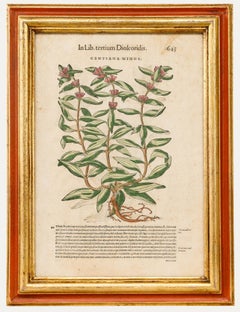
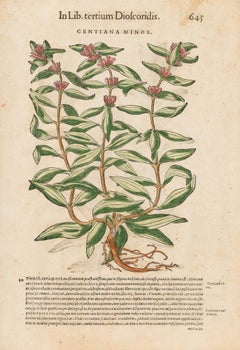
A delicate 16th century, hand-coloured botanical print depicting Gentiana Minor. Unsigned. Beautifully presented in a distressed gilt frame. On laid. Image size: 34 x 23cm.

Category

16th Century Engraving Still-life Prints

Materials

Engraving

SITUATION
SITUATION

SITUATION

By Katsunori Hamanishi

Located in Santa Monica, CA

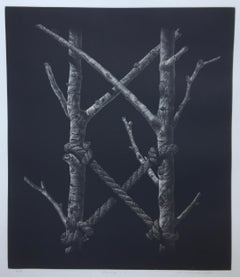
KATSUNORI HAMANISHI (b.1949) SITUATION X (S. 32) Mezzotint Signed, titled and numbered 6/90 in pencil. 13 1/4 x 11 5/8 inches, sheet 18 1/4 x 14 1/2 inches. Excellent condition. She...

Category

1980s Realist Engraving Still-life Prints

Materials

Mezzotint

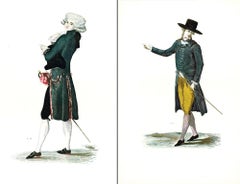
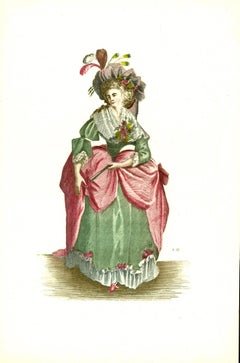
Eight 18th century-era fashion plates from the portfolio Modes, by M. Connat

Eight 18th century-era fashion plates from the portfolio Modes, by M. Connat

Located in Middletown, NY

Eight 18th century-era fashion plates from the portfolio Modes, by Madeleine Connat. Paris: Paris Etching Society, 1951. Each an engraving with hand coloring in watercolor on cream ...

Category

18th Century French School Engraving Still-life Prints

Materials

Watercolor, Engraving

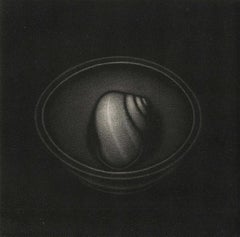
Snail in a Bowl (Artist Proof inscribed to Fritz Eichenberg)

Snail in a Bowl (Artist Proof inscribed to Fritz Eichenberg)

Located in New Orleans, LA

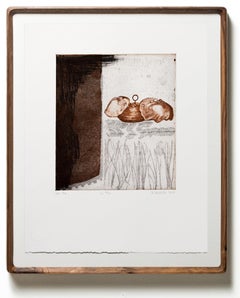
Leonard Merchant's mezzotint, "Snail in Cup" is inscribed for fellow artist, Fritz Eichenberg. While a student at the Central School for Arts and Crafts in London, a young Leonard Marchant found an engraving rocker in a cupboard and proceeded to turn himself into a master of the painstaking art of mezzotinting. Marchant, who has died in Shrewsbury aged 70, grew up in Simonstown, the Royal Navy's enclave in South Africa. Though his first job was as a parliamentary messenger, he taught himself to paint and, aged 19, was given a one-man show in Cape Town. Fired by this success, he left for England to study painting and, he claimed, to escape the stifling home atmosphere created by his Catholic mother and aunts. (His father was killed in the second world war.) Without contacts in London, he phoned Jacob Epstein, whose recommendation resulted in a grant to study briefly at the Central School. It was later, when studying full-time at the Central, that he saw the mezzotints of the Japanese master, Yozo Hamaguchi, in a London gallery. He was hooked. Creating a mezzotint is tedious in the extreme. The copper plate must first be prepared with a "rocker" which roughens the surface. A plate may be "rocked" 30 or 40 times. The rough texture is then reduced with a burnisher and a scraper, allowing the print a range of tones from velvety black through the greys to white. Marchant's plates could be months in the making. But the technical demands were the least of his worries. In its 18th- and 19th-century heyday, mezzotint was solely a reproductive medium, for copying masters such as Reynolds and Turner. The development of photography rendered it unfashionable, and by the 1960s the technique, known as la manière anglaise, was a bygone medium. Marchant, by now a teacher in printmaking at the Central, began to create original mezzotints with a colleague, Radavan Kraguly. A perfectionist, he seemed to revel in the straitjacket procedure. Perhaps it was the metaphor of bringing darkness out of light that appealed to this straight-talking, sometimes sombre, man, who would suddenly relax and light up like a gleaming hue on one of his prints. His work was of squares and triangles with the occasional cat, black and ominous, and carefully arranged still lifes, featuring plants, a seed pod, a pot he might have bought at auction to celebrate the sale of a print. There were one-man shows, notably at the Bankside Gallery. He sold well at the Royal Academy summer exhibition, was a Florence Biennale prizewinner, spent a fellowship year at the British School in Rome, and was elected a Fellow of the Royal Society of Painter-Printmakers. But making mezzotints was not a paying job. Marchant and his South African wife...

Category

1980s Modern Engraving Still-life Prints
Materials

Mezzotint

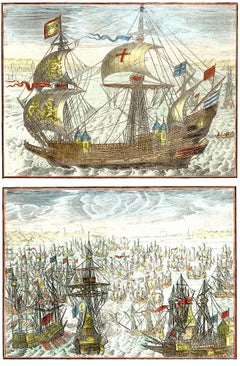
Two naval images depicting 17th century warships

Two naval images depicting 17th century warships

Located in Middletown, NY

French School 20th century Two naval images depicting 17th century warships flying various flags, including the Plantagenet Lions and St. George's Cross. (2) c1950. Two engravings w...

Category

20th Century French School Engraving Still-life Prints
Materials

Watercolor, Engraving

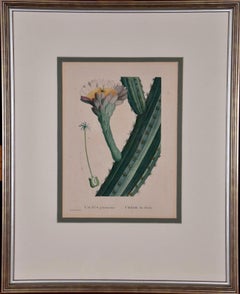
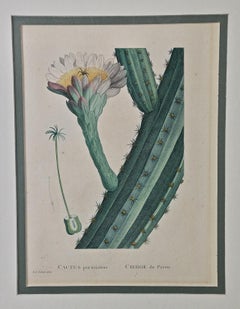
Flowering Cactus: A Framed 18th C. Hand-colored Engraving by Redoute

Flowering Cactus: A Framed 18th C. Hand-colored Engraving by Redoute

By Pierre-Joseph Redouté

Located in Alamo, CA

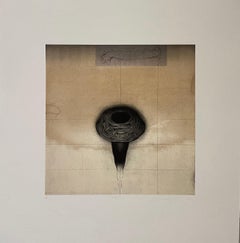
This framed hand-colored stipple engraving entitled "Cactus Peruvianus Cierge du Pérou" by Pierre-Joseph Redouté, Plate 58 from his illustrated publication 'Plantarum Historia Succulentarum ou Histoire des Plantes Grasses', published in Paris in 1799. It depicts a branching limb of a cactus with a beautiful flower. There is a separate detail of the anatomy of a seed with early growth. Redoute was a pioneer of the stipple engraving technique, which he used to create this image. It involves utilizing a series of small dots worked into a copper plate rather than the more common lines. These dots can be made smaller or thicker depending on the degree of opacity the artist intends for various areas of the print. When inked and applied to paper, this allows for a greater portion of the paper to be seen, which accentuates the appearance of luminosity of the subject the artist is creating. Different color inks are used in the printing process, a time consuming technique known as "a la poupee". The engraving is then finished with watercolor to further enhance the beauty and realism of the print subject. This engraving of a flowering cactus is presented in silver-colored ribbed wood frame and a double mat; cream-colored outer mat and heather green inner mat. The frame measures 21.25" high by 17.25" wide by 1.13" deep. The sheet measures 19.88" high by 14" wide. There are wide margins with a few short tears and chips along the the left, right and upper edges, which are all covered by the mat. There are small spots predominantly in the margins, with a few present in the image area. The print is otherwise in very good condition. There is another Redoute flowering cactus listed on 1stdibs, LU117326853392, which is framed and matted identically to this one. The pair would make an attractive display grouping. Pierre-Joseph Redouté (1759-1840), was a painter and botanist originally from Belgium, who pursued his extremely successful artistic career in France. He is well known for his watercolor paintings of roses, lilies and other flowers and their subsequent folio-sized, color stipple engravings. Some believe him to be the greatest botanical illustrator of all time. Redouté was a favorite of the French royal court at the time and of the post French...

Category

Late 18th Century Naturalistic Engraving Still-life Prints
Materials

Engraving

Besler Hand Colored Botanical Engraving of Wood Pink & Cottage Pink Flowers

Besler Hand Colored Botanical Engraving of Wood Pink & Cottage Pink Flowers

By Basilius Besler 1

Located in Alamo, CA

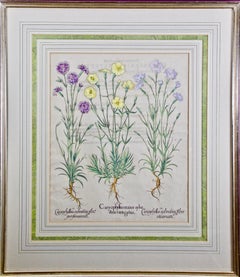
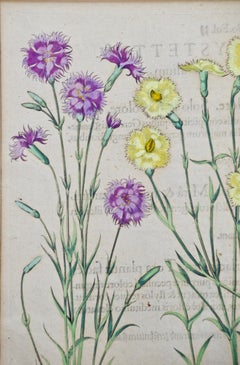
A 17th century hand-colored copper plate engraving entitled "Caryophyllus Maior Sylve Strisvarie Gatus" (Wood Pink & Cottage Pink Flowers) from Basilius Besler's landmark work, Hortus Eystettensis (Garden at Eichstatt), first published in 1613 in Eichstatt, Germany near Nuremberg and later in 1640 and 1713. This engraving is presented in a silver and gold-colored wood frame with a green edge and three elaborate cream-colored French mats...

Category

17th Century Old Masters Engraving Still-life Prints
Materials

Engraving

Iris Lurida. Iris Brune.

Iris Lurida. Iris Brune.

By Pierre-Joseph Redouté

Located in London, London

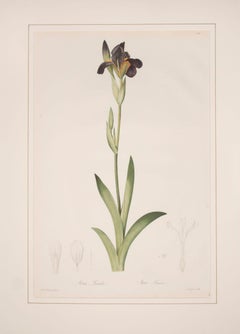
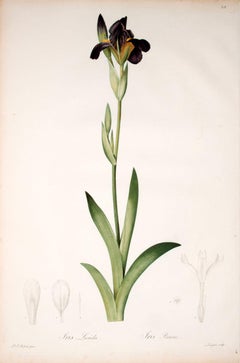
REDOUTE, Pierre-Joseph. Iris Lurida. Iris Brune. Paris, Chez L’Auteur, 1802-16 The highest peak of Redoute's artistic and botanical achievement... Among the most important monum...

Category

Mid-19th Century Naturalistic Engraving Still-life Prints
Materials

Paper, Engraving

4 plates from The Wondrous Transformation of Caterpillars & their Strange Diet..

4 plates from The Wondrous Transformation of Caterpillars & their Strange Diet..

By Maria Sibylla Merian

Located in Middletown, NY

Four plates from The Wondrous Transformation of Caterpillars and their Strange Diet of Flowers. “Wolfsmelk Rupsen;" “Wolfsmilch, Raupe und Schmetterling" Amsterdam: JF Bernard, 1730. Each an engraving with hand coloring in watercolor and gouache printed on one sheet of watermarked Honig cream laid paper, each measures 6 1/4 x 5 inches (157 x 121 mm), sheet measures 20 5/8 x 14 inches (522 x 355 mm), full margins. With handling creases in the lower right sheet quadrant, as well as minor, loose cockling, otherwise in very good condition. The colors are superb with exceptionally fresh and bright saturation. Engraved between 1679 and 1683, printed 1730. Plates included: CXLI, CXLII, CXIII & CXLIV. MARIA SIBYLLA MERIAN was one of the most highly respected entomologists of the 17th century, and remains today one of the field's most significant figures. A German-born naturalist and scientific illustrator, she reared herself on the study of caterpillars, and made tremendous contributions to the knowledge of the life cycles of numerous species. Until her detailed and careful study of the process of metamorphosis it was thought that insects were "born of mud," through spontaneous generation. Trained as a miniature painter by her stepfather, she published her first book of illustrations in 1675, at the age of 28. In 1679, Merian published the first volume of the two-volume series on caterpillars, The Wondrous Transformation of Caterpillars and their Strange Diet of Flowers; the second volume followed in 1683. Each volume contained 50 plates that she engraved and etched. In 1699, Merian traveled to Dutch Guiana...

Category

Early 18th Century Naturalistic Engraving Still-life Prints
Materials

Watercolor, Engraving

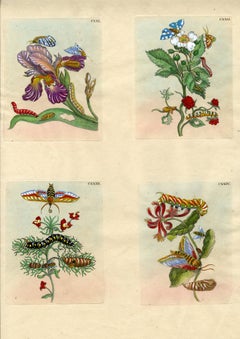
4 plates from The Wondrous Transformation of Caterpillars & their Strange Diet..

4 plates from The Wondrous Transformation of Caterpillars & their Strange Diet..

By Maria Sibylla Merian

Located in Middletown, NY

Four plates from The Wondrous Transformation of Caterpillars and their Strange Diet of Flowers. “Wolfsmelk Rupsen;" “Wolfsmilch, Raupe und Schmetterling" Amsterdam: J F Bernard, 1730. Each an engraving with hand coloring in watercolor and gouache printed on one sheet of watermarked Honig cream laid paper, each measures 6 1/4 x 5 inches (157 x 121 mm), sheet measures 20 5/8 x 14 inches (522 x 355 mm), full margins. With one 1.5 inch inch tear across the area of the top-left corner, well outside of image area. Handling creases in the lower right sheet quadrant, as well as minor, loose cockling, otherwise in very good condition. The colors are superb with exceptionally fresh and bright saturation. Engraved between 1679 and 1683, printed 1730. Plates included: CXXI, CXXII, CXXIII, & CXXIV. MARIA SIBYLLA MERIAN was one of the most highly respected entomologists of the 17th century, and remains today one of the field's most significant figures. A German-born naturalist and scientific illustrator, she reared herself on the study of caterpillars, and made tremendous contributions to the knowledge of the life cycles of numerous species. Until her detailed and careful study of the process of metamorphosis it was thought that insects were "born of mud," through spontaneous generation. Trained as a miniature painter by her stepfather, she published her first book of illustrations in 1675, at the age of 28. In 1679, Merian published the first volume of the two-volume series on caterpillars, The Wondrous Transformation of Caterpillars and their Strange Diet of Flowers; the second volume followed in 1683. Each volume contained 50 plates that she engraved and etched. In 1699, Merian traveled to Dutch Guiana...

Category

Early 18th Century Naturalistic Engraving Still-life Prints
Materials

Watercolor, Engraving

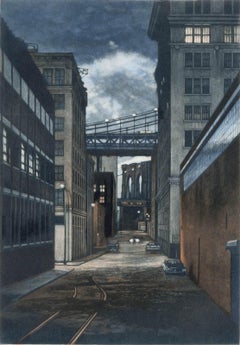
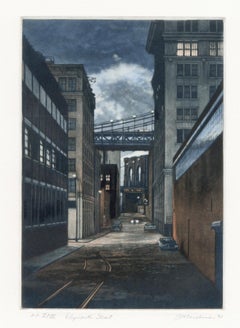
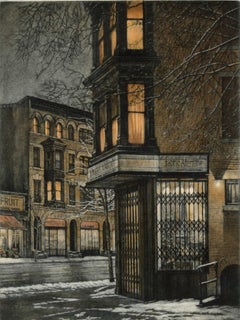
Plymouth Street ( a twilight scene is set in the Brooklyn section of DUMBO)

Plymouth Street ( a twilight scene is set in the Brooklyn section of DUMBO)

By Frederick Mershimer

Located in New Orleans, LA

This view of the Brooklyn and Manhattan Bridges is looking down "Plymouth Street" to the intersection of Jay Street. It is #35 in the catalogue raisonne by Retif & Salzer and is in the permanent collection of the Museum of City of New York...

Category

1990s Contemporary Engraving Still-life Prints
Materials

Mezzotint, Aquatint

"(Love's) Ring of Fire", Intaglio with Aquatint, geometric shapes, patterns

"(Love's) Ring of Fire", Intaglio with Aquatint, geometric shapes, patterns

By Katie VanVliet

Located in Philadelphia, PA

This piece titled "(Love's) Ring of Fire" is a limited edition piece by Kate VanVliet and is made from intaglio with aquatint, soft ground, and drypoint on Rives BFK. This piece is a...

Category

21st Century and Contemporary Contemporary Engraving Still-life Prints
Materials

Paper, Drypoint, Aquatint, Intaglio

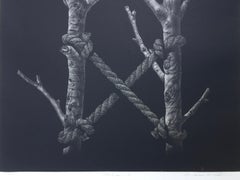
Stones, Mezzotint Print, Abstract Still-Life, Signed, 1975 Edition of 5

Stones, Mezzotint Print, Abstract Still-Life, Signed, 1975 Edition of 5

By Marc Balakjian

Located in New Orleans, LA

Marc Balakjian was enigmatic in his subject matter creating images that are disturbing in their ambiguity. Is this image just striped fabric tied with ropes on a platform or is this is a flag-draped coffin symbolizing those who passed "in memory of an historic phrase"? Politicians may turn the phrase but a price must be paid. This small edition mezzotint was created in 1975 in an edition of only 5. Armenian by descent, Marc Balakjian was raised in Lebanon. He spent his early years in the small town of Rayak, before moving to Beirut at the age of 10. He came to England in 1966, initially to study architecture with a firm in Oxford. He then decided to study art at Hammersmith College of Art and took up a postgraduate degree in printmaking at the Slade School of Art in 1971. After graduating he began working at Studio Prints in 1973, just as it was establishing itself in Queen’s Crescent. By 1976 he had become a full time partner, collaborating with other artists as well as continuing his own work, much of which is inspired by his Armenian and Lebanese culture and heritage. By the 1980s work was falling off, so Balakjian and Studio Prints introduced in-house plate-making to serve painters and sculptors who had little experience with printmaking. Artists such as Leon Kossoff, Frank Auerbach, Lucian Freud and Ken Kiff...

Category

1990s Engraving Still-life Prints
Materials

Mezzotint

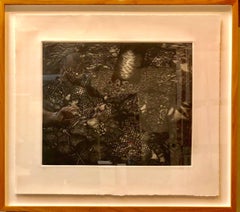
Mezzotint Etching Botanical Print 'Mantle' Signed AP Jungle Image

Mezzotint Etching Botanical Print 'Mantle' Signed AP Jungle Image

By Richard Hricko

Located in Surfside, FL

Richard Hricko has exhibited internationally in museums, galleries and juried competitions, including the National Academy Museum in New York, Glynn Vivian Art Museum in Wales, and G...

Category

20th Century Contemporary Engraving Still-life Prints
Materials

Mezzotint, Etching

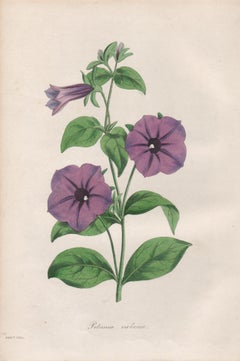
Hand-colored 1834 Joseph Paxton Botanical Engraving of Yellow Trumpet Flowers

Hand-colored 1834 Joseph Paxton Botanical Engraving of Yellow Trumpet Flowers

By Joseph Paxton

Located in Alamo, CA

This is a hand-colored engraving of yellow trumpet flowers from Sir Joseph Paxton's (1803-1865) "Magazine of Botany and Register of Flowering Plants", published in 1834. This engravi...

Category

Early 19th Century Academic Engraving Still-life Prints
Materials

Engraving

BROOKSHAW. A Pair of Melons: White Seed'd Rock and Silver Rock Mellon

BROOKSHAW. A Pair of Melons: White Seed'd Rock and Silver Rock Mellon

By George Brookshaw

Located in London, London

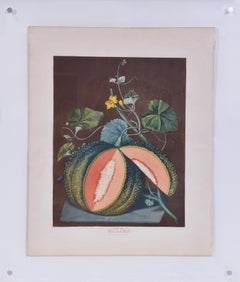
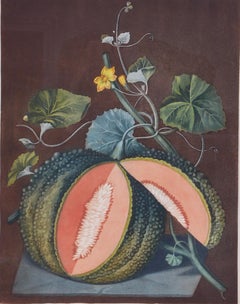
Pair of aquatints with stipple-engraving, printed in colours and finished by hand, made for Brookshaw's most famous work "Pomona Britannica" or a "Collection of the Most Esteemed Fru...

Category

1810s Naturalistic Engraving Still-life Prints
Materials

Engraving, Handmade Paper, Aquatint

Watering Jug and Brush

Watering Jug and Brush

By Tomoe Yokoi

Located in Fairlawn, OH

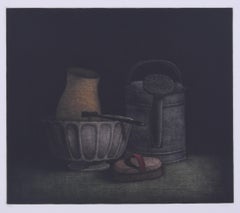
Watering Jug and Brush Color mezzotint, c. 1973 Signed and editioned in pencil by the artist (see photos) Titled in pencil verso Edition: 150 (126/150) Published by John Szoke Graphi...

Category

1970s Contemporary Engraving Still-life Prints
Materials

Mezzotint

"La Mer VE 6/8" Intaglio, hand colored, seashell motif

"La Mer VE 6/8" Intaglio, hand colored, seashell motif

By Katie VanVliet

Located in Philadelphia, PA

This piece titled "La Mer VE 6/8" is a variable edition piece by Kate VanVliet and is made from two-plate intaglio with drypoint, aquatint, and soft ground on Rives BFK. This piece i...

Category

21st Century and Contemporary Contemporary Engraving Still-life Prints
Materials

Archival Paper, Color, Drypoint, Etching, Aquatint, Intaglio

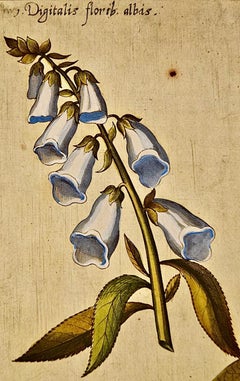
Flowering Digitalis Plants: An Original 17th C. Botanical Engraving by E. Sweert

Flowering Digitalis Plants: An Original 17th C. Botanical Engraving by E. Sweert

By Emanuel Sweert

Located in Alamo, CA

This beautiful and extremely rare early 17th century hand-colored copperplate engraving of four flowering Digitalis plants by the Dutch artist and botanist Emanuel Sweert is plate 6 ...

Category

Early 17th Century Naturalistic Engraving Still-life Prints
Materials

Engraving

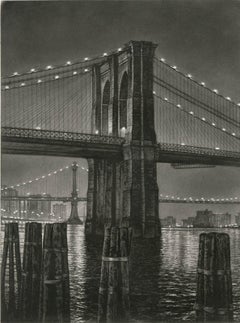
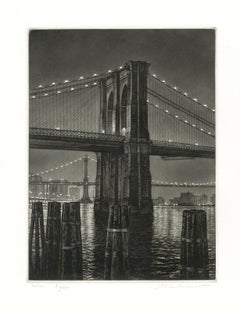
Pylon (Brooklyn Bridge from Manhattan side of East River near South St. Seaport)

Pylon (Brooklyn Bridge from Manhattan side of East River near South St. Seaport)

By Frederick Mershimer

Located in New Orleans, LA

A "Pylon" of the Brooklyn Bridge with the Manhattan Bridge and Williamsburg Bridge visible in the background is captured in this powerful image by Frederick Mershimer. It is #77 in t...

Category

Early 2000s Contemporary Engraving Still-life Prints
Materials

Mezzotint

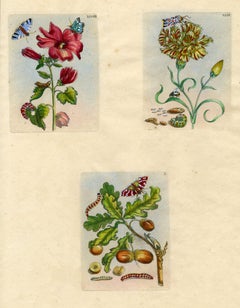
3 plates from The Wondrous Transformation of Caterpillars & their Strange Diet..

3 plates from The Wondrous Transformation of Caterpillars & their Strange Diet..

By Maria Sibylla Merian

Located in Middletown, NY

Three plates from The Wondrous Transformation of Caterpillars and their Strange Diet of Flowers. “Wolfsmelk Rupsen;" “Wolfsmilch, Raupe und Schmetterling" Amsterdam: J F Bernard, 1730. Each an engraving with hand coloring in watercolor and gouache printed on one sheet of watermarked Honig cream laid paper, each measures 6 1/4 x 5 inches (157 x 121 mm), sheet measures 20 5/8 x 14 inches (522 x 355 mm), full margins. With handling creases in the lower right sheet quadrant, as well as minor, loose cockling, otherwise in very good condition. The colors are superb with exceptionally fresh and bright saturation. Engraved between 1679 and 1683, printed 1730. Plates included: XLVIII; XLIX & L. MARIA SIBYLLA MERIAN was one of the most highly respected entomologists of the 17th century, and remains today one of the field's most significant figures. A German-born naturalist and scientific illustrator, she reared herself on the study of caterpillars, and made tremendous contributions to the knowledge of the life cycles of numerous species. Until her detailed and careful study of the process of metamorphosis it was thought that insects were "born of mud," through spontaneous generation. Trained as a miniature painter by her stepfather, she published her first book of illustrations in 1675, at the age of 28. In 1679, Merian published the first volume of the two-volume series on caterpillars, The Wondrous Transformation of Caterpillars and their Strange Diet of Flowers; the second volume followed in 1683. Each volume contained 50 plates that she engraved and etched. In 1699, Merian traveled to Dutch Guiana...

Category

Early 18th Century Naturalistic Engraving Still-life Prints
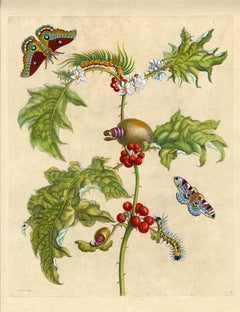
Materials

Watercolor, Engraving

"The Fern Gatherers" 18th Century Antique Mezzotint Engraving by John R. Smith

"The Fern Gatherers" 18th Century Antique Mezzotint Engraving by John R. Smith

By George Morland

Located in Carmel, CA

"The Fern Gatherers" After a painting by George Morland. 1763-1804. - Mezzotint engraving by John Raphael Smith. 1752-1812. Print: 20.75" x 26" - With Frame: 28" x 33.5" Published:...

Category

Late 18th Century Realist Engraving Still-life Prints
Materials

Engraving, Mezzotint

Flowering Prickly Pear Cactus: Framed 18th C. Hand-colored Engraving by Redoute

Flowering Prickly Pear Cactus: Framed 18th C. Hand-colored Engraving by Redoute

By Pierre-Joseph Redouté

Located in Alamo, CA

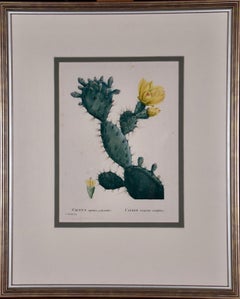
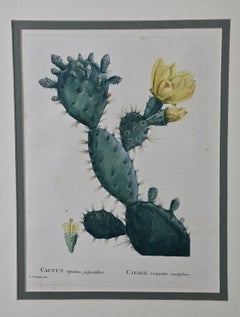
This is a hand-colored stipple engraving entitled "Cactus Opuntia Polyanthos, Cierge Raquette Multiflore" (Prickly Pear Cactus) by Pierre-Joseph Redouté, Plate 59 from his illustrated publication 'Plantarum Historia Succulentarum ou Histoire des Plantes Grasses', published in Paris in 1799. Redoute was a pioneer of the stipple engraving technique, which he used to create this image. It involves utilizing a series of small dots worked into a copper plate rather than the more common lines. These dots can be made smaller or thicker depending on the degree of opacity the artist intends for various areas of the print. When inked and applied to paper, this allows for a greater portion of the paper to be seen, which accentuates the appearance of luminosity of the subject the artist is creating. Different color inks are used in the printing process, a time consuming technique known as "a la poupee". The engraving is then finished with watercolor to further enhance the beauty and realism of the print subject. This engraving of a flowering cactus is presented in a double mat; white outer mat and heather green inner mat.The mat measures 20" x 16" and the sheet measures 19.5" x 13.38". There are wide margins with a few short tears and chips along the the right and upper edges, which are all covered by the mat. There are small spots predominantly in the margins, but a few are present in the image area, but the print is otherwise in very good condition. There is another Redoute flowering cactus listed on 1stdibs, LU117326854582. The pair would make an attractive display grouping. Pierre-Joseph Redouté (1759-1840), was a painter and botanist originally from Belgium, who pursued his extremely successful artistic career in France. He is well known for his watercolor paintings of roses, lilies and other flowers and their subsequent folio-sized, color stipple engravings. Some believe him to be the greatest botanical illustrator of all time. Redouté was a favorite of the French royal court at the time and of the post French...

Category

Late 18th Century Naturalistic Engraving Still-life Prints
Materials

Engraving

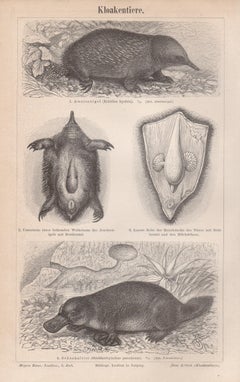
Echidna and Platypus, Australian animal monotreme antique engraving print

Echidna and Platypus, Australian animal monotreme antique engraving print

Located in Melbourne, Victoria

'Kloakentiere' (Monotremes - echidna and platypus)) German wood-engraving, circa 1895. 240mm by 155mm (sheet)

Category

Late 19th Century Naturalistic Engraving Still-life Prints
Materials

Engraving

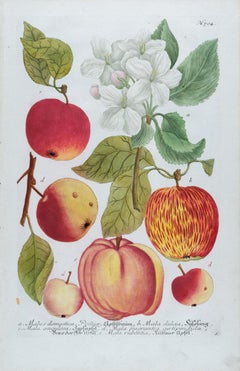
Flowering Apple Plant: 18th Century Hand-colored Botanical Engraving by Weinmann

Flowering Apple Plant: 18th Century Hand-colored Botanical Engraving by Weinmann

By Johann Wilhelm Weinmann

Located in Alamo, CA

This striking hand-colored botanical mezzotint and line engraving is entitled Malus domestica, Pomier, Apfelbaunt (Apple)". It is plate 704 in Johann Weinmann's monumental publicatio...

Category

Mid-18th Century Naturalistic Engraving Still-life Prints
Materials

Engraving, Mezzotint

Caunga Cucumber Plant: A 17th Century Botanical Engraving by Hendrik van Rheede

Caunga Cucumber Plant: A 17th Century Botanical Engraving by Hendrik van Rheede

Located in Alamo, CA

This is a rare 17th century engraving of a plant entitled "Caunga" by the Dutch botanist Hendrik van Rheede tot Drakenstein, plate 6 from his 'Hortus Indicus Malabaricus' (Garden of Malabar), published in Amsterdam in 1686 by Johann van Someren. The engraving depicts the caunga plant, also known as Inca cucumber or horned squash, which is a climbing vine that produces edible, cucumber-like fruits. Rheede's 19th century publication featured illustrations of exotic plants and fruits labelled with script in the upper right corner in Latin, Malay, Arabic, and Sanskrit. Hortus Indicus Malabaricus is believed to be the earliest comprehensive published work on the flora of Asia and the tropics. The 17th century treatise featured important illustrations of 740 plants of the region, including Indian medicinal plants. The engraving is printed on 17th century laid, chain-linked paper, watermarked with an elaborate crown design. The sheet measures 15.25" high by 18.88" wide. There is a central fold, as issued. There is a small dark spot on the left which appears to represent a paper inclusion which occurred when the hand-made paper was produced. The print is otherwise in excellent condition. There are additional Rheede botanical engravings from his 'Hortus Indicus Malabaricus' publication that are listed on my 1stdibs storefront and online website. These would make for an impressive display grouping. A discount is available for purchase of two or more of the prints. Hendrik Adriaan van Rheede tot Drakenstein...

Category

Late 17th Century Naturalistic Engraving Still-life Prints
Materials

Engraving

Engraving still-life prints for sale on 1stDibs.
Find a wide variety of authentic Engraving still-life prints available on 1stDibs. While artists have worked in this medium across a range of time periods, art made with this material during the 21st Century is especially popular. There are many well-known artists whose body of work includes ceramic sculptures. Popular artists on 1stDibs associated with pieces like this include Bertha Evelyn Clausen Jaques, and Henri Le Sidaner. Frequently made by artists working in the Modern, Post-Impressionist, all of these pieces for sale are unique and many will draw the attention of guests in your home. Not every interior allows for large Engraving still-life prints, so small editions measuring 2.25 inches across are also available Prices for still-life prints made by famous or emerging artists can differ depending on medium, time period and other attributes. On 1stDibs, the price for these items starts at $60 and tops out at $33,867, while the average work can sell for $625.