Want more images or videos?
Request additional images or videos from the seller
1 of 14

Josef Moest
Crusader with shield and mace / - Ready to strike -

c. 1910

$6,773.60
£5,075.62
€5,800VAT Included
CA$9,518.79
A$9,744.57
CHF 5,524.41
MX$118,233.81
NOK 65,106.81
SEK 65,470.33
DKK 44,222.52

About the Item

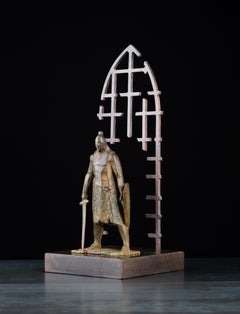
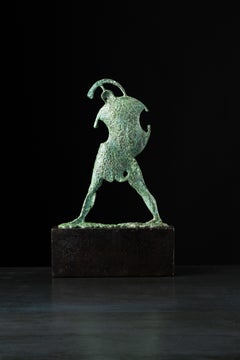
Josef Moest (1873 Cologne - 1914 Rath), Crusader with shield and mace, around 1910. Bronze on a black marble pedestal (19 cm high). 57.5 cm (total height) x 21 cm (width) x 12 cm (depth), weight 24.8 kg. Incised signature “MOEST.” on the back of the base. - Slightly worn in places, base minimally bumped, otherwise in excellent condition - Ready to strike - The crusader gazes resolutely over his raised shield at the enemy, his confident posture indicating that he will not retreat in the least, defending the terrain with his tightly wrapped mace. The armor, slightly damaged on the left shoulder, bears witness to battles already fought. However, the stance is not only a secure position, but also a purposeful retreat that turns into a lunging movement. The already tensed muscles are masterfully visible under the chain mail, anticipating the powerful blow. By dynamizing the figure in this way, Josef Moest succeeds in depicting the battle on the basis of the individual figure without illustrating the battle as such. The impression of the crusader's presence beyond the historical distance is reinforced by the extremely realistic details. The finely woven chain mail as well as the leather straps give a convincing impression of the actual material. The positioning on the high pedestal lends the figure a monumental quality, giving a moral impetus to the inner attitude depicted. About the artist As the son of the Cologne sculptor, restorer and collector of medieval sculptures, Richard Moest, Josef Moest was born with an interest in sculpture. After training under the cathedral sculptor Peter Fuchs, he studied sculpture under Syrius Eberle at the Munich Academy from 1897 to 1902. Moest then opened his own studio. He quickly made a name for himself as a sculptor. He created high-quality salon sculptures and was involved in numerous church decorations. In 1904, he co-founded the Cologne artists' association “Stil”. In 1908 he took part in the exhibition at the Munich Glaspalast and in 1909 in the Great Art Exhibition of the Düsseldorf Academy. Suffering from tuberculosis, Moest designed a Pietà for his own grave in 1912, when he was just 39 years old, before he died two years later. GERMAN VERSION Josef Moest (1873 Köln - 1914 Rath), Kreuzritter mit Schild und Streitkolben, um 1910. Bronze auf schwarzem Marmorpostament (19 cm Höhe). 57,5 cm (Gesamthöhe) x 21 cm (Breite) x 12 cm (Tiefe), Gewicht 24,8 kg. Ritzsignatur „MOEST.“ auf der Rückseite des Sockels. - vereinzelt leicht betrieben, Sockel minimal bestoßen, ansonsten ausgezeichnet erhalten - Zum Hieb bereit - Der Kreuzritter blickt über das erhobene Schild hinweg entschlossen dem Feind entgegen, während der sichere Stand davon kündet, keinen Deut zurückzuweichen und das Terrain mit dem festumschlossenen Streitkolben zu verteidigen. Die an der linken Schulter etwas lädierte Rüstung zeugt von bereits ausgefochtenen Schlachten. Die Körperhaltung ist aber nicht allein ein sicherer Stand, sie ist zugleich ein anvisierendes Zurückweichen, das in eine Ausholbewegung übergeht. Die bereits angespannte Muskulatur zeichnet sich auf meisterhafte Weise unter dem Kettenhemd ab und antizipiert den kraftvollen Schlag. Durch diese Dynamisierung der Figur gelingt es Josef Moest, das Kampfestgeschehen anhand der Einzelfigur zur Darstellung zu bringen, ohne den Kampf als solchen zu veranschaulichen. Dabei wird der Eindruck einer über die historische Distanz hinweg gegebenen Präsenz des Kreuzritters durch die äußerst realistisch ausgearbeiteten Details verstärkt. Das feinmaschige Kettenhemd vermittelt ebenso überzeugend wie die Lederriemen den Eindruck ihrer eigentlichen materiellen Beschaffenheit. Die Positionierung auf dem hohen Postament verleiht der Figur etwas Denkmalhaftes, wodurch die dargestellte innere Haltung einen moralischen Impetus erhält. zum Künstler Als Sohn des Kölner Bildhauers, Restaurators und Sammlers mittelalterlicher Skulpturen, Richard Moest, war Josef Moest das Interesse für Bildhauerei in die Wiege gelegt. Nach einer Ausbildung bei dem Dombildhauer Peter Fuchs studierte er von 1897 bis 1902 bei Syrius Eberle Bildhauerei an der Münchener Akademie. Anschließend eröffnete Moest ein eigenes Atelier. Schnell machte er sich als Bildhauer einen Namen. Er schuf qualitätvolle Salonplastiken und war an zahlreichen Kirchenausstattungen beteiligt. 1904 war er Mitbegründer der Kölner Künstlervereinigung „Stil“. 1908 nahm er an der Ausstellung im Münchner Glaspalast teil und 1909 an der Großen Kunstausstellung der Düsseldorfer Akademie. An Tuberkulose leidend, entwarf Moest 1912, mit gerade einmal 39 Jahren, eine Pietà für sein eigenes Grab, bevor er zwei Jahre später verstarb.
  • Creator:
    Josef Moest (1873 - 1914, German)
  • Creation Year:
    c. 1910
  • Dimensions:
    Height: 22.64 in (57.5 cm)Width: 8.27 in (21 cm)Depth: 4.73 in (12 cm)
  • Medium:
  • Movement & Style:
  • Period:
  • Condition:
  • Gallery Location:
    Berlin, DE
  • Reference Number:
    1stDibs: LU2438215480412

More From This Seller

View All
Naked warrior with short sword / - The New Hercules -

Naked warrior with short sword / - The New Hercules -

Located in Berlin, DE

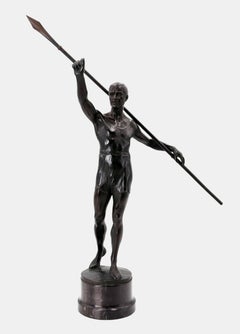
Hermann Volz (1847 Karlsruhe - 1914 ibid.), Naked warrior with short sword, c. 1935. Partially (?) patinated bronze with cast plinth mounted on a black marble base (6.8 cm high). 32....

Category

1930s Art Deco Nude Sculptures

Materials

Bronze

Gladiator ready for battle / - Ready for anything -

Gladiator ready for battle / - Ready for anything -

By Bruno Zach

Located in Berlin, DE

Bruno Zach (1891 Zhitomir - 1945 Vienna), Gladiator ready for battle, c. 1930. Blackish patinated bronze with silver-plated helmet, shield rim and shield pommel mounted on a fluted m...

Category

1930s Art Deco Nude Sculptures

Materials

Bronze

The Victorious David / - The melancholy of the radiant hero -

The Victorious David / - The melancholy of the radiant hero -

By Henri Honoré Plé

Located in Berlin, DE

Henri Honoré Plé (1853 Paris - 1922 Paris), The Victorious David, around1890. Red-brown and brown patinated bronze with terrain plinth mounted on a round base. 42 cm (total height) x...

Category

1890s Realist Figurative Sculptures

Materials

Bronze

The Victorious David / - The melancholy of the radiant hero -

The Victorious David / - The melancholy of the radiant hero -

By Henri Honoré Plé

Located in Berlin, DE

Henri Honoré Plé (1853 Paris - 1922 Paris), The Victorious David, around 1890. Red-brown and brown patinated bronze with terrain plinth mounted on a round base. 62 cm (total height) ...

Category

1890s Realist Figurative Sculptures

Materials

Bronze

Javelin thrower / - Roman present -

Javelin thrower / - Roman present -

By Franz Iffland

Located in Berlin, DE

Franz Iffland (1862 Tempelhof - 1935 Berlin), Javelin thrower, after 1910. Olive-black patinated bronze with cast plinth mounted on a white-veined black marble base (7 cm high). Tota...

Category

1910s Art Deco Nude Sculptures

Materials

Bronze

The Blacksmith of Solingen / - The Double-edged Sword -

The Blacksmith of Solingen / - The Double-edged Sword -

Located in Berlin, DE

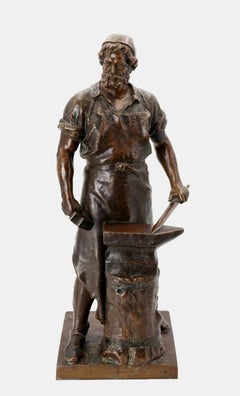
Wilhelm Albermann (1835 Werden an der Ruhr - 1913 Cologne), The Blacksmith of Solingen, after 1895. Bronze-color patinated zinc cast on plinth, 47 cm (height) x 20 cm (width) x 16 cm (depth), weight 5.5 kg. Signed “Albermann.” on the plinth and identified as a cast by “AKT.[TIEN] GES.[ELLSCHAFT] GLADENBECK BERLIN”. Dedication on the front: “Mr. Ing. F. Kuhlmann to the wedding. Management and officials of the Hannoversche Waggonfabrik. Aircraft construction department". - The zinc showing through in spots, the patina somewhat stained, the right upper arm under the sleeve retouched in black. - The Double-edged Sword - The figure is a reduction of Wilhelm Albermann's 1895 fountain figure of the armourer of Solingen, who has always been identified with the historical blacksmith Peter Hahn. In 1839, Karl Simrock wrote the poem “The Blacksmith of Solingen" and thus coined the legendary figure. The first and penultimate verses read: A blacksmith spoke to Solingen With every bayonet, That came to his diligence: "Oh, that Fritz had it!" The war took its course, Many battles were fought, Which often made him fearful and anxious In his soul. The blacksmith had given up his trade to fight for Frederick the Great. Not least because of his strength and will to fight, the battles were won. With his fountain sculpture, Albermann has given the legendary blacksmith a figurative form and at the same time created a landmark for the city of Solingen, which was once famous for the art of sword forging and today still stands for the production of high-quality knives. During the bombing raid in November 1944, the fountain was destroyed along with the entire old town of Solingen. Only the head remained. The broad-shouldered blacksmith stands securely behind his anvil, his leather apron tied around him, and has just finished a sword blade with his own "weapon" - the blacksmith's hammer. His entire body shows the strength with which he wields the hammer, but also the strain of this activity, as evidenced by the wide open shirt, the somewhat 'untidy' apron, and especially the furrowed face. However, the blacksmith does not look at the finished work, but resolutely and at the same time thoughtfully into the distance, in line with the quoted verse from Simrock's poem that the battles "often made him fearful and anxious in his soul". There is certainly something melancholy in his gaze, fed by the knowledge of the necessity of forging swords and taking up arms and their deadly use - experiences Albermann had to make during his own war missions. The flowing full beard gives his gaze into the distance an almost prophetic character. In keeping with the craft of the perfectly formed art of blacksmithing, the detailed casting reproduces the respective materials depicted in perfect form: the leather apron convincingly conveys the impression of leather and lies - also in the back view - like a second formed layer over the body, while the shirt and trousers illustrate their own textile qualities. Due to its masterful execution and profound content, the “Blacksmith of Solingen”, which has survived in its cast reproductions, remains Albermann's most famous work to this day. About the artist The son of a carpenter, Wilhelm Albermann began an apprenticeship as a joiner, but then followed his artistic calling and trained as a sculptor in Elberfeld. In 1855, at the age of twenty, he was drafted into the army in Berlin, where he served until 1857. Albermann attended the Berlin Art Academy on the side and began regular studies after his service. While still a student, he completed commissioned works for his teachers August Fischer and Hugo Hagen. His first independent commissions followed, enabling him to establish a flourishing sculpture studio in Cologne in 1865. His artistic activities were repeatedly interrupted by military service, and he took part in the German-Danish War in 1864, the war against Austria in 1866, and the Franco-Prussian War in 1870/71. After his last war service, Albermann, already a respected artist, founded a commercial drawing school at the request of the city government, where he taught the modeling class and served as director until 1896. In 1890 he also worked for the "Society for the Promotion of Sculpture in the Rhineland and Westphalia". Albermann was one of the most prolific sculptors in Cologne in the second half of the 19th century. He created numerous monuments, fountains, tomb sculptures, architectural ornaments, and domestic statues. At its peak, his workshop employed up to thirty sculptors and stonemasons at a time. GERMAN VERSION Wilhelm Albermann (1835 Werden an der Ruhr - 1913 Köln), Der Schmied von Solingen, nach 1895. Bronzefarben patinierter Zinkguss auf gegossener Plinthe, 47 cm (Höhe) x 20 cm (Breite) x 16 cm (Tiefe), Gewicht 5,5 kg. Auf der Plinthe mit „Albermann.“ signiert und als Guss der „AKT.[TIEN] GES.[ELLSCHAFT] GLADENBECK BERLIN“ ausgewiesen. Schauseitige Widmung: „Herrn Ing. F. Kuhlmann zur Vermählung. Direktion und Beamte der Hannoverschen Waggonfabrik. Abt. Flugzeugbau“. - Punktuelles Durchscheinen des Zinks, Patina etwas fleckig, der rechte Oberarm unter dem Ärmel schwarz retuschiert. - Die Zweischneidigkeit des Schwertes - Die Figur ist eine Reduktion von Wilhelm Albermanns 1895 geschaffener Brunnenfigur des Waffenschmieds von Solingen, der seit jeher mit dem historischen Schmied Peter Hahn identifiziert wurde. 1839 hatte Karl Simrock das Gedicht „Der Schmied von Solingen“ verfasst und damit die legendäre Figur geprägt. Die erste und die vorletzte Strophe lauten: Zu Solingen sprach ein Schmied Bei jedem Bajonette, Das seinem Fleiß geriet: »Ach, daß der Fritz es hätte!« Der Krieg ging seinen Gang, Man schlug noch viele Schlachten, Die oft ihm angst und bang' In seiner Seele machten. Der Schmied hatte sein Handwerk ruhen lassen, um selbst für Friedrich den Großen zu kämpfen. Nicht zuletzt durch seine Kraft und seinen Kampfeswillen verliefen die Schlachten siegreich. Dem legendären Schmied verlieht Albermann mit seiner Brunnenskulptur eine bildliche Gestalt und schuf damit zugleich ein Wahrzeichen der Stadt Solingen, die einst für die Kunst des Schwerterschmiedens berühmt war und bis heute für die Herstellung qualitätvoller Messer einsteht. Beim Bombenangriff im November 1944 wurde mit der gesamten Solinger Altstadt auch der Brunnen zerstört. Einzig der Kopf blieb erhalten. Mit sicherem Stand und umgebundener Lederschürze steht der breitschultrige Schmied hinter seinem Amboss und hat gerade mit seiner eigenen ‚Waffe‘ – dem Schmiedehammer – eine Schwertklinge fertiggestellt. Seinem gesamten Körper ist die Kraft abzulesen, mit der er den Hammer führt, aber auch die Anstrengung dieser Tätigkeit, wovon das weit geöffnete Hemd, die etwas ‚unordentlich‘ arrangierte Schürze und vor allem das zerfurchte Gesicht zeugen. Der Schmied schaut aber nicht auf das vollendete Werk, sondern entschlossen und zugleich sinnierend in die Ferne, entsprechend der zitierten Zeile von Simrocks Gedicht, dass die Schlachten „oft ihm angst und bang‘ in seiner Seele machten“. Der Blick hat durchaus etwas Melancholisches, dass sich aus dem Wissen um die Notwendigkeit, Schwerter zu schmieden und zu den Waffen zu greifen und deren tödlichem Einsatz speist – Erfahrungen, die Albermann bei seinen eigenen Kriegseinsätze machen musste. Der wallende Vollbart verleiht dem in die Ferne schauenden Blick einen beinahe prophetischen Charakter. Dem Handwerk der formvollendenden Schmiedekunst entsprechend, gibt der detaillierte Guss die jeweils dargestellten Materialien in vollendeter Ausformung wieder: Die Lederschürze vermittelt überzeugend den Eindruck des Leders und liegt – auch in der Rückenansicht – wie eine zweite ausgeformte Schicht über dem Körper, während das Hemd und die Hose...

Category

1890s Realist Figurative Sculptures
Materials

Metal

You May Also Like

Crusader. Llimited edition: 2/5. Sculpture by Sergey Oganov. Bronze

Crusader. Llimited edition: 2/5. Sculpture by Sergey Oganov. Bronze

Located in Riga, LV

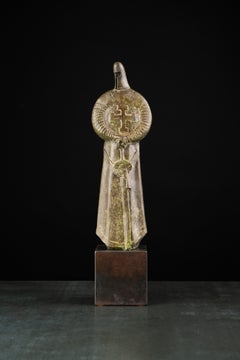
"I wanted to explore the paradox of a warrior – a figure driven by lofty ideals, yet capable of dark, blood-soaked deeds. The result is this frozen idol: a hollow shell clad in armor...

Category

2010s Realist Figurative Sculptures
Materials

Bronze, Metal

Bronze Sculpture Soldier in Armor

Bronze Sculpture Soldier in Armor

Located in Buenos Aires, Argentina

Bronze sculpture soldier in armor Onix base origin France circa 1900 natural wear Very good condition the measurements are with its base.

Category

Antique Early 1900s French Neoclassical Figurative Sculptures
Materials

Bronze

"The Gallant Knight" Bronze Sculpture by John Kearney

"The Gallant Knight" Bronze Sculpture by John Kearney

By John Kearney 1

Located in Wiscasset, ME

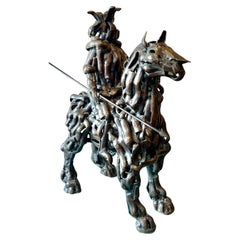
Constructed out of bronze and signed Kearney on the underside of the horse. Measures 24" x 25.5" x 10" and featuring a knight on horseback. John Kearney, 1924-2014 Chicago and env...

Category

20th Century American Mid-Century Modern Figurative Sculptures
Materials

Bronze