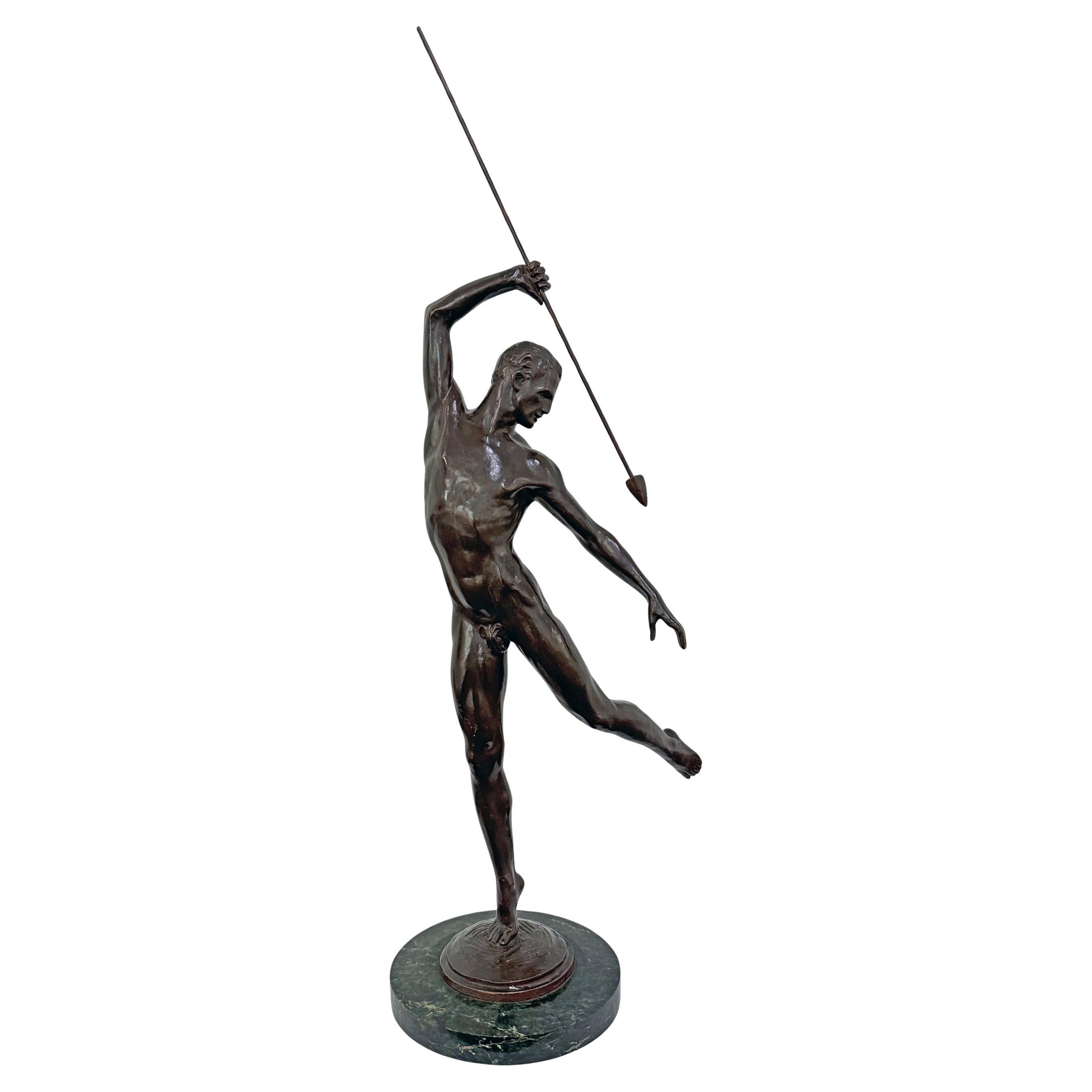
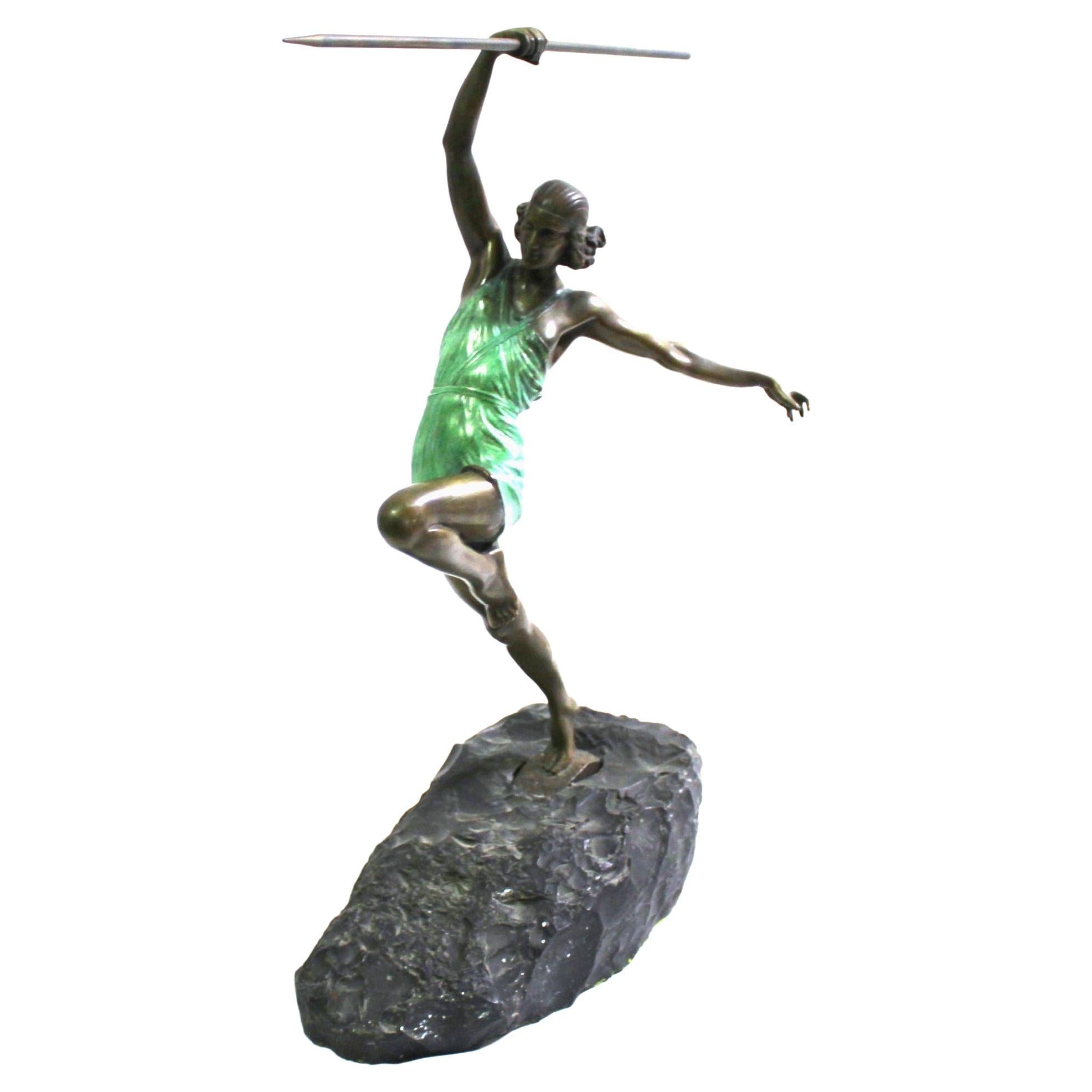
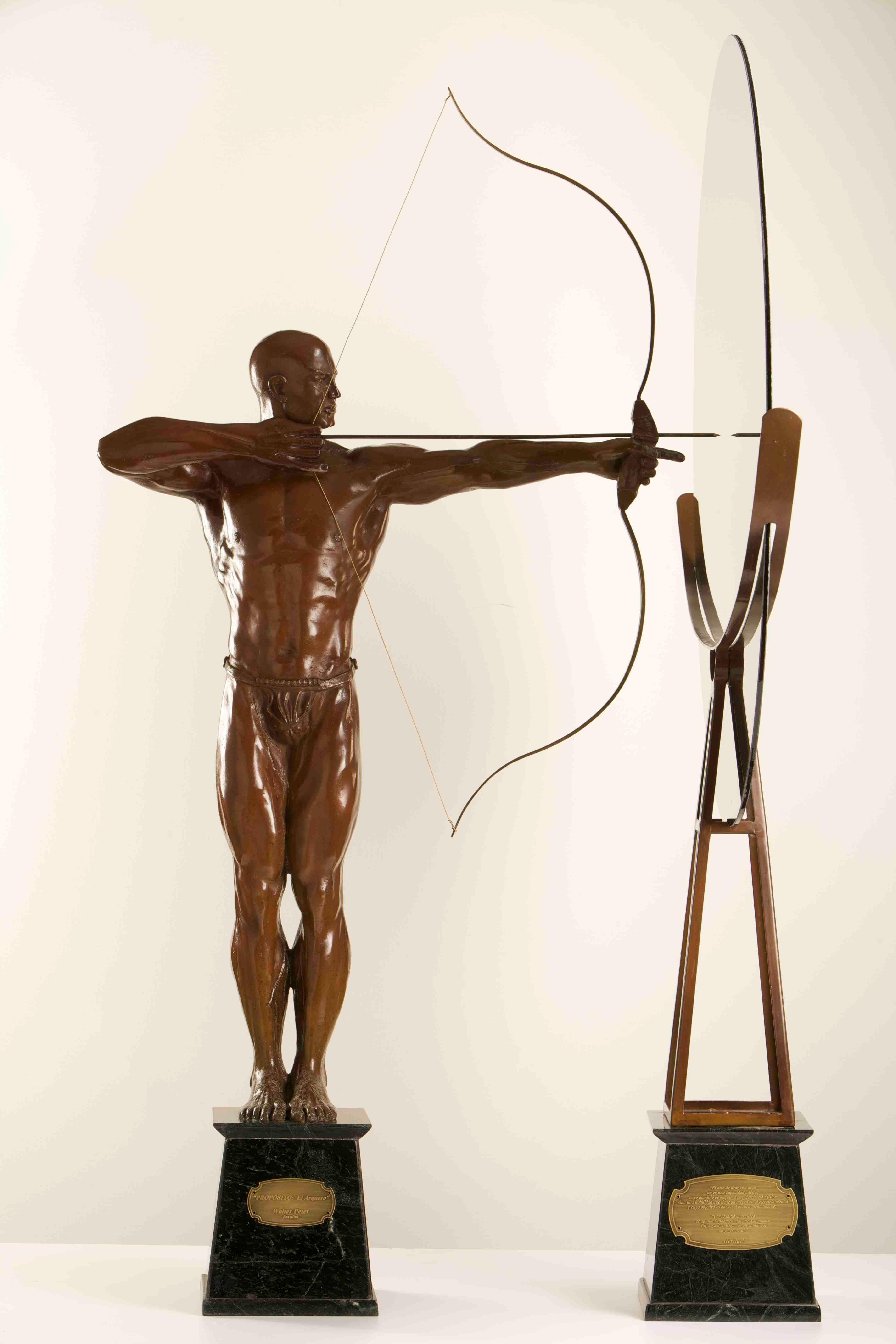
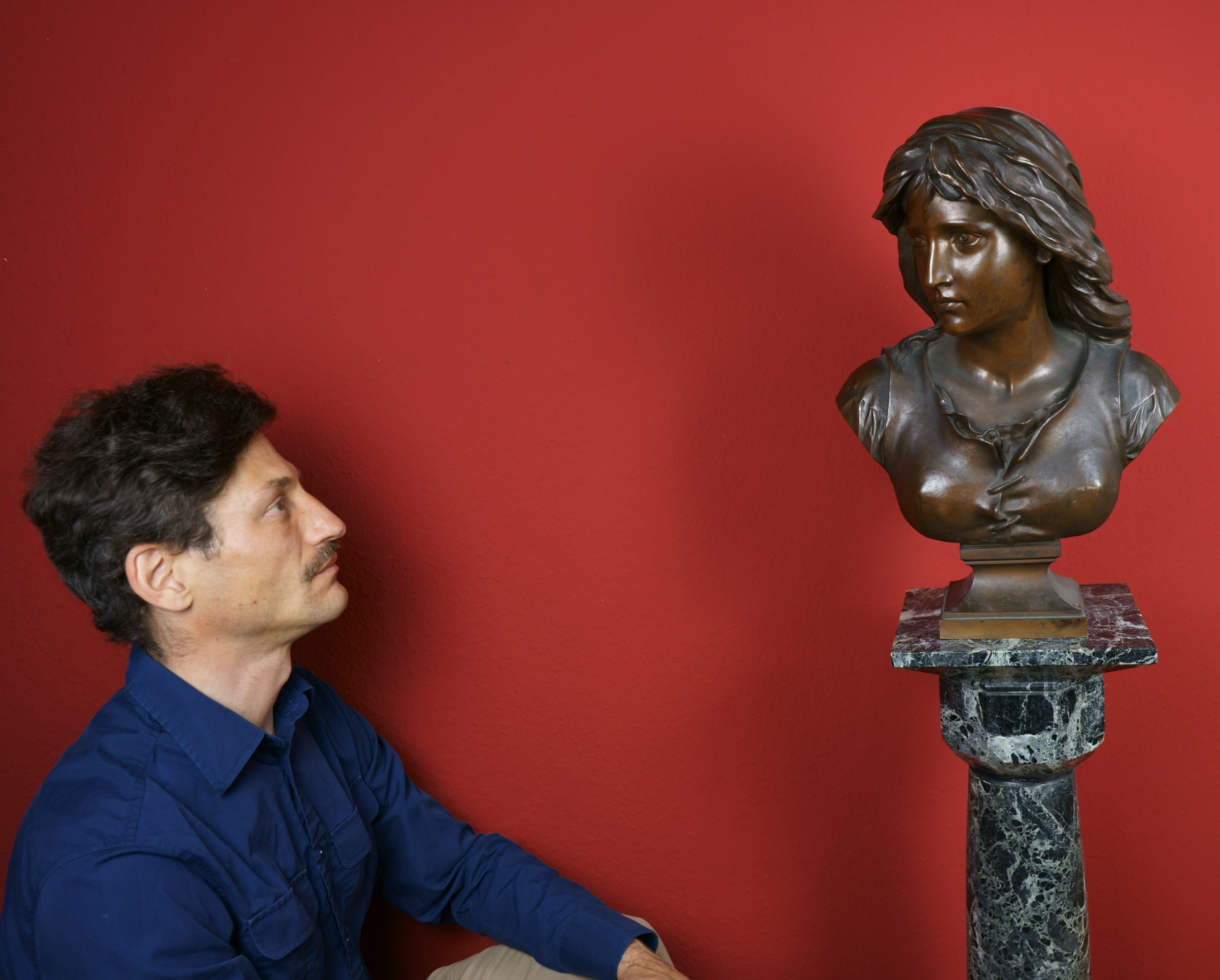
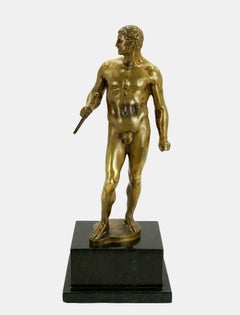
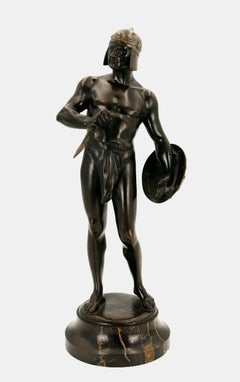
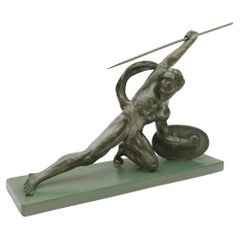
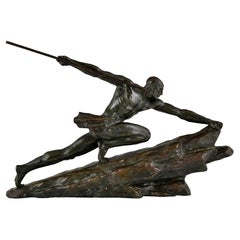
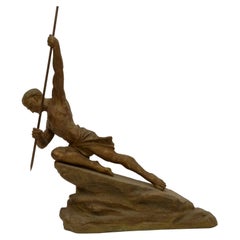
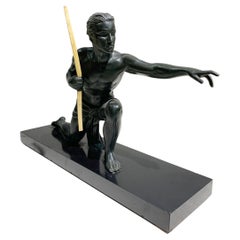
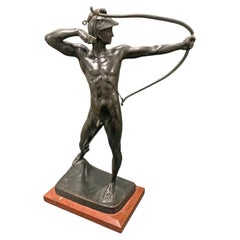
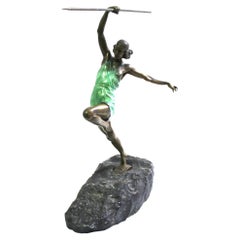
Franz Iffland (1862 Tempelhof - 1935 Berlin), Javelin thrower, after 1910. Olive-black patinated bronze with cast plinth mounted on a white-veined black marble base (7 cm high). Total height 61 cm. Dimensions of the bronze without spear: 46 cm (height) x 26 cm (width) x 25 cm (depth), length of the removable spear: 58 cm, weight 4.8 kg. Signed “Iffland” on the plinth.
- The calf of the left leg with a small restored area, patina with scratch mark at the point where the spear is attached to the head, very occasionally somewhat rubbed.
- Roman present -
As part of the physical culture that emerged in the 19th century and the popular sport that developed from it, the athlete became the new hero. In 1894, the Olympic Games were re-established, with athletics as the supreme discipline, in keeping with the ancient tradition. The javelin thrower is also associated with this. Iffland did not portray an athlete of his time, but rather the epitome of the athlete. The javelin thrower has raised his fist in triumph as he comes to a stop and looks up as if he has reached his goal. His concise facial expression is still marked by the will to win, and the immense javelin bears witness to his almost superhuman performance. His entire body displays a muscular agility that would allow him to master any other discipline.
The short haircut, combed forward, reminiscent of Caesar, and the Roman nose with its pronounced hump do not refer to Athens but to ancient Rome, so that the gesture and the gaze also have the character of the Caesar salute, which had become established as the Olympic salute in Iffland's time. Through the jersey and shoes, Iffland's athlete also refers to the present, with which the artist makes clear that the ideals of Roman antiquity should be carried into the present through sport.
About the artist
Even though Franz Iffland's work and biography have remained unexplored by art historians to this day, the Berlin sculptor was one of the most popular creators of domestic bronze sculptures of his time, who helped shape both Art Nouveau and Art Deco. He was regularly represented at the exhibitions of the Berlin Art Academy from 1862 and presented his works at the International Art Exhibition in 1891 and the Great Berlin Art Exhibition in 1893.
GERMAN VERSION
Franz Iffland (1862 Tempelhof - 1935 Berlin), Speerwerfer, nach 1910. Olivschwarz patinierte Bronze mit gegossener Plinthe auf weiß geädertem schwarzem Marmorsockel (7 cm Höhe) montiert. Gesamthöhe 61 cm. Maße der Bronze ohne Speer: 46 cm (Höhe) x 26 cm (Breite) x 25 cm (Tiefe), Länge des abnehmbaren Speers: 58 cm, Gewicht 4,8 kg. Auf der Plinthe mit „Iffland“ signiert.
- An der Wade des linken Beins mit kleiner restaurierter Stelle, Patina mit Kratzspur an der Ansatzstelle des Speeres am Kopf, sehr vereinzelt etwas berieben.
- Römische Gegenwart -
Im Rahmen der im 19. Jahrhundert aufkommenden Körperkultur und dem sich daraus entwickelndem Breitensport wurde der Athlet zum neuen Heros. 1894 wurden die Olympischen Spiele wiederbegründet, bei denen – in antiker Tradition – die Leichtathletik als Königsdisziplin galt. In diesem Zusammenhang steht auch der Speerwerfer. Iffland hat hier keinen Sportler seiner Zeit porträtiert, sondern den Inbegriff des Athleten geschaffen. In einer zum Stehen kommenden Vorwärtsbewegung hat der Speerwerfer siegreich seine Faust erhoben und den Blick in die Höhe gerichtet, als ob er das anvisierte Ziel erreicht hätte. Seine prägnant ausgeformte Mimik ist noch ganz vom Siegeswillen geformt und der immense Speer zeugt von der schier übermenschlichen Leistung. Sein ganzer Körper weist eine muskulöse Agilität auf, die ihn auch alle anderen Disziplinen meistern lassen würde.
Der an Cäsar gemahnende nach vorne gekämmte Kurzhaarschnitt und die römische Nase mit dem ausgeprägten Höcker verweisen nicht nach Athen, sondern in das antike Rom, so dass die Handhaltung und der Blick zugleich den Charakter des Caesarengrußes hat, der sich zur Zeit Ifflands als Olympischer Gruß etabliert hatte. Durch das Trikot und die Schuhe bezieht sich auch Ifflands Athlet auf seine gegenwärtige Zeit, womit der Künstler verdeutlicht, dass die Ideale der römischen Antike durch den Sport in die Gegenwart getragen werden sollten.
zum Künstler
Auch wenn das Werk und die Biographie Franz Ifflands bis heute kunsthistorisch unerschlossen geblieben ist, war der Berliner Bildhauer einer der populärsten Schöpfer häuslicher Bronzeplastiken seiner Zeit, der sowohl den Jugendstil als auch das Art déco mitprägte. Er war ab 1862 regelmäßig auf den Ausstellungen der Berliner Kunstakademie vertreten und präsentierte 1891 seine Werke auf der Internationalen und 1893 auf der Großen Berliner Kunstausstellung.