Cubist Art

CUBIST STYLE

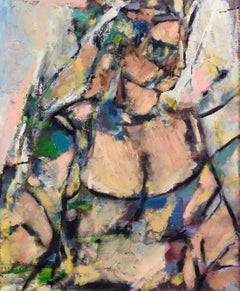
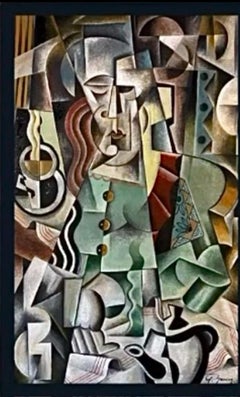
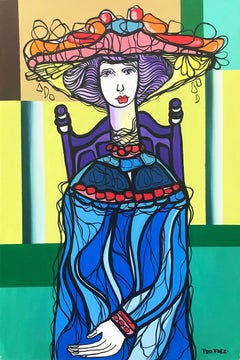
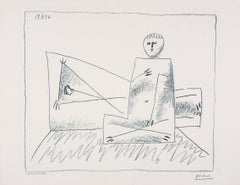
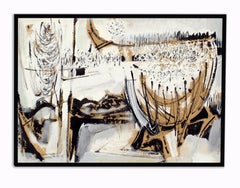
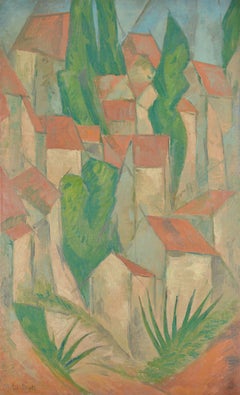
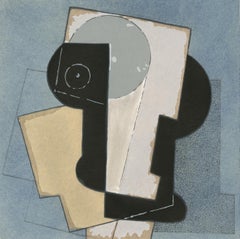
Inspired by the nontraditional ways Postimpressionists like Paul Cézanne and Georges Seurat depicted the world, Pablo Picasso and Georges Braque pioneered an even more abstract style in which reality was fragmented into flat, geometric forms. Cubism majorly influenced 20th-century Western art as it radically broke with the adherence to composition and linear perspectives that dated back to the Renaissance. Its watershed moments are considered Picasso’s 1907 Les Demoiselles d’Avignon, in which nude figures are fractured into angular shapes, and Georges Braque’s 1908 painting show, which prompted a critic to describe his visual reductions as “cubes.”

Although Cubism was a revolutionary art movement for European culture, it was informed by African masks and other tribal art. Its artists, which included Fernand Léger, Alexander Archipenko, Marcel Duchamp, Juan Gris and Jean Metzinger, experimented with compressing space and playing with the tension between solid and void forms in their work. While their subjects were often conventional, such as still lifes, nudes and landscapes, they were distorted without any illusion of realism.

Cubist art evolved through different distinct phases. In Analytic Cubism, from 1908 to 1912, figures or objects were “analyzed” into pieces that were reassembled in paintings and sculptures, as if presenting the same subject matter from many perspectives at once. The palette was usually monochromatic and muted, giving attention to the overlapping planes. Synthetic Cubism, dating from 1912 to 1914, moved to brighter colors and a further flattening of images. This unmooring from formal ideas of art would shape numerous styles that followed, from Dada to Surrealism.

Find a collection of authentic Cubist paintings, prints and multiples, sculptures and more art on 1stDibs.

to
673
718
325
449
223
169
Overall Width
to
Overall Height
to
3
1,384
524
4
39
58
111
119
259
214
104
56
43
117,906
64,549
56,621
28,641
14,581
9,627
6,898
6,035
4,181
3,158
2,548
2,315
2,144
604
1,142
600
77
675
519
385
240
232
215
133
111
60
51
50
30
26
26
26
25
24
24
24
23
902
552
507
352
348
142
94
39
32
29
488
235
1,149
719
Style: Cubist
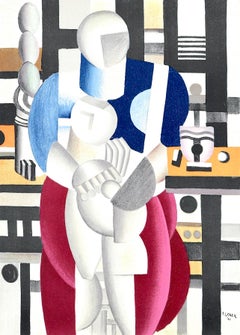
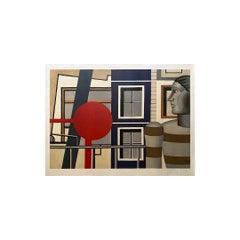
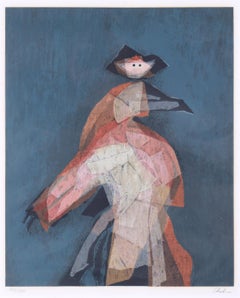
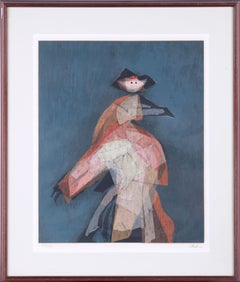
Fernand Leger, The Woman and the Child, from Derriere le miroir, 1955 (after)

Fernand Leger, The Woman and the Child, from Derriere le miroir, 1955 (after)

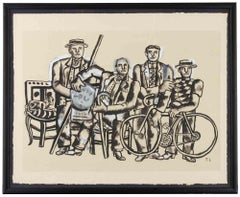
By Fernand Léger

Located in Southampton, NY

This exquisite lithograph after Fernand Leger (1881–1955), titled La Femme et l’Enfant (The Woman and the Child), from the folio Derriere le miroir, No. 79-81, originates from the 1955 edition published by Maeght Editeur, Paris, and printed by Mourlot Freres, Paris, 1955. This composition exemplifies Leger’s rhythmic balance of color, form, and movement, translating the mechanical vitality of modern life into a harmonious, humanized geometry. Executed as a lithograph on velin paper, this work measures 15 x 11 inches. Signed in the plate and unnumbered as issued. The edition exemplifies the superb craftsmanship of Mourlot Freres, Paris. Artwork Details: Artist: After Fernand Leger (1881–1955) Title: La Femme et l’Enfant (The Woman and the Child), from the folio Derriere le miroir, No. 79-81 Medium: Lithograph on velin paper Dimensions: 15 x 11 inches (38.1 x 27.94 cm) Inscription: Signed in the plate and unnumbered as issued Date: 1955 Publisher: Maeght Editeur, Paris Printer: Mourlot Freres, Paris Condition: Well preserved, consistent with age and medium Provenance: From the folio Derriere le miroir, No. 79-81, published by Maeght Editeur, Paris; printed by Mourlot Freres, Paris, 1955 About the Publication: Derriere le miroir (Behind the Mirror) was one of the most important art publications of the 20th century, created and published by Maeght Editeur in Paris from 1946 to 1982. Founded by the visionary art dealer and publisher Aime Maeght, the series served as both an exhibition catalogue and a work of art in its own right, uniting original lithographs by leading modern and contemporary artists with critical essays, poetry, and design of the highest quality. Printed by master lithographers such as Mourlot Freres and Arte, Derriere le miroir became synonymous with the artistic vanguard of postwar Europe. Each issue was devoted to a single artist or theme and published to accompany exhibitions at the Galerie Maeght in Paris, featuring works by Pablo Picasso, Henri Matisse, Georges Braque, Joan Miro, Marc Chagall, Alexander Calder, Fernand Leger, and Alberto Giacometti, among others. The publication reflected Maeght's belief that art should be both accessible and elevated—an ideal realized through its luxurious production values, meticulous printing, and collaboration with the greatest creative minds of its time. About the Artist: Fernand Leger (1881–1955) was a visionary French painter, sculptor, designer, and filmmaker whose groundbreaking fusion of modern industry, vivid color, and geometric form transformed the course of 20th-century art. Born in Argentan, Normandy, Leger began as an architectural draftsman before studying at the Academie Julian and the Ecole des Beaux-Arts in Paris, where he absorbed the lessons of Paul Cezanne’s structural rigor and the revolutionary ideas of Cubism. Alongside Pablo Picasso and Georges Braque, he became one of the leading innovators of the avant-garde, yet his work stood apart through its embrace of mechanical rhythm, bold contrasts, and industrial modernity—earning him the title “the painter of the machine age.” His art celebrated the beauty of technology, urban life, and the human form rendered in dynamic, interlocking cylinders and planes, evoking the pulse of the modern world. Immersed in the vibrant Parisian art scene, Leger worked in dialogue with peers and contemporaries such as Alexander Calder, Alberto Giacometti, Salvador Dali, Joan Miro, Wassily Kandinsky, Marcel Duchamp, and Man Ray, all of whom shared his commitment to innovation and the reimagining of artistic expression. Beyond painting, Leger’s creative reach extended into film, design, and monumental public art—his 1924 collaboration on Ballet Mecanique with Dudley Murphy and Man Ray remains a landmark of avant-garde cinema. His later works evolved toward greater clarity and monumentality, celebrating the unity of form, color, and humanity through large-scale murals and mosaics that bridged fine art and architecture. Leger’s synthesis of Cubism, Futurism, and abstraction paved the way for movements such as Pop Art and influenced generations of artists including Roy Lichtenstein, Ellsworth Kelly, Robert Indiana, and Alexander Calder, who admired his fusion of structure, energy, and optimism. Today, his works are prized by major museums and collectors worldwide for their bold visual power and enduring modernity. His highest auction record was achieved by La femme en rouge et vert (1914), which sold for 39,241,000 USD at Sotheby’s, New York, on May 7, 2008. After Fernand Leger La Femme et l’Enfant 1955, Leger Derriere le miroir No. 79-81, Leger Mourlot...

Category

1950s Cubist Art

Materials

Lithograph

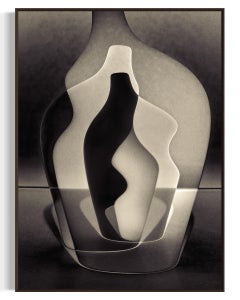
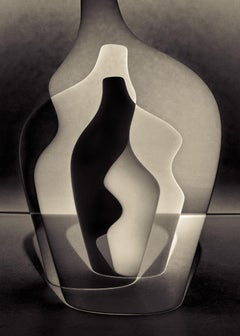
In Between Shadows 'Vintage Bottle', 20th Century Framed Large Fine Art Print

In Between Shadows 'Vintage Bottle', 20th Century Framed Large Fine Art Print

By Sander Vos

Located in London, GB

Intertwined silhouettes reveal the rhythmic dance of light and shadow in abstract form... The series ‘In Between the Shadows’ consists of structural and geometric photographs that ta...

Category

2010s Cubist Art

Materials

Photographic Paper, Black and White, Color, Giclée, Archival Pigment

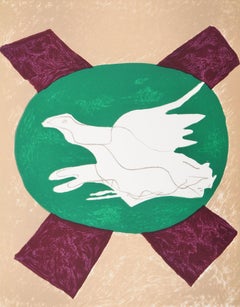
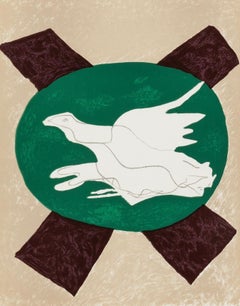
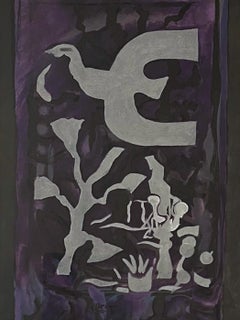
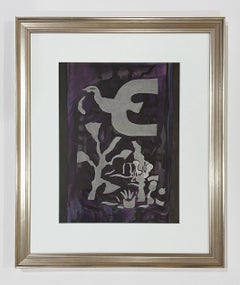
Georges Braque, Bird on Background of X, San Lazzaro et ses Amis, 1975 (after)

Georges Braque, Bird on Background of X, San Lazzaro et ses Amis, 1975 (after)

By Georges Braque

Located in Southampton, NY

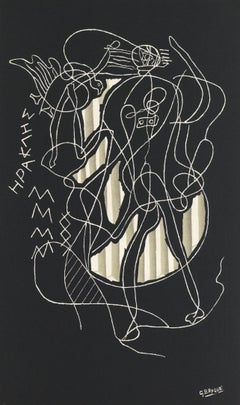
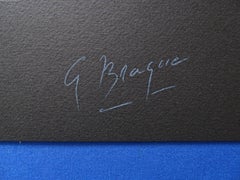
This exquisite lithograph after Georges Braque (1882–1963), titled Oiseau sur fond de X (Bird on Background of X), from the album San Lazzaro et ses Amis, Hommage au fondateur de la revue XXe siecle (San Lazzaro and His Friends, Tribute to the Founder of the Journal XXe Siecle), originates from the 1975 edition published by XXe siecle, Paris, and printed by Mourlot Freres, Paris, October 1975. Oiseau sur fond de X exemplifies Braque’s late-career mastery of poetic symbolism and formal harmony. The composition’s abstracted bird—one of Braque’s most enduring motifs—emerges from an intricate background of interlocking shapes and textures, expressing his lifelong fascination with balance, serenity, and the unity between nature and form. Executed as a lithograph on velin d'Arches paper, this work measures 10.5 x 14 inches (26.67 x 35.56 cm). Unsigned and unnumbered as issued. The edition reflects the exceptional craftsmanship of Mourlot Freres, the legendary Parisian atelier known for its collaborations with Braque, Picasso, Chagall, and Matisse. Artwork Details: Artist: After Georges Braque (1882–1963) Title: Oiseau sur fond de X (Bird on Background of X), from San Lazzaro et ses Amis, Hommage au fondateur de la revue XXe siecle, 1975 Medium: Lithograph on velin d'Arches paper Dimensions: 10.5 x 14 inches (26.67 x 35.56 cm) Inscription: Unsigned and unnumbered as issued Date: 1975 Publisher: XXe siecle, Paris Printer: Mourlot Freres, Paris Catalogue raisonne references: Vallier, Dora, et al. Braque, the Complete Graphics: Catalogue Raisonne. Translated by Robert Bononno, Gallery Books, 1988, illustration 122. Condition: Well preserved, consistent with age and medium Provenance: From the album San Lazzaro et ses Amis, Hommage au fondateur de la revue XXe siecle, published by XXe siecle, Paris, October 1975 Notes: Excerpted from the folio (translated from French), Finished printing in Paris in October 1975. This album has been printed on velin d'Arches in DLXXV numbered examples. The LXXV original examples include a series of VIII original lithographs, signed and numbered by the artists. In addition, LV examples were printed for artists, authors, friends and collaborators of XXe siecle. The typography is from l'Imprimerie Union in Paris; the lithographs of Max Bill, Marc Chagall, Hans Hartung, Braque, Fontana, Magnelli, Picasso, Magritte and Poliakoff were printed by Fernand Mourlot in Paris; those of Alexander Calder and Joan Miro by l'imprimerie Arte in Paris; that of Max Ernst by Pierre Chave in Vence; that of Zao Wou-Ki by ateliers Bellini in Paris; and that of Henry Moore by the Curwen Studio in London. About the Publication: San Lazzaro et ses Amis, Hommage au fondateur de la revue XXe siecle (San Lazzaro and His Friends, Tribute to the Founder of the Journal XXe Siecle), published in 1975 by XXe siecle, Paris, was conceived as a landmark tribute to Gualtieri di San Lazzaro, the visionary founder of the celebrated art journal XXe Siecle. The folio unites original lithographs by leading masters of modern art—Braque, Picasso, Chagall, Miro, Calder, Hartung, Moore, and others—printed by premier Parisian ateliers including Mourlot, Arte, Bellini, and Curwen. Representing the creative spirit and internationalism of postwar modernism, this edition stands as one of the great artistic collaborations of the 20th century. About the Artist: Georges Braque (1882–1963) was a French painter, printmaker, sculptor, and collagist whose visionary innovations and lifelong pursuit of balance, structure, and poetic form made him one of the most influential figures in 20th-century art. Born in Argenteuil-sur-Seine and raised in Le Havre, Braque began as a decorative painter before studying at the Ecole des Beaux-Arts and the Academie Humbert in Paris, where he absorbed the vibrant colorism of the Fauves and the structural logic of Paul Cezanne. His encounter with Pablo Picasso in 1907 led to one of the most groundbreaking collaborations in art history—the invention of Cubism—a movement that redefined visual perception by fragmenting form, rejecting single-point perspective, and reconstructing reality into a multidimensional experience. Between 1908 and 1914, Braque and Picasso revolutionized painting through Analytical Cubism, a style characterized by muted palettes, overlapping planes, and a focus on underlying structure rather than surface appearance. In 1912, Braque pioneered papier colle, the first use of collage in fine art, incorporating wallpaper and printed paper into his compositions and forever changing the relationship between art and the material world. After World War I, he returned to painting with renewed sensitivity, developing a lyrical and introspective form of Synthetic Cubism distinguished by harmony, rhythm, and a meditative sense of stillness. His still lifes, musical instruments, and interior scenes became metaphors for balance and contemplation, uniting intellect and emotion in perfect equilibrium. Immersed in the Parisian avant-garde, Braque worked alongside and exchanged ideas with Pablo Picasso, Alexander Calder, Alberto Giacometti, Salvador Dali, Joan Miro, Wassily Kandinsky, Marcel Duchamp, and Man Ray, each of whom shared his passion for redefining the boundaries of modern art. His innovations in form, collage, and spatial construction deeply influenced later artists, including Jean Dubuffet, Nicolas de Stael, Henry Laurens, Ellsworth Kelly, Richard Diebenkorn, and Jasper Johns, shaping the course of postwar abstraction and modern design. In 1961, Braque became the first living artist to have a solo exhibition at the Louvre, a recognition of his monumental impact on modern aesthetics. His works are now housed in major museums worldwide, including the Museum of Modern Art in New York, the Tate Modern in London, and the Centre Pompidou in Paris, and remain sought after for their intellectual depth and timeless serenity. His highest auction record was achieved by Paysage a la Ciotat, which sold for $15.8 million at Sotheby’s, New York, in 2013, reaffirming Georges Braque’s legacy as one of the founding architects of Cubism and a master whose art continues to define the modern age. Georges Braque Oiseau...

Category

1970s Cubist Art
Materials

Lithograph

Cubist Renaissance Woman - Oil on Canvas

Cubist Renaissance Woman - Oil on Canvas

Located in Soquel, CA

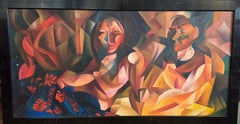
Abstracted portrait of a renaissance era woman by Sonia Gichner (20th Century). This piece is painted with splashes of bright colors, contrasting nicely with skin tones and black lin...

Category

1980s Cubist Art

Materials

Gesso, Canvas, Oil

The Keeper
The Keeper

The Keeper

By Pascal Jarrion

Located in Los Angeles, CA

Pascal Jarrion was born in 1961 in Perpignan, France, a region known for its Catalan culture as well as its influence on artists before him, including Picasso, Van Gogh, and Maillol....

Category

21st Century and Contemporary Cubist Art

Materials

Oil, Wood Panel

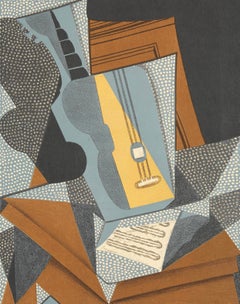
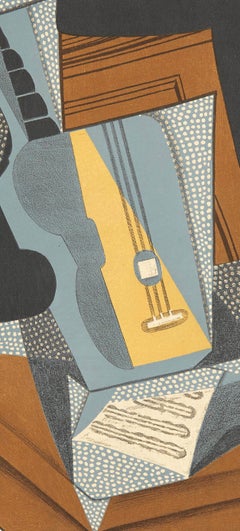
Juan Gris, Guitar, from Au Soleil du Plafond, 1955 (after)

Juan Gris, Guitar, from Au Soleil du Plafond, 1955 (after)

By Juan Gris

Located in Southampton, NY

This exquisite lithograph after Juan Gris (1887–1927), titled Guitare (Guitar), from the folio Au Soleil du Plafond (In the Sunlight of the Ceiling), originates from the 1955 edition...

Category

1950s Cubist Art

Materials

Lithograph

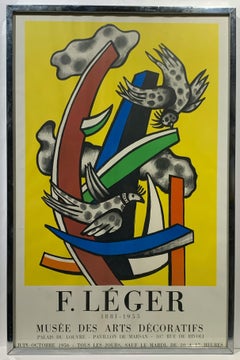
1956 Fernand Leger Mourlot Exhibition Poster

1956 Fernand Leger Mourlot Exhibition Poster

By Fernand Léger

Located in Wilton Manors, FL

76 x 52 cm. Printed by Fernand Mourlot on rag paper watermarked "Mourlot." A condition. Not in Saphire. .Fernand Mourlot was born in Paris in 1895. He grew up in the family print shop but it wasn't until he took over in the early 1920s that he would change the fabric of printing forever. His influence fostered a resurgence of lithography, revealing it as a new avenue for expression and a new realm of possibilities for likes of Pablo Picasso, Henri Matisse, Marc Chagall, Joan Miró, Georges Braque, Fernand Léger, and Alberto Giacometti to enrich their own work as well as fine art in general. Fernand cultivated the lithograph as a painter's medium and the family studio on Rue Chabrol became a hub where he could invite artists to work directly on the stone, as if creating a poster. In 1937, the studio produced two posters (based on paintings by Matisse...

Category

Mid-20th Century Cubist Art

Materials

Paper, Lithograph

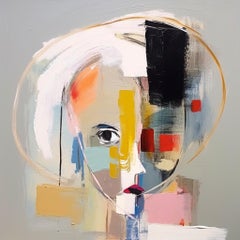
Man Cubist Portrait - Limited Edition Textured Canvas Print  45x45 "

Man Cubist Portrait - Limited Edition Textured Canvas Print 45x45 "

By Irena Orlov

Located in Los Angeles, CA

"Man Cubist Portrait - Limited Edition Textured Canvas Print" Step into the mesmerizing world of "Man Cubist Portrait," a limited edition textured canvas print that redefines artist...

Category

2010s Cubist Art

Materials

Canvas, Paint, Cotton Canvas, Ink, Archival Ink, Mixed Media, Acrylic, C...

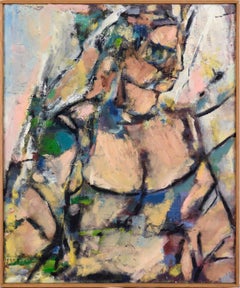
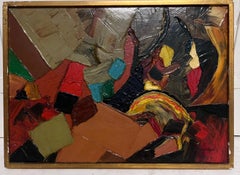
1960's French Abstract Oil Painting Very Very Thick Impasto Oil Exhibited work

1960's French Abstract Oil Painting Very Very Thick Impasto Oil Exhibited work

Located in Cirencester, Gloucestershire

"France" by Jean Pierre Stagnaro (1927 - 2013) 1960 signed inscribed verso signed oil on canvas, framed framed: 13.5 x 18.5 inches canvas: 13 x 18 inches provenance: private collection, France; Salon exhibition label...

Category

Mid-20th Century Cubist Art

Materials

Oil, Canvas

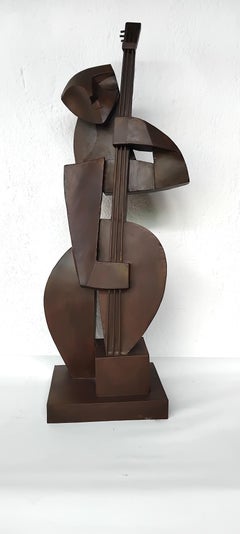
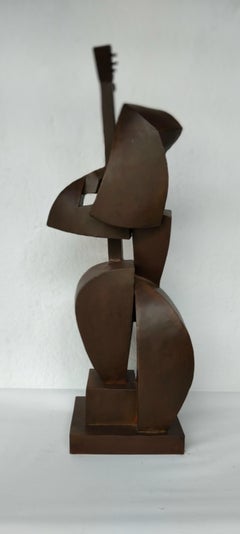
Música
Música

Música

Located in Los Angeles, CA

Unique patinated metal cubist sculpture. Ulises Jiménez Obregón was born in La Mansion de Nicoya, Costa Rica, in November 1953. In 1968 he obtained a diploma of "Honor of Merit" i...

Category

21st Century and Contemporary Cubist Art

Materials

Metal

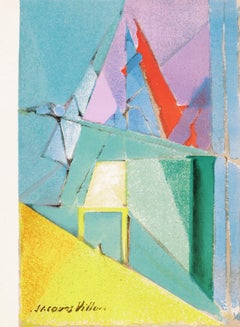
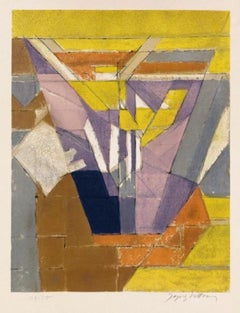
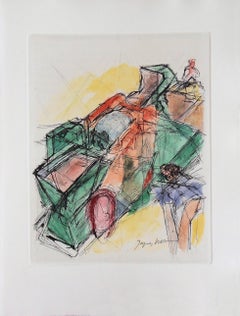
Comme il vous Plaira: Ascension

Comme il vous Plaira: Ascension

By Jacques Villon

Located in New York, NY

Color lithograph, 1958. Signed by the artist in pencil, lower right. Numbered 19/50 in pencil, lower left. Printed by Mourlot, Paris Overall sheet dimension 24 x 16.5 inches, wit...

Category

1950s Cubist Art

Materials

Lithograph, Color

Valley Town Oil Painting, Cubist Style, Late 19th Century. Signed

Valley Town Oil Painting, Cubist Style, Late 19th Century. Signed

Located in Riga, LV

Mikhail ld Dentu. A Russian artist, a talented painter and a graphic artist, one of the leading practitioners and theoreticians of avant-garde, in particular, a member of «The Donkey...

Category

Late 19th Century Cubist Art

Materials

Oil, Canvas

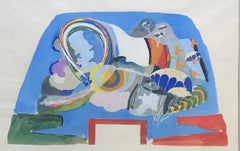
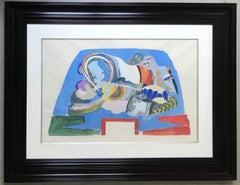
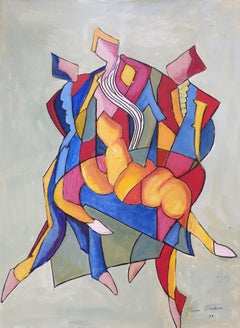
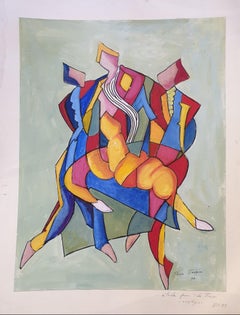
Etude pour le Trio, Colorful Cubist Acrylic on Paper, Signed, 70x55 cm

Etude pour le Trio, Colorful Cubist Acrylic on Paper, Signed, 70x55 cm

Located in Cotignac, FR

Cubist acrylic on paper on card by French artist Eliane Versini , signed, dated and titled 'Etude pour le Trio' to the front bottom right and the same to the bottom right reverse. H...

Category

Late 20th Century Cubist Art

Materials

Paper, Acrylic, Cardboard

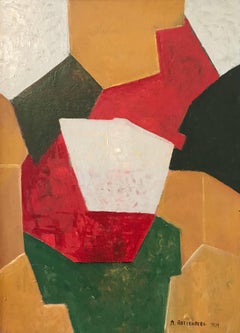
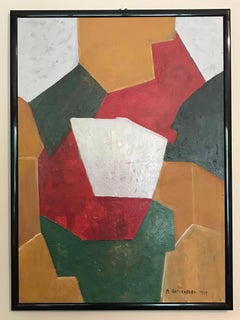
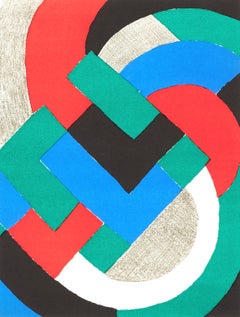
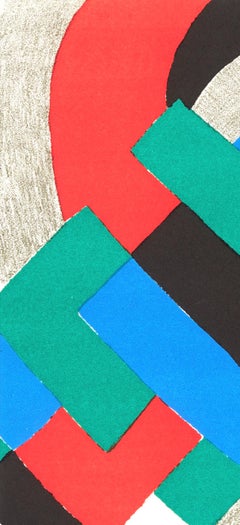
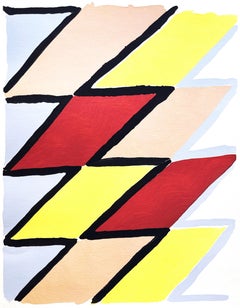
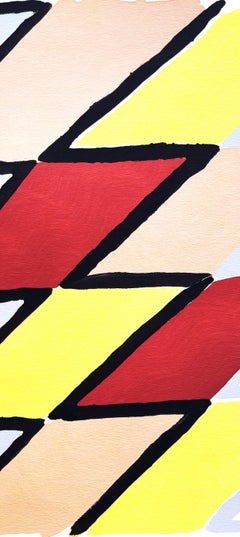
Sonia Delaunay, Color Rhythms, from XXe Siecle, 1969

Sonia Delaunay, Color Rhythms, from XXe Siecle, 1969

By Sonia Delaunay

Located in Southampton, NY

This exquisite lithograph by Sonia Delaunay (1885–1979), titled Rythmes couleur (Color Rhythms), from the album XXe Siecle, Nouvelle serie, XXXIe Annee No. 32, Juin 1969, originates ...

Category

1960s Cubist Art

Materials

Lithograph

Rue Caulaincourt
Rue Caulaincourt

Rue Caulaincourt

By Louis Marcoussis

Located in Fairlawn, OH

Rue Caulaincourt Etching and engraving, 1931 Initialed in the plate (see photo) Edition: 77 Plate 10 from "Plaches de Salut" Published by Aux Editions Jeanne Bucher, Paris Rue Caulai...

Category

1930s Cubist Art

Materials

Engraving, Etching

Kiss, Contemporary Ceramic Sculpture by Mirkò Guida

Kiss, Contemporary Ceramic Sculpture by Mirkò Guida

By Mirko Guida

Located in Long Island City, NY

Artist: Mirkò Guida (Italian, b. 1980) Title: Kiss Year: 2006 Medium: Painted terracotta artistic vase, signed and dated Size: 31 x 19 x 13 in. (78.74 x 48.26 x 33.02 cm)

Category

Early 2000s Cubist Art

Materials

Ceramic, Terracotta

Floral Still Life - British art 1930 Post Cubist oil painting red yellow flowers

Floral Still Life - British art 1930 Post Cubist oil painting red yellow flowers

By Paul Earee

Located in Hagley, England

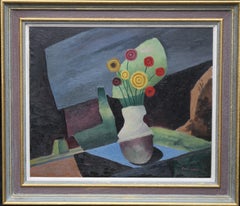
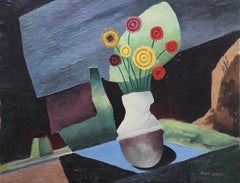
This appealing original oil on canvas painting is by British artist Paul Earee. Painted in a Post Cubist manner circa 1930, this floral still life depicts a vase of flowers on a table in bold blocks of colour. A really vibrant painting in superb tones. Signed lower right. Provenance. Estate of the artist. Condition. Oil on canvas. Image size 24 inches by 20 inches and in excellent condition. Housed in a gallery frame with complementary tones, 31 inches by 27 inches approx framed. As Frederick Percy Eary, he was born at Sudbury, Suffolk on 16 July 1888, son of Albert Henry Eary (1862-1941), mat weaver, and his wife Hannah (1860-1939). Known as Paul Earee, he was an artist who was professionally trained as an ecclesiastical architect, art teacher and illustrator, using his spare time in painting, etchings and drawing with strong regional content. As an architect he designed many buildings and interiors in Sudbury including the pulpit of St Gregory...

Category

1930s Cubist Art

Materials

Oil

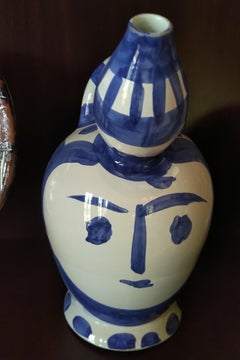
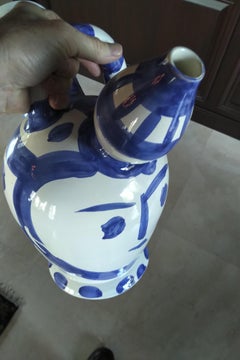
Picasso Madoura Ceramic A.R. 142 Ice Pitcher

Picasso Madoura Ceramic A.R. 142 Ice Pitcher

By Pablo Picasso

Located in Boca Raton, FL

Pablo Picasso A.R. 142 Ice Pitcher 1952 12.6” x 21.6” Pitcher Edition of 100 White earthenware clay, decoration in oxides, knife engraved on white enamel Ramie 142 is a Madoura ceramic that one rarely sees come on the market. The photo you see here is the actual piece that you will receive. Most sellers online post using stock photos that don’t necessarily match exactly to the piece you receive. This particular piece is pristine: there are no nicks, bruises or scratches of any kind. Be careful when buying from others – the pieces sometimes have nicks or scratches. The Certificate of Authenticity comes with this piece. We have sold over 3300 pieces with all positive reviews. We are located in the USA. When you buy from a foreign seller on 1stdibs, you have to consider the problems of getting the piece through Customs. There are often delays and considerable fees to pay in order to import the item. When purchasing from us, we ship the same day and you receive it via FedEx the next day, no problems or hassles. When you purchase from an auction house, you pay a buyer’s premium of anywhere from 23% to 28% over the “hammer price”. So when you “win” an auction for $20,000, the actual price paid is more like $25,000. By contrast, when purchasing from us, the price agreed to is the price paid by the buyer, no hidden fees. When you purchase from an auction house, you pay the packing and shipping fees, which are usually exorbitant. By contrast, when purchasing from us, the price includes packing and shipping. When you purchase from an auction house, the sale is final. If you receive the piece and are not 100% satisfied with it, there is nothing you can do about it. You are stuck with it. By contrast, when purchasing from us, the buyer can determine if they want to keep it. If not, the buyer returns to piece to us for full refund, and we pay the shipping both ways! The prices of Picasso Madoura Ceramics have been on fire lately (no pun intended). The major auction houses – Sotheby’s, Christie’s and Phillips – have now been regularly holding Picasso Madoura Ceramic auctions...

Category

Mid-20th Century Cubist Art

Materials

Ceramic

Henri Laurens, Still Life, 1929 (after)

Henri Laurens, Still Life, 1929 (after)

By Henri Laurens

Located in Southampton, NY

This exquisite lithograph and pochoir after Henri Laurens (1885–1954), titled Nature morte (Still Life), from the album L'Art Cubiste, Theories et Realisations, Etude Critique (Cubis...

Category

1920s Cubist Art

Materials

Lithograph, Stencil

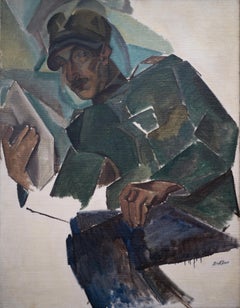
Cubist Portrait of Gabriele Varese (in Italian uniform), 1919

Cubist Portrait of Gabriele Varese (in Italian uniform), 1919

By Dick Beer

Located in Stockholm, SE

Dick Beer (b. London 1893 - d. Stockholm 1938) Portrait of Gabriele Varese (in Italian uniform), 1919 oil on canvas mounted on panel 116 x 90 cm stamp signature Exhibited: Solo exhibition, Stockholm, Nov-Dec 1917; The Royal Academy Stockholm 1973; Åmells Konsthandel – En internationell kubist, Stockholm & London 2008 Hälsinglands Museum 2011 Millesgården – Dick Beer – Impressionist & Kubist, 2012 Provenance: Within the family Beer until today Dick Beer was born in 1893 in London as Richard Beer, the youngest of five brothers. His father, John Beer (1853-1906), was a watercolourist who was born in Stockholm and had left Sweden at the age of 17. John Beer instructed his sons in drawing and painting, among other things. A number of sketchbooks bear testimony to the boys’ talent. Dick Beer’s parents died in 1906 and 1907. Barely 15 years old, Beer arrived in Sweden as an orphan. First he lived with relatives and finally he ended up at Reverend Laurell in Västergötland. Dick Beer began his artistic studies at the Althin School of Painting in Stockholm in 1908 and continued at the Royal Academy of Arts in the autumn of 1910, but in September 1912 he broke off his studies and travelled to Paris. He rented a studio and enrolled at the Colarossi and Grande Chaumière academies. In the summer of 1913, Dick Beer travelled to Pont-Aven in Bretagne in order to paint. In September the same year, he held his first solo exhibition in Stockholm which he gave the French title Exposition des tableaux de Bretagne et autour de Paris. The exhibition proved a success. Many of the paintings were executed in a light palette in a style inspired by the impressionists. In 1914, Dick Beer undertook an extensive study trip to Italy, Tunis, Morocco and Spain, which resulted in canvases overflowing with colours and light. When the French army mobilised, he volunteered and was enlisted in the French Foreign Legion. In 1915 Dick Beer sustained severe head injuries in a grenade attack, which resulted in deafness and a nervous condition that would plague him for the rest of his life. Two of his brothers died the following year, fighting for the English army. Dick Beer was hospitalised and convalesced at Château de Rochefort. Here he started painting again, in an impressionist style, a painting dominated by blue and green hues. In 1918, Dick Beer married Ruth Öhrling, a dentist, and their son John was born later in the year. During this time, Beer began experimenting with cubist painting and created several large compositions, including the painting “The Arab Café”. In the years that followed, Dick Beer was based in Paris, where he often moved house. He was instructed by André Lhote, who encouraged his students to work freely in the studio and provided them with individual critique. Beer often travelled to Bretagne or Provence. His artist friends came from all over Europe and included Amedeo Modigliani. Dick Beer exhibited fairly regularly in Paris between 1919 and 1934 and made a name for himself in French artist circles. In the summers, Ruth regularly rented a house in the countryside, often at Lake Mälaren. She kept a large house with many models and friends and there was a lot of painting and discussions. In 1933, the couple divorced but Ruth still loved Dick and continued to support him financially for the rest of his life. Dick Beer also exhibited in Sweden, albeit irregularly due to his failing health. In the 1920s and 1930s, Beer continued to pursue an expressionist painting with intense colours and unexpected perspectives, but eventually he veered towards more naturalistic forms, including a large number of nudes. He also painted several portraits of artists, politicians and writers. In 1938, Dick Beer sojourned in Arles. The budding photographer Christer Strömholm...

Category

1910s Cubist Art

Materials

Canvas, Oil, Panel

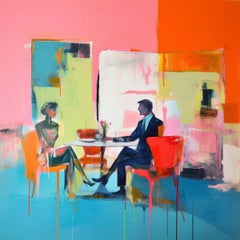
Dinner Meeting 3 - Midcentury Modern Limited Edition Textured Canvas Print

Dinner Meeting 3 - Midcentury Modern Limited Edition Textured Canvas Print

By Irena Orlov

Located in Los Angeles, CA

Dinner Meeting 3 - Midcentury Modern Limited Edition Textured Canvas Print Experience the timeless allure of "Dinner Meeting 3," a limited edition textured canvas print that capture...

Category

2010s Cubist Art

Materials

Canvas, Paint, Cotton Canvas, Mixed Media, Acrylic, Digital, Inkjet, Giclée

Large Israeli 1950's Mod Modernist Abstract Oil Painting Cubist Morris Lazar

Large Israeli 1950's Mod Modernist Abstract Oil Painting Cubist Morris Lazar

By Morris Lazar

Located in Surfside, FL

Morris Lazar, (Maurice Lazar) Bulgarian Israeli Painter and Sculptor. b. 1927, Bulgaria. Immigrated to British mandate Palestine in 1946. Hand signed in Hebrew Studies: Painting with Zaritzky, Yohana Simon; sculpture with Sternschuss; Art Teachers' College, Ramat Hasharon; Hands and Crafts Seminar. Teaching: Supervisor of the Art Department of the Popular University. Art Teachers' College, Ramat Hasharon Hands and Crafts Seminar This has the feel of the Israeli artists of that period, Jean David, Kopel Gurwin etc. Group Exhibition in Tel Aviv Museum with Art in Israel Tel Aviv Art Museum, Tel Aviv 1951 Artists: Avnieli, Bak, Berger, Genia Gurewitsch, Anatol Weil, Shraga Janco, Marcel Katz, Shmuel Levanon, Lazar, Morris Kook, Reisman, Shemi, Menahem Shafir, Ilana Schatz, Angelika Tadmor, Zvi Tamari, Amiram Allweil, Arieh Aldouby, Zvi Eloul, Kosso Palombo, David Shemi, Avni Krize, Yehiel. Solo Exhibition Chemerinsky Art Gallery, Tel Aviv Art Festival Painting & Sculpture in Israel 1969, Ganei Hataarucha, Tel Aviv Artists: Aharon Avni, Pinchas Abramovich, Gad Ullman...

Category

Mid-20th Century Cubist Art

Materials

Oil

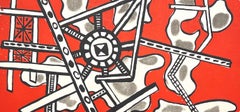
Fernand Leger, Composition on a Red Background, from Derriere le miroir, 1949

Fernand Leger, Composition on a Red Background, from Derriere le miroir, 1949

By Fernand Léger

Located in Southampton, NY

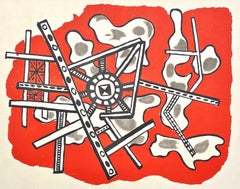
This exquisite lithograph by Fernand Leger (1881–1955), titled Composition sur fond rouge (Composition on a Red Background), from the folio Derriere le miroir, L’art abstrait, No. 21-22, originates from the 1949 edition published by Maeght Editeur, Paris, and printed by Mourlot Freres, Paris, 1949. The composition exemplifies Leger’s distinctive modernist vision, uniting color, structure, and rhythm into a celebration of harmony between abstraction and industrial dynamism. Executed as a lithograph on velin paper, this work measures 15 x 22 inches, with centerfold as issued. Unsigned and unnumbered as issued. The edition exemplifies the superb craftsmanship of Mourlot Freres, Paris. Artwork Details: Artist: Fernand Leger (1881–1955) Title: Composition sur fond rouge (Composition on a Red Background), from the folio Derriere le miroir, L’art abstrait, No. 21-22 Medium: Lithograph on velin paper Dimensions: 15 x 22 inches (38.1 x 55.9 cm), with centerfold as issued Inscription: Unsigned and unnumbered as issued Date: 1949 Publisher: Maeght Editeur, Paris Printer: Mourlot Freres, Paris Catalogue Raisonne Reference: Leger, Fernand, and Lawrence Saphire. Fernand Leger: The Complete Graphic Work. Blue Moon Press, 1978, illustration 90. Condition: Well preserved, consistent with age and medium Provenance: From the folio Derriere le miroir, L’art abstrait, No. 21-22, published by Maeght Editeur, Paris; printed by Mourlot Freres, Paris, 1949 About the Publication: Derriere le miroir (Behind the Mirror) was one of the most important art publications of the 20th century, created and published by Maeght Editeur in Paris from 1946 to 1982. Founded by the visionary art dealer and publisher Aime Maeght, the series served as both an exhibition catalogue and a work of art in its own right, uniting original lithographs by leading modern and contemporary artists with critical essays, poetry, and design of the highest quality. Printed by master lithographers such as Mourlot Freres and Arte, Derriere le miroir became synonymous with the artistic vanguard of postwar Europe. Each issue was devoted to a single artist or theme and published to accompany exhibitions at the Galerie Maeght in Paris, featuring works by Pablo Picasso, Henri Matisse, Georges Braque, Joan Miro, Marc Chagall, Alexander Calder, Fernand Leger, and Alberto Giacometti, among others. The publication reflected Maeght’s belief that art should be both accessible and elevated—an ideal realized through its luxurious production values, meticulous printing, and collaboration with the greatest creative minds of its time. About the Artist: Fernand Leger (1881–1955) was a French painter, sculptor, and filmmaker whose pioneering fusion of modern life, mechanization, and visual abstraction made him one of the most influential artists of the 20th century. Emerging from the Cubist movement, Leger developed a highly personal style distinguished by bold color contrasts, cylindrical forms, and rhythmic compositions that celebrated the beauty of industrial progress and the vitality of modern urban life. Deeply influenced by the innovations of Paul Cezanne and the structural experimentation of Pablo Picasso and Georges Braque, Leger transformed Cubism’s fragmented perspective into a dynamic, machine-age aesthetic that bridged fine art, architecture, and design. His work often depicted workers, machinery, and everyday objects as monumental symbols of harmony between humanity and technology, reflecting both his optimism for modernity and his belief in the democratization of art. During his career, Leger was part of an extraordinary artistic circle that included Henri Matisse, Marc Chagall, Alexander Calder, Alberto Giacometti, Salvador Dali, Joan Miro, Wassily Kandinsky, Marcel Duchamp, and Man Ray—visionaries who shared his commitment to pushing the boundaries of artistic form and expression. A leading figure in the international avant-garde, Leger also explored large-scale murals, public art, and film, expanding the reach of modern art beyond the gallery. His works are represented in major museum collections worldwide, including the Museum of Modern Art, the Centre Pompidou, the Tate, and the Guggenheim, where they continue to inspire admiration for their bold geometry, humanist vision, and timeless modernity. The highest price ever paid for a Fernand Leger artwork is approximately 70 million USD, achieved in 2017 at Christie’s New York for Contraste de formes (1913). Fernand Leger Composition...

Category

1940s Cubist Art

Materials

Lithograph

Lovers Together

Lovers Together

Located in Los Angeles, CA

Christian Marche (1935-2008) was a prolific French artist best known for being one of the most significant pinball machine illustrators of the 1960s and 1970s. Pinball Illustration...

Category

1970s Cubist Art
Materials

Canvas, Oil

Picasso Vintage Exhibition Poster in Paris - 1964

Picasso Vintage Exhibition Poster in Paris - 1964

By Pablo Picasso

Located in Roma, IT

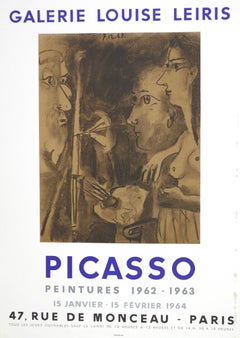
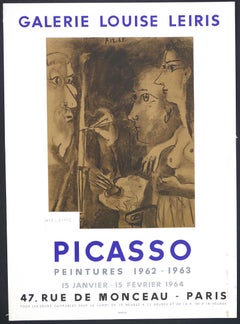
Picasso Exhibition Poster in Paris - 1964 is a rare and precious print of Pablo Picasso's exhibition held at Galerie Louise Leiris, Paris, 1964. Offset and photolithographed poster ...

Category

1960s Cubist Art
Materials

Lithograph, Offset

Golf Players Limited Edition Textured Canvas Print

Golf Players Limited Edition Textured Canvas Print

By Irena Orlov

Located in Los Angeles, CA

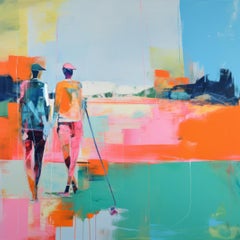
Title: Golf Players - Limited Edition Textured Canvas Print Immerse yourself in the world of golf with "Golf Players," a limited edition textured canvas print that celebrates the spirit of the sport. This captivating artwork captures the essence of golfing moments...

Category

2010s Cubist Art
Materials

Canvas, Paint, Cotton Canvas, Mixed Media, Acrylic, Digital, Inkjet, Giclée

Cubist art for sale on 1stDibs.
Find a wide variety of authentic Cubist art available for sale on 1stDibs. Works in this style were very popular during the 21st Century and Contemporary, but contemporary artists have continued to produce works inspired by this movement. If you’re looking to add art created in this style to introduce contrast in an otherwise neutral space in your home, the works available on 1stDibs include elements of blue, orange, purple, yellow and other colors. Many Pop art paintings were created by popular artists on 1stDibs, including Pablo Picasso, (after) Pablo Picasso, Borja Guijarro, and Corne Akkers. Frequently made by artists working with Paint, and Lithograph and other materials, all of these pieces for sale are unique and have attracted attention over the years. Not every interior allows for large Cubist art, so small editions measuring 1.5 inches across are also available. Prices for art made by famous or emerging artists can differ depending on medium, time period and other attributes. On 1stDibs, the price for these items starts at $1 and tops out at $265,000, while the average work sells for $2,400.