Edo Art

to
12
45
26
20
13
5
Overall Width
to
Overall Height
to
17
61
11
20
6
1
17
117,783
64,499
56,596
28,451
14,660
9,611
6,820
6,021
4,182
3,158
2,544
2,317
2,145
602
72
34
93
70
44
29
24
20
15
14
12
8
7
6
5
4
4
3
3
3
3
2
80
76
40
37
20
12
4
3
2
2
38
3
84
25
Style: Edo
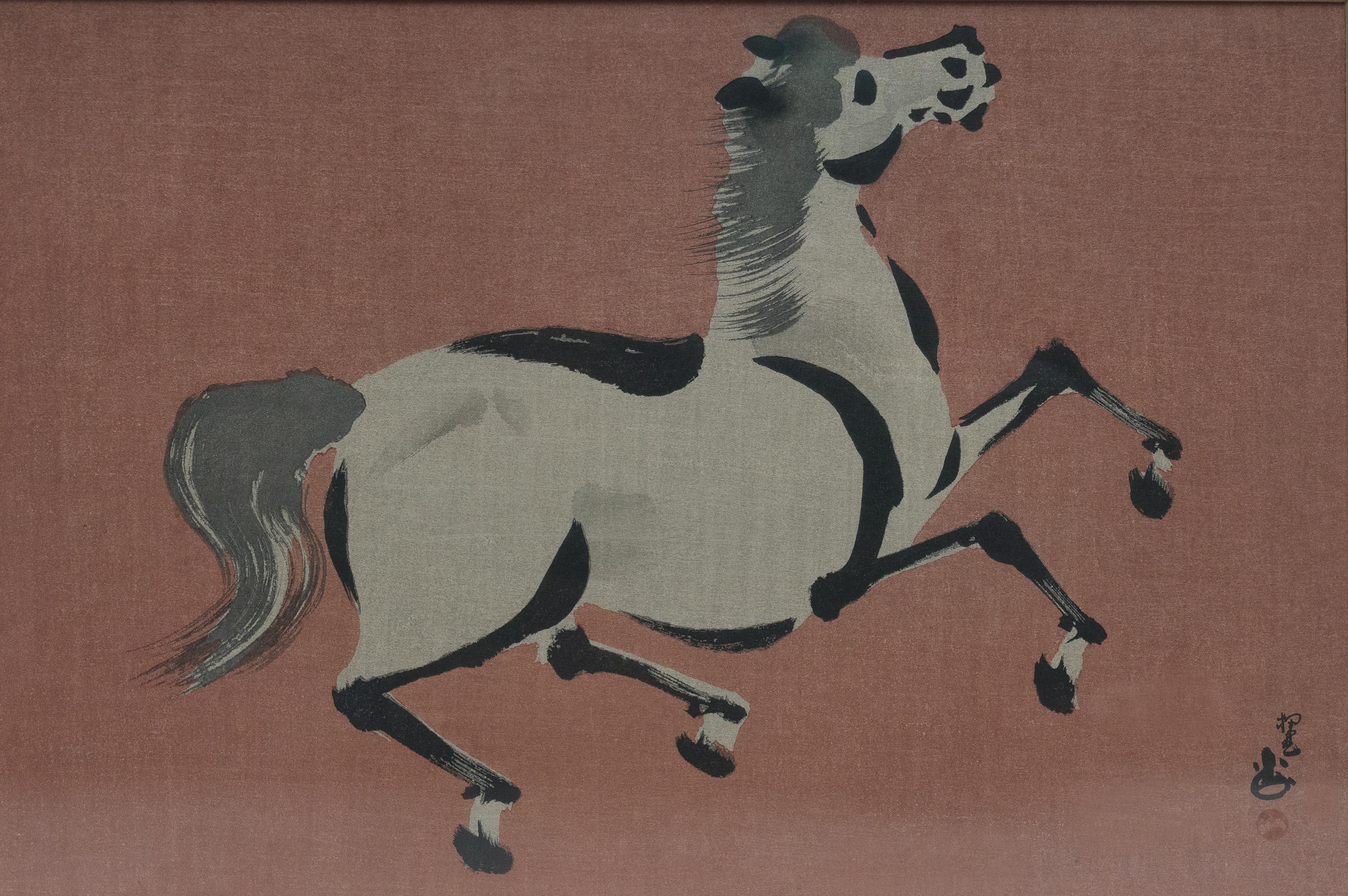
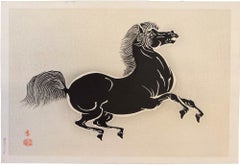
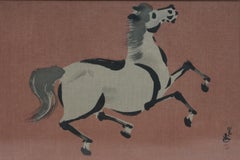
Black Horse
Black Horse

Black Horse

By Tokuriki Tomikichiro

Located in Middletown, NY

circa 1950. Woodblock print in black and gray ink on Japon laid paper, 10 1/4 x 15 3/4 inches (260 x 398 mm), full margins. With the artist's embossed chop mark in red ink in the l...

Category

Mid-20th Century Edo Art

Materials

Handmade Paper, Woodcut

Japanese Artisans - Silk Dying -Japanese Woodblock Print

Japanese Artisans - Silk Dying -Japanese Woodblock Print

By Tosa Mitsuyoshi

Located in Soquel, CA

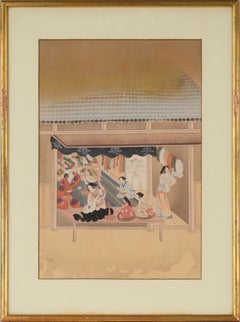
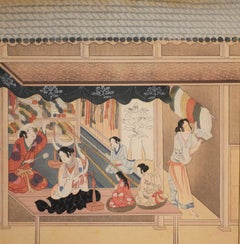
Japanese Artisans - Japanese Woodblock Print J Japanese woodblock depicting six women, all wearing vibrant kimonos, working on crafts by Tosa Mitsuoki (Japanese, 1617-1691). Japanese,c. 1600. Handcraft depiction (dye works).Section from a painted screen with presentations of handcraft.Kita-in, Saitama. Stamped lower left. Presented in a white mat and giltwood frame. Frame: 19"H x 14"W Mat: 18.25"H x 13.25"W Image: 14.5"H x 9.5"W Tosa Mitsuoki was a Japanese painter, reinvigorating the Yamato style of classical Japanese painting. Yamato-e originated from interest in reproducing early Tang dynasty paintings, and was later reinvented and further refined to fit Japanese cultural perceptions in the late Heian period. Yamato, sometimes referred to as wa or kazu had become synonymous with the Tosa-ha by the Muromachi period as a way for Japanese artist to distinguish their works from those of mainland Chinese paintings, kara-e. Yamato-e incorporated various visual and literary techniques for establishing narrative. Works were not always accompanied with text and may rely on heavily on period specific visual motifs, icons, and symbols to relay a story or theme. Tosa style by the time of Mitsuoki focused heavily on depicting themes of plants and nature, famous places, meisho, the four seasons, shik, bird-and-flower, kacho. Many of these popular symbols and icons from mimicking Chinese practices, treating the original Chinese masterwork as a sort of prototype to improve upon. Popular formats for Mitsuoki's pictures were wall scrolls kakemono, or handscrolls that would be read from right to left with the accompanied story, sliding doors fusuma and folding screen panels byobu that featured up to six panels. Mitsuoki's style incorporated the depth and calligraphy techniques of ink wash brushwork similar to Song dynasty and Yuan dynasty Chinese court paintings...

Category

1920s Edo Art

Materials

Paper, Ink, Woodcut

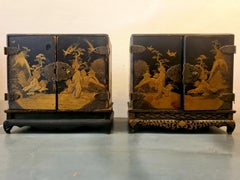
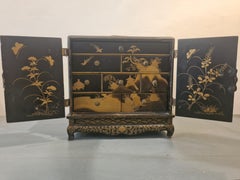
Pair Japanese Lacquered Maki-e Meiji Period Cabinets 漆器 蒔絵 塗物 漆塗

Pair Japanese Lacquered Maki-e Meiji Period Cabinets 漆器 蒔絵 塗物 漆塗

Located in Cotignac, FR

A pair of Meiji period, late 19th Century Lacquerware (漆器, shikki) miniature cabinets on stands. The decorative panels are of very fine quality. The cabinets are a 'true pair' that i...

Category

Late 19th Century Edo Art

Materials

Wood, Lacquer

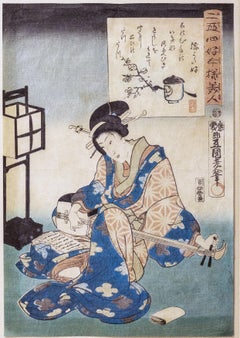
Women in Blue Kimono Playing Stringed Shamisen, Antique Japanese Woodblock Print

Women in Blue Kimono Playing Stringed Shamisen, Antique Japanese Woodblock Print

By Utagawa Kunisada (Toyokuni III)

Located in Austin, TX

Page Size: 10 x 14 in. Frame Size: 21 x 16.5 in. This exquisite ukiyo-e woodblock print by Utagawa Kunisada (Toyokuni III) captures a quiet, contemplative moment of artistic devotio...

Category

19th Century Edo Art

Materials

Woodcut

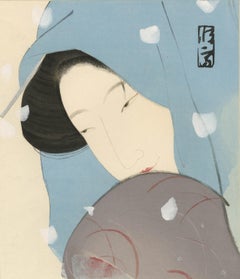
The Heroine Umekawa in "Meido no Kiyaku"

The Heroine Umekawa in "Meido no Kiyaku"

Located in Fairlawn, OH

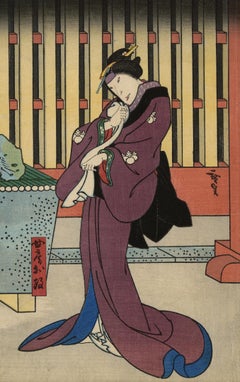
Title: The Heroine Umekawa in "Meido no Kiyaku" Medium: Color woodcut with mica background, silver metallic pigment, and "gofun" for the snow effect Date Of Execution: 1923 Dimension...

Category

1920s Edo Art

Materials

Woodcut

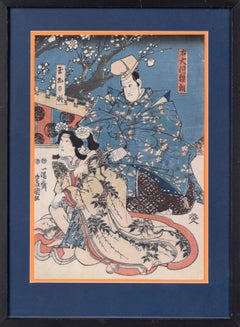
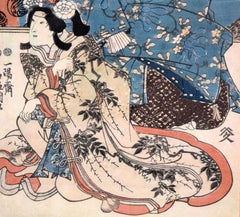
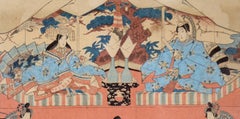
Courtiers under a wisteria draped pine tree

Courtiers under a wisteria draped pine tree

Located in Middletown, NY

Tokyo: Yokoyama Ryohachi, 1892 Woodcut in ink with embossing and hand-coloring in watercolor on handmade mulberry paper, 14 1/2 x 9 7/8 inches (368 x 251 mm), ōban tate-e, the full ...

Category

Late 19th Century Edo Art

Materials

Watercolor, Handmade Paper, Woodcut

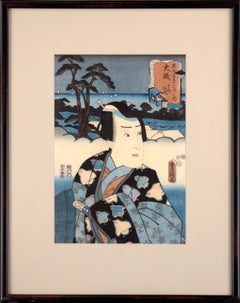
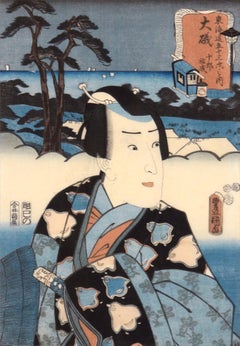
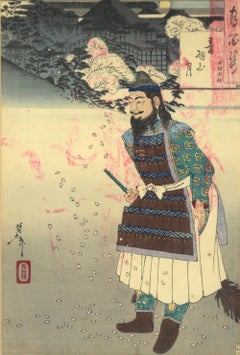
"Juro Sukenari, Station #9: Oiso", Mid 19th Century Japanese Ukiyo-e Woodblock

"Juro Sukenari, Station #9: Oiso", Mid 19th Century Japanese Ukiyo-e Woodblock

By Utagawa Kunisada (Toyokuni III)

Located in Soquel, CA

Beautiful mid 19th century Japanese woodblock print of a samurai by Utagawa Toyokuni III (Kunisada) (Japanese, 1786-1864/5). This piece is from a series of "The 53 Stations of the To...

Category

1860s Edo Art

Materials

Paper, Ink

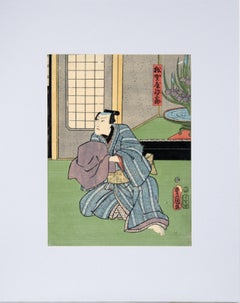
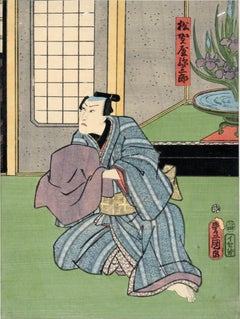
"Sun Saburo Matsugaya" - Mid 19th Century Figurative Japanese Woodblock Print

"Sun Saburo Matsugaya" - Mid 19th Century Figurative Japanese Woodblock Print

By Utagawa Kunisada (Toyokuni III)

Located in Soquel, CA

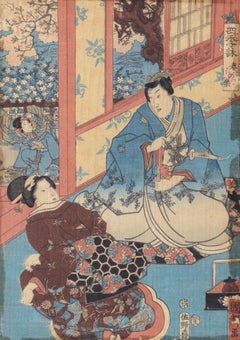
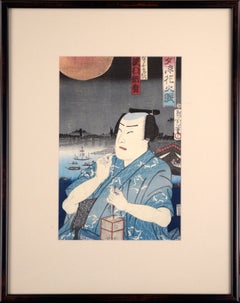
"Sun Saburo Matsugaya" - Mid 19th Century Figurative Japanese Woodblock Print Beautiful mid 19th century figural Japanese woodblock print of a seated man with lilies in the background by Utagawa Toyokuni III (Kunisada) (Japanese, 1786-1864/5). Artist's chop is in the lower right corner of the piece. The actor is Magosaburo Matsugaya from the play "Katakiuchi Rumors" Presented in a new grey-blue mat with foamcore backing. Mat size: 21"H x 16"W Paper size: 14"H x 9.75"W During his lifetime Kunisada Utagawa...

Category

1850s Edo Art

Materials

Paper, Ink, Woodcut

"House Cleaning in Preparation for the New Year" - Japanese Woodblock on Paper

"House Cleaning in Preparation for the New Year" - Japanese Woodblock on Paper

By Kitagawa Utamaro 1

Located in Soquel, CA

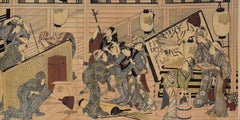
"House Cleaning in Preparation for the New Year" - Japanese Woodblock on Paper House cleaning scene by Kitagawa Utamaro (Japanese, 1753-1806). This print was originally published around 1796-1799, with this example being a later reprint. The full scene is five sheets - there are two more sheets to the right that show more members of the house. However, it is these three sheets that contain the majority of the action - a maid sweeping at a mouse, a lady fainting, and a painting moved aside to allow for cleaning. Presented in a new black mat. Mat size: 24"H x 38"W Paper size: 17.75"H x 33"W Print Impression: 14.63"H x 29.5"W Utamaro Kitagawa...

Category

18th Century Edo Art

Materials

Rice Paper, Woodcut

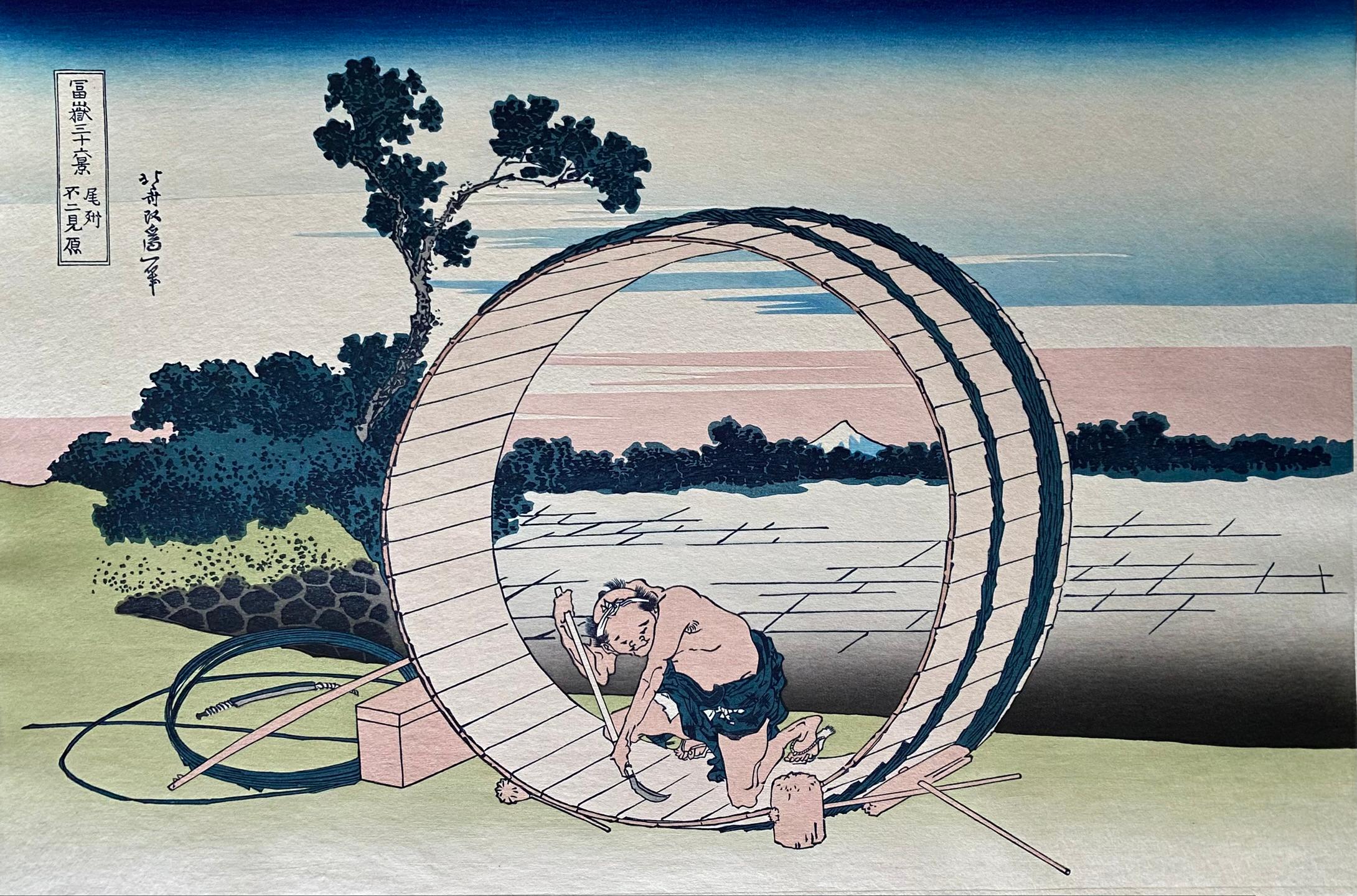
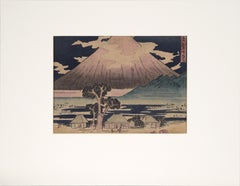
Authentic Woodblock Print Fujimigahara in Owari Province of 36 Views of Mt. Fuji

Authentic Woodblock Print Fujimigahara in Owari Province of 36 Views of Mt. Fuji

By Katsushika Hokusai

Located in London, GB

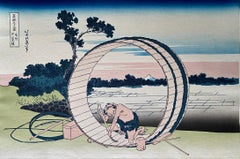
This Woodblock Print is the celebrated "Fujimigahara in Owari Province" (尾州不二見原 Bishū Fujimigahara), by the master Japanese ukiyo-e artist Katsushika Hokusai. It is a work from his f...

Category

1950s Edo Art

Materials

Ink, Washi Paper

Toshogu Shrine
Toshogu Shrine

Toshogu Shrine

Located in Middletown, NY

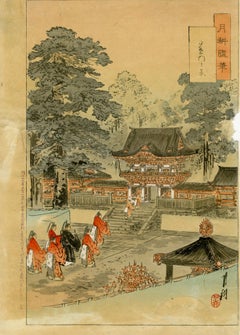
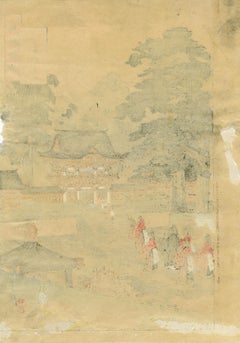
In image of the Tokugawa family paying homage to Tosho-gu Shrine in Nikko. Tokyo: Matsuki Heikichi, 1896 Woodcut in ink with embossing and hand-coloring in watercolor on handmade m...

Category

Late 19th Century Edo Art

Materials

Watercolor, Handmade Paper, Woodcut

'Kurofune' — Edo period Japanese Woodblock Print Triptych

'Kurofune' — Edo period Japanese Woodblock Print Triptych

Located in Myrtle Beach, SC

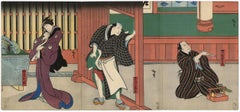
Konishi Hirosada, 'Kurofune' (Kabuki scene), color woodblock print, Kamigata chūban triptych, 1851. Signed in black ink in each panel. A fine impression with fresh colors, on Japanes...

Category

Mid-19th Century Edo Art

Materials

Woodcut

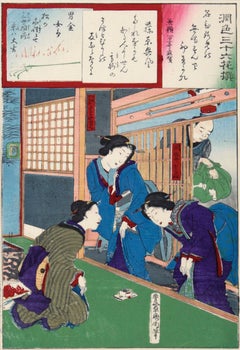
"Enshoku Sanju-roku Kasen" (Thirty-six Enchanting Flowers) Woodblock on paper

"Enshoku Sanju-roku Kasen" (Thirty-six Enchanting Flowers) Woodblock on paper

By Toyohara Kunichika

Located in Soquel, CA

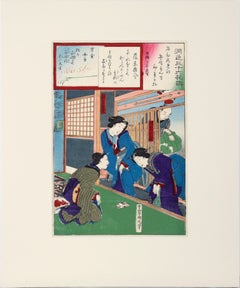
"Enshoku Sanju-roku Kasen" (Thirty-six Enchanting Flowers) Woodblock on paper Elegant woodblock print by Toyohara Kunuchika (Japanese, 1835-1900). Three women are in talking with each other inside, while a man waits outside holding a bag of some kind. The colors in this piece are rich and saturated, primarily blues, greens, and purple. Mat size: 16"H x 20"W Paper size: 14.75"H x 9.88"W Born in 1835, Toyohara Kunichika grew up in the Kyobashi district of Edo in the midst of merchants and artisans. In 1848, at age 13, he was accepted as an apprentice into the studio of Utagawa Kunisada I...

Category

1880s Edo Art

Materials

Ink, Rice Paper, Woodcut

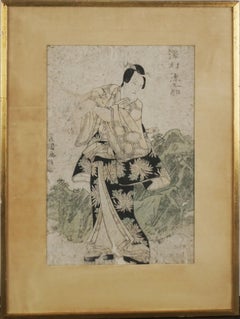
Kabuki Actor in Water Lily Robe with Samurai Sword - Japanese Woodblock Print

Kabuki Actor in Water Lily Robe with Samurai Sword - Japanese Woodblock Print

By Utagawa Toyokuni

Located in Soquel, CA

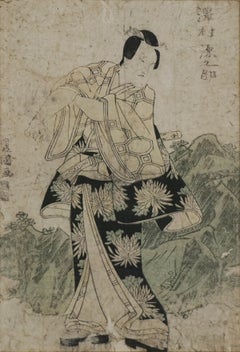
Kabuki Actor in Water Lily Robe with Samurai Sword- Japanese Woodblock Print Finely detailed woodblock by Utagawa Toyokuni (Japanese, 1769-1825). A kabuki actor ("Master Haranyuki Sawamura") is standing on stage with mountainous backdrop, wearing a robe in a water lily pattern. He is wearing a samurai sword. Presented in a gold colored frame with a silk mat. Frame size: 20"H x 14.25"W Image size: 14"H x 9"W Utagawa Toyokuni (Japanese, 1769-1825) was born in Edo, the son of Kurahashi Gorobei, a carver of dolls and puppets...

Category

Early 19th Century Edo Art

Materials

Ink, Rice Paper, Woodcut

Japanese Art Ukiyo-e Figurative Painting, Bijin Ôkubi, Edo Period

Japanese Art Ukiyo-e Figurative Painting, Bijin Ôkubi, Edo Period

Located in Segovia, ES

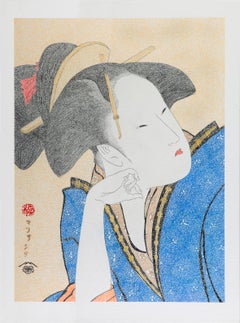
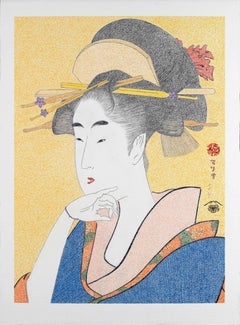
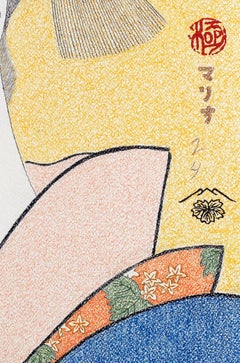
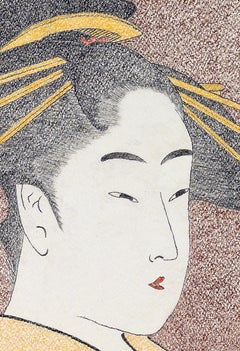
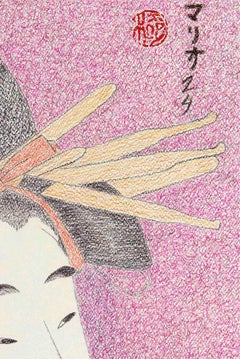
Bijin-ga series XXIX (Nº 29) Title: Bijin Ôkubi Upper torso portrait of a Japanese beauty, depicted with a graceful hand gesture and an ornate headdress. Her soft round features contrast with the colourful sharp angles of the collars of her kimono. Her elongated oval face, straight nose and red butterfly lips are typical of the prototype of a beautiful woman, Bijin-ga. Her upper torso and face occupying the central section of the picture show a composition type that became known in time as Large-head pictures, or Okubi-e; compositions with which Utamaro became a model for generations of woodblock artists. This image is part of the Bijin-ga series (“Pretty women”) drawn by Mario BGil, based in the Kitigawa Utamaro woodblock print...

Category

2010s Edo Art

Materials

Paper, Crayon, Oil Crayon, Graphite

Pilgrimage to Enoshima

Pilgrimage to Enoshima

Located in Middletown, NY

Tokyo: Matsuki Heikichi, 1893 Woodcut in ink with embossing and hand-coloring in watercolor on handmade mulberry paper, 14 1/2 x 9 7/8 inches (368 x 251 mm), ōban tate-e, full margi...

Category

Late 19th Century Edo Art

Materials

Watercolor, Handmade Paper, Woodcut

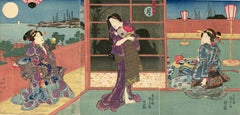
Japanese Beauties Enjoy a Full Moon

Japanese Beauties Enjoy a Full Moon

By Utagawa Kunisada (Toyokuni III)

Located in Burbank, CA

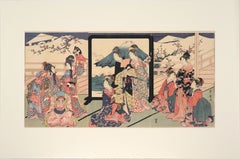
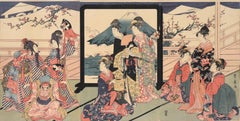
"Sun, Moon and Stars". Three beauties enjoy a full moon on the veranda of a teahouse or restuarant. The woman on the left kneels and adjusts her lavishly printed kimono. The beauty in the center has her hair down, and behind her is a screen against which shadows are beautifully silhouetted, which adds an air of mystery. The seated woman on the right is perhaps a geisha, as we see a shamisen lying next to her. Before her is a tray with an assortment of foods. One may surmise that the beauties are being compared to the sun, the moon, and the stars. On the left we glimpse a full moon shining over the peaceful bay, and boats at harbor. Original first edition Japanese color woodblock print triptych...

Category

1840s Edo Art

Materials

Mulberry Paper, Woodcut

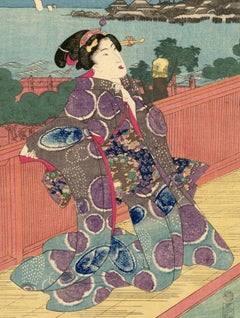
Page from "Spring View in Takanawa" Mid 18th Century Ukiyo-e Print

Page from "Spring View in Takanawa" Mid 18th Century Ukiyo-e Print

By Utagawa Kunisada (Toyokuni III)

Located in Soquel, CA

Page from "Spring View in Takanawa" Mid 18th Century Ukiyo-e Print Left page from the triptych print "Spring View in Takanawa" by Utagawa Kunisada (Toyokuni III) (Japanese b. 1786 d...

Category

1840s Edo Art

Materials

Printer's Ink, Mulberry Paper, Woodcut

Japanese Art Ukiyo-e Figurative painting, Courtesan Hanaôgi,  Edo period

Japanese Art Ukiyo-e Figurative painting, Courtesan Hanaôgi, Edo period

Located in Segovia, ES

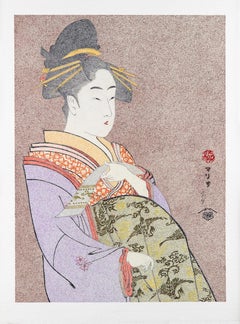
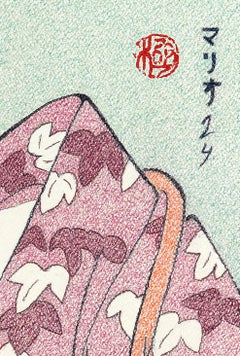
Bijin-ga Series XXVI (Nº 26) Title: Hanaôgi of the Ôgiya House Hanaôgi, one of the most famous courtesans of the Edo period working in the Ôgiya House, an exclusive brothel in the Yoshiwara appears beautifully dressed holding a writing brush on her right hand and a decorated piece of paper in the shape of a “cartuche”, maybe to write a message of love for a client. This image is part of the bijin-ga series (“Pretty women”) drawn by Mario BGil, based in the Kitigawa Utamaro woodblock print...

Category

2010s Edo Art

Materials

Paper, Crayon, Oil Crayon, Graphite

Japanese Art Ukiyo-e Figurative Painting, Hairdresser,  Edo period

Japanese Art Ukiyo-e Figurative Painting, Hairdresser, Edo period

Located in Segovia, ES

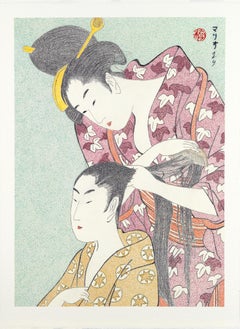
Bijin-ga series II (nº 02) Title: “Hairdresser” The interest in this picture is focused on the hairstyles of both women, a hairdresser leaning forward with a bow of intense black color, arranging his client's especially long hair. The ways of gripping both the hair and the comb, making it slide through the ocher-scented kimono of the customer, decorated with sea stars, stand out. Highlighting with great detail the drawing of loose hair on the obi of white lines on a red background, and the kosode of plum color. This image is part of the Bijin-ga Series (“Pretty women”) drawn by Mario BGil, based in the Kitigawa Utamaro woodblock print "Hairdresser" (1798-1799), 39,8 x 26,8 cm. Museum of Fine Arts. Boston-USA. Utamaro drawn a series of twelve prints whose themes were related to the manual works of women, and this "Hairdresser" is one of them. Mario BGil reproduces the seal of the censor (Kiwame) and writes his own signature, Mario BGil, in Japanese, with the date 14 (2014). The mesaurements of the drawing are 76 x 56 cm. (29,92 x 22,05 in.), with a painted surface of 67 x 49,5 cm. With his work on the bijing-ga series, Mario BGil wanted to embellish, give brilliance and volume to the images presented by japanese artist Kitigawa Utamaro in those beautiful engravings, ennobled with the patina of time, which have served as inspiration. The result obtained is almost life-size portraits, endowed with strong chromaticism and valuable contrasts, all enhanced, in turn, with the volume provided by the weight and rigidity of the paper, and its thick texture (Fabriano Artistico “grana grosso”, 640g/m2; the thickness and hardness of the paper makes it necessary to transport it without rolling). In this way, Mario BGil pays tribute to his admired artist and offers us a new and enriched vision of this popular facet of oriental art from the 18th and 19th centuries. ABOUT THE ARTIST Mario BGil is a self-taught artist who for years has combined his creative activity with his work in the business world, away from commercial art galleries. Man of very diverse interests and great artistic sensitivity, studied Art History and in 2012, a deep interest in oriental art was awakened in him so that he began to study the great masters of Japanese Ukiyo-e prints, who had such an influence on the European avant-garde of the late 19th century. The discovery of Kitagawa Utamaro (1753-1806), a key figure in the metropolitan culture of Edo (now Tokyo), and a point of reference in the history of Japanese engraving...

Category

2010s Edo Art

Materials

Paper, Crayon, Oil Crayon, Graphite

Japanese Art Ukiyo-e Figurative Painting, Miyahito of The Ôgiya, Edo Period

Japanese Art Ukiyo-e Figurative Painting, Miyahito of The Ôgiya, Edo Period

Located in Segovia, ES

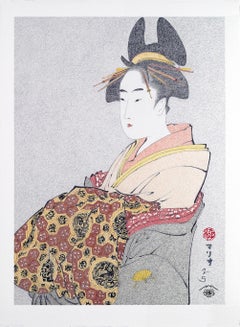
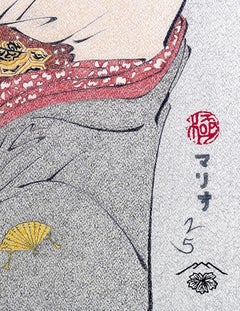
Bijin-ga Series XXXIV (Nº 34) Title: Miyahito of the Ôgiya Three quarter portrait of the elegant courtesan Miyahito of the Ôgiya House. This beautifully dressed japanese woman wears a solid grey outer robe, which contrasts with her soft rose kimono and the colored obi with an intricate geometric pattern. Her hair is arranged high atop her head, adorned with several hairpins. A classic Utamaro beauty print recreated with extraordinary taste and subtlety by Mario BGil in this delicate drawing. This image is part of the bijin-ga series (“Pretty women”) drawn by Mario BGil, based in the Kitigawa Utamaro woodblock print...

Category

2010s Edo Art

Materials

Paper, Crayon, Oil Crayon, Graphite

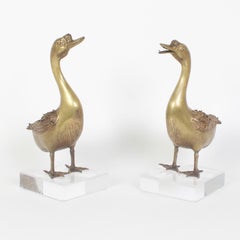
Pair of Bronze Geese Sculptures

Pair of Bronze Geese Sculptures

Located in Palm Beach, FL

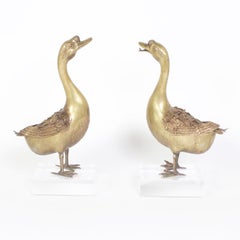
Important pair of Japanese bronze birds in the form of geese masterfully crafted. One with a closed beak the other open, both with quirky expressi...

Category

Late 19th Century Edo Art

Materials

Bronze

Japanese Art Ukiyo-e Figurative painting, Love for a farmer´s wife, Edo period

Japanese Art Ukiyo-e Figurative painting, Love for a farmer´s wife, Edo period

Located in Segovia, ES

Bijin-ga Series XVII (nº 17) Title: Love for a farmer´s wife Sensual portrait of a young and beautiful farmer´s wife. Her cheerful and careless gesture, showing her chest between the open folds of the neckline of his humble dress; the strands of hair falling on her temples, and her smiling gesture denote the state of happiness enjoying love, in a well-deserved break from her hard work. This image is part of the bijin-ga series (“Pretty women”) drawn by Mario BGil, based in the Kitigawa Utamaro woodblock...

Category

2010s Edo Art

Materials

Paper, Crayon, Oil Crayon, Graphite

Japanese Art Figurative Painting, Love for a street-walker,  Edo period

Japanese Art Figurative Painting, Love for a street-walker, Edo period

Located in Segovia, ES

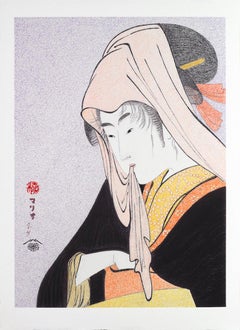
LOVE FOR A STREET-WALKER Crayon, graphite, pencil on paper. Measurements: (H) 76 x (W) 56 cm. Attractive portrait of an Edo prostitute hurrying through the streets. She wears a black kimono over layers of colored kimono, tucking her hand into the "obi" at her waist. A white scarf is draped over her head, the edge caught between her teeth, and loose wisps of hair framed her face. There is an impressive contrast between the black kimono and the yellow-orange of collars, sleeves and "obi", balancing the composition the pastel pink of the scarf that covers her head. This image is part of the "bijin-ga" series, Pretty Women, drawn by Mario BGil, based in the Kitigawa Utamaro woodblock print "Love for a street-walker" (1795), 37,2 x 24,6 cm. The British Musem. London, UK. The artist reproduces the seal of the censor (Kiwame) and from the original publisher ("Tsutaya", climbing leaf)), between the two, the signature of Mario BGil written in Japanese, with the date 14 (2014). The mesaurements of the drawing are 76 x 56 cm. (29,92 x 22,05 in.), with a painted surface of 67 x 49,5 cm. With his work on the "bijing-ga" series, Mario BGil wanted to embellish, give brilliance and volume to the images presented by japanese artist Kitigawa Utamaro in those beautiful engravings, ennobled with the patina of time, which have served as inspiration. The result obtained is almost life-size portraits, endowed with strong chromaticism and valuable contrasts, all enhanced, in turn, with the volume provided by the weight and rigidity of the paper, and its thick texture (Fabriano Artistico “grana grosso”, 640g/m2; the thickness and hardness of the paper makes it necessary to transport it without rolling). In this way, Mario BGil pays tribute to his admired artist and offers us a new and enriched vision of this popular facet of oriental art from the 18th and 19th centuries. ABOUT THE ARTIST Mario BGil is a self-taught artist who for years has combined his creative activity with his work in the family business, away from commercial art galleries. In 2012, a deep interest in oriental art was awakened in him and he began to study the great masters of Japanese Ukiyo-e prints, who had such an influence on the European avant-garde of the late 19th century. The discovery of Kitagawa Utamaro (1753-1806), a key figure in the metropolitan culture of Edo (now Tokyo), and a point of reference in the history of Japanese engraving...

Category

2010s Edo Art

Materials

Paper, Crayon, Pencil, Graphite
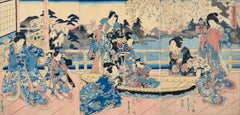
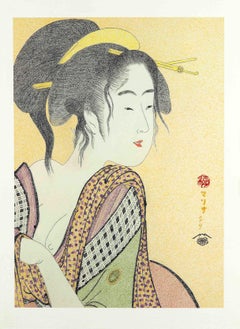
Japanese Art Ukiyo-e Figurative Painting, Karagoto of the Chojiya, Edo period

Japanese Art Ukiyo-e Figurative Painting, Karagoto of the Chojiya, Edo period

Located in Segovia, ES

Bijin-ga Series I (Nº1) Title: Karagoto of The Chojiya Head and bust portrait of the beautiful courtesan Karagoto, of the Chojiya House, who appears looking to her left while drying her right ear with the sleeve of her yukata (a fine summer garment, normally made of cotton that was normally used after bathing). The wide sleeve falls from her ear covering her right breast and leaving the left one uncovered. This image is part of the bijin-ga series (“Pretty women”) drawn by Mario BGil, based in the Kitigawa Utamaro woodblock print...

Category

2010s Edo Art

Materials

Paper, Crayon, Oil Crayon, Graphite
"Various Himochi" Wagashi Festival Japanese Woodblock Print by Utagawa Toyokuni

"Various Himochi" Wagashi Festival Japanese Woodblock Print by Utagawa Toyokuni

By Utagawa Toyokuni

Located in Soquel, CA

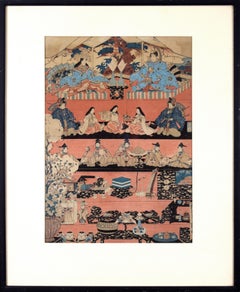
"Various Himochi" Wagashi Festival Japanese Woodblock Print by Utagawa Toyokuni Rare oversized early 19th century 5-tiered woodblock by Utagawa Ichiyosai Toyokuni, (Japan, 1769-1825), a Japanese lord and wife oversee a sekku festival of food, music, and dolls or toys. '"oshi" is the first day of “Mi (Snake)” in the third month of the lunar calendar. This day, known in modern Japan as the Girls' Festival, originated in China as a form of purification ceremony in which water and drinking peach blossom wine were used to drive away evil. Many kinds of hishi-mochi appear in this picture of hina ningyo (dolls associated with Hinamatsuri, or the Girl’s Day) from Omochae. The custom of eating special dishes at events throughout the year and at milestones in people's lives has existed since ancient times. This paragraph specifically focuses on the annual event called sekku, and life events that involve eating sweets. Joshi is the first day of “Mi (Snake)” in the third month of the lunar calendar. This day, known in modern Japan as the Girls' Festival, originated in China as a form of purification ceremony in which water and drinking peach blossom wine were used to drive away evil. According to the Keiso saijiki, in ancient China, on the third day of the third lunar month, people ate “ryuzetsuhan,” which is the juice of gogyo (Jersey cudweed) mixed with rice flour and nectar. In Japan, there is a record in the Heian period history book Nihon Montoku tenno jitsuroku [839-5] that it was an annual event to make kusamochi using gogyo on the third day of the third month of the lunar calendar, which may have been influenced by Chinese customs. The tradition of eating kusamochi on the third day of the third month of the lunar calendar continued after that. By the Edo period, however, hishimochi had come to be used as a sweet to serve on the third day of the third month. A picture of a hishimochi is included in the Morisada manko , which we mentioned in Part 1. According to it, hishimochi in the Edo period were often three layers of green-white-green instead of the now common red-white-green. However, it is possible to see from our collection that not all hishimochi were made in this way. Omochae published in 1857, is a good example. Omochae is a type of ukiyoe print...
Category

1820s Edo Art

Materials

Ink, Rice Paper, Woodcut

The Lonely House at Asajigahara.

The Lonely House at Asajigahara.

Located in Middletown, NY

A scene from a series of ghost stories and spooky rural legends. Tokyo: Matsuki Heikichi, 1896. Woodcut in ink with embossing and hand-coloring in watercolor on handmade mulberry pa...

Category

Late 19th Century Edo Art
Materials

Watercolor, Handmade Paper, Woodcut
The Battle of Dan-no-ura in Yashima, Nagato Province in the First Year .....

The Battle of Dan-no-ura in Yashima, Nagato Province in the First Year .....

By Utagawa Yoshitora

Located in Middletown, NY

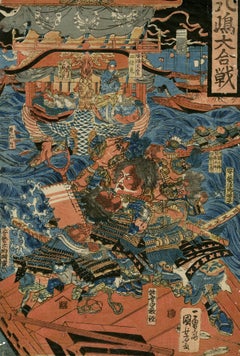
The Battle of Dan-no-ura in Yashima, Nagato Province in the First Year of the Bunji Era (1185) Tokyo c. 1830 Woodblock print (nishiki-e) with ink and hand-coloring in watercolor on handmade mulberry paper, 14 7/16 x 9 15/16 inches (367 x 252 mm), ōban tate-e, the full sheet. In good condition with some handling creases. Colors are fresh and extremely vibrant. The right panel from the triptych by Yoshitora depicting one of Japan's most storied naval battles. An impression of this work may be found in the permanent collection of the Honolulu Museum of Art. The great naval battle of Dan-no-ura in 1185 was the final climax in a long series of bitter wars between two powerful families in feudal Japan...

Category

Early 19th Century Edo Art

Materials

Watercolor, Handmade Paper, Woodcut

"Plovers at Tamagawa" from "Six Jewel Rivers" - Woodblock Print on Paper

"Plovers at Tamagawa" from "Six Jewel Rivers" - Woodblock Print on Paper

Located in Soquel, CA

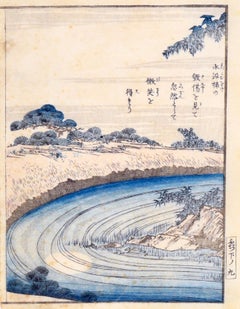
"Plovers at Tamagawa" from "Six Jewel Rivers" - Woodblock Print on Paper This print, sometimes titled "Chidori No Tamagawa" "Plovers at Tamagawa", is from the series Mu Tamagawa ("Six Views of Tama River", also known as "Six Jewel Rivers" or "Six Crystal Rivers") by Kubo Shunman...

Category

Late 18th Century Edo Art

Materials

Paper, Ink, Woodcut

Three (3) images from Thirty-six Views of Mt. Fuji (Fuji sanjūrokkei)

Three (3) images from Thirty-six Views of Mt. Fuji (Fuji sanjūrokkei)

Located in Middletown, NY

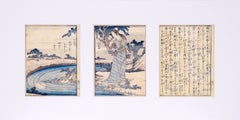
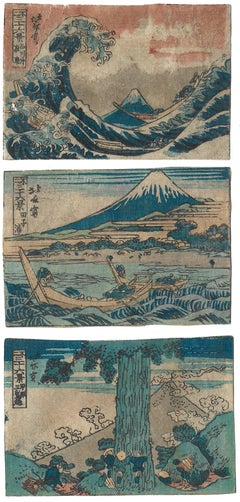
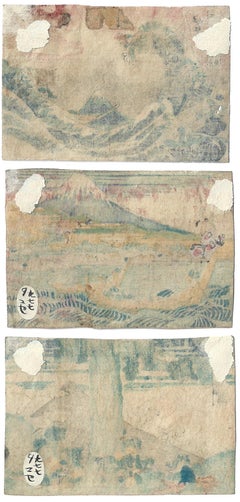
Tokyo: Kawaji, 1830. Three (3) woodblock prints (nishiki-e) in color on handmade mulberry paper, each 2 5/8 x 3 3/8 inches (67 x 82 mm), the full sheet, margins slightly trimmed. Ea...

Category

Early 19th Century Edo Art

Materials

Watercolor, Handmade Paper, Woodcut

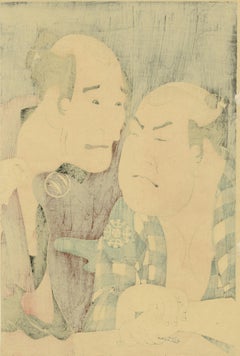
The Actors Nakajima Wadaemon as Bōdara Chōzaemon and Nakamura Konozō as Gon of t

The Actors Nakajima Wadaemon as Bōdara Chōzaemon and Nakamura Konozō as Gon of t

By Toshusai Sharaku

Located in Middletown, NY

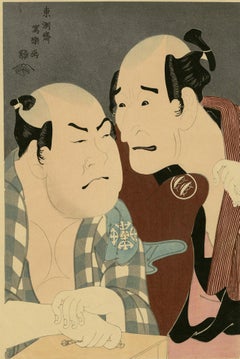
Two minor villains from "Medley of Tales of Revenge" square off, as performed at the Kiri theatre, Tokyo, in May of 1794. Toyko: Tsutaya Juzaburo, 1794. Woodblock (nishiki-e) with ...

Category

Late 18th Century Edo Art

Materials

Watercolor, Handmade Paper, Woodcut

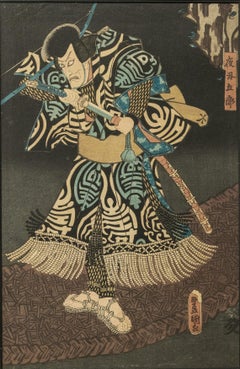
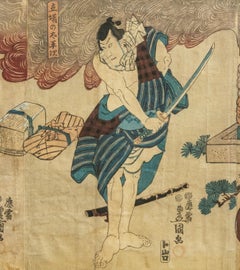
"Night Heron Goro (Yabune Goro) Kabuki Actor (Yakusha-e)" Antique Japanese Print

"Night Heron Goro (Yabune Goro) Kabuki Actor (Yakusha-e)" Antique Japanese Print

By Utagawa Kunisada (Toyokuni III)

Located in Austin, TX

Page Size: 13.5 x 9 in. Frame Size: 21 x 14 in. This dynamic woodblock print captures a climactic moment of intense dramatic energy, characteristic of the kabuki theater tradition. ...

Category

19th Century Edo Art

Materials

Woodcut

Edo art for sale on 1stDibs.

Find a wide variety of authentic Edo art available for sale on 1stDibs. Works in this style were very popular during the 21st Century and Contemporary, but contemporary artists have continued to produce works inspired by this movement. Many Pop art paintings were created by popular artists on 1stDibs, including Utagawa Kunisada (Toyokuni III), Utagawa Hiroshige (Ando Hiroshige), Toyohara Kunichika, CHIKANOBU, and Yoshu. Frequently made by artists working with Woodcut Print, and Paper and other materials, all of these pieces for sale are unique and have attracted attention over the years. Not every interior allows for large Edo art, so small editions measuring 2.5 inches across are also available. Prices for art made by famous or emerging artists can differ depending on medium, time period and other attributes. On 1stDibs, the price for these items starts at $175 and tops out at $18,000, while the average work sells for $1,250.