C. Detouche Decorative Objects

to
2
2
1
2
2
1
1
1
1
1
2
2
Height
to
Width
to
2
2
2
2
1,522
691
542
514
Creator: C. Detouche
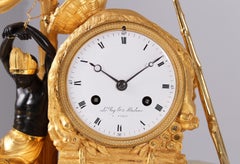
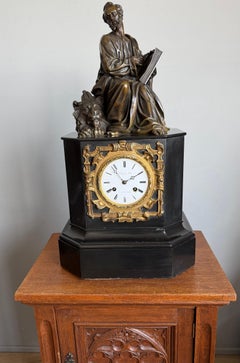
Fine Early 19th C. Bronze Mantel Clock “Saint Mark with Lion”, Detouche, Paris

Fine Early 19th C. Bronze Mantel Clock “Saint Mark with Lion”, Detouche, Paris

By C. Detouche

Located in Lisse, NL

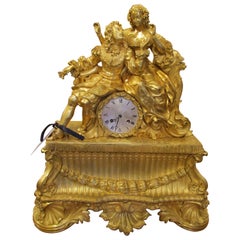
A fine and highly decorative early 19th century French mantel clock, signed C. Detouche, Bté, Paris, depicting Saint Mark the Evangelist seated beside his traditional attribute, the ...

Category

Early 19th Century French Empire Antique C. Detouche Decorative Objects

Materials

Marble, Brass, Bronze

Palatial & Rare Napoleon III French Ormolu and Patinated Bronze Clock, Detouche

Palatial & Rare Napoleon III French Ormolu and Patinated Bronze Clock, Detouche

By C. Detouche

Located in Long Island City, NY, NY

A Palatial and Extremely Rare Napoleon III French Ormolu and Patinated Bronze Regulateur de Parquet Clock by Louis-Constantin Detouche, Paris, Circa 1850 An exceptional testament to the grandeur and technical mastery of 19th-century French horology, this palatial and extraordinarily rare Napoleon III ormolu and patinated bronze Regulateur de Parquet clock stands as a crowning achievement of the renowned Parisian horologist Louis-Constantin Detouche. Created circa 1850, this monumental timepiece exemplifies the perfect synthesis of artistic opulence and mechanical precision, distinguishing itself as one of the most impressive works from Detouche’s illustrious oeuvre. At over six feet tall, this clock’s imposing scale and decorative grandeur make it an object of immense historical and aesthetic significance. The case, crafted from the finest French ormolu, features two majestic patinated bronze seated putti, serving as allegorical figures and underscoring the artistic sophistication characteristic of the Second Empire style. The white enamel dial, elegantly signed "C. Detouche/Paris," affirms its prestigious maker, while the movement, meticulously numbered 7064 and bearing the stamps "C. Detouche RUE St. MARTIN" and "C. DETOUCHE 158 R. St MARTIN 160," speaks to the highest standards of 19th-century horological craftsmanship. Further distinguishing this piece is the medaille d’argent stamp, a testament to the numerous accolades and awards bestowed upon Detouche for his innovations in timekeeping. A Masterpiece of Horological Artistry: Louis-Constantin Detouche was not merely a clockmaker; he was a visionary whose contributions to horology redefined precision and complexity. This particular regulator clock...

Category

19th Century French Napoleon III Antique C. Detouche Decorative Objects

Materials

Bronze, Ormolu

Related Items
Napoleon III Patinated Bronze & Ormolu Crown, France, Circa 1870

Napoleon III Patinated Bronze & Ormolu Crown, France, Circa 1870

Located in West Palm Beach, FL

Napoleon III Patinated Bronze & Ormolu Crown, France, Circa 1870 A rare and unusual Napoleon III patinated bronze and ormolu crown from France, circa 1870. This distinctive work fea...

Category

19th Century French Napoleon III Antique C. Detouche Decorative Objects

Materials

Bronze, Ormolu

Napoleon III Period Gilt and Patinated Bronze Clock by Delafontaine

Napoleon III Period Gilt and Patinated Bronze Clock by Delafontaine

Located in London, GB

The acclaimed French bronze foundry, Delafontaine, created this remarkable mantel clock. At the time this piece was crafted, in c.1860, the company was directed by Auguste-Maximilien Delafontaine (1813-1892). The firm was famous for its high-quality artistic bronzes, which can today be viewed in major art collections, such as the Louvre in Paris. Shaped like an upside down ‘T’, this gilt bronze...

Category

1860s French Napoleon III Antique C. Detouche Decorative Objects

Materials

Enamel, Ormolu, Bronze

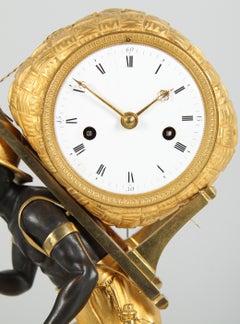
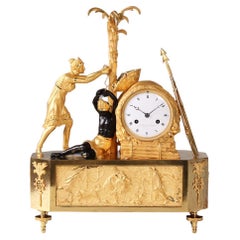
Early 19th Century Ormolu Mantel Clock, Atala freeing Chactas, Paris, circa 1810

Early 19th Century Ormolu Mantel Clock, Atala freeing Chactas, Paris, circa 1810

Located in Greven, DE

Mantel Clock "Atala and Chactas" Paris Bronze (fire-gilt and patinated), enamel Empire around 1810 Dimensions: H x W x D: 40 x 32 x 11 cm Description: Very rare and extremely high quality French mantel clock, so-called Pendule Au Bon Sauvage. Depicted are scenes from the love story "Atala or the love of two savages in the desert" written by Francois René Vicomte de Chateaubriand in 1801. At the beginning of the 19th century, this was probably the most famous love story in Europe, but today it has been forgotten. The story, set in present-day Louisiana (USA), is roughly rewritten about the forbidden love between Chactas, a young Indian, and Atala, the beautiful daughter of a Spaniard. Chactas is captured in a battle between two Indian tribes, chained to a palm tree and is to be sacrificed. Atala wants to save his life and convert him to Christianity. She unties him from the palm tree at night and they flee together into the wilderness of North America. Their love for each other grows stronger and stronger and they have prospects for a future together. The story takes a tragic turn when Atala, who must remain a virgin due to a vow made by her mother, can no longer withstand the conflict of her feelings and commits suicide. The main group of characters thus shows Chacta's liberation through Atala. Atala is leaning against a pile of logs. The animal fur thrown over the logs and the weapons leaning against the stack on the right give the impression of a night camp. The bronze is of rarely beautiful quality, finely chiselled and makes the scene appear very lively. The contrast of fire-gilded and patinated bronze adds tension to the composition. In the base we see the Entombment as the end of the tragic love story. This bronze work is also very detailed, the interplay of bright and matt gilding makes the flat relief appear much deeper than it is. The depiction of the mantel clock presented here shows that the exotic was only known from stories and that the bronzier had his own ideas about the appearance of this distant world. The Indian, for example, has very European facial features and his skin was not black in reality, of course. The palm tree was also certainly not found in the North American wilderness. The heart of the clock is a French pendulum movement, integrated into the wooden pile, with an eight-day power reserve and a lock plate striking a bell on the half and full hour. The pendulum is suspended on a thread, typical of the period. The classically shaped hands, so-called Breguet hands, are also typical of the time. The enamelled dial has black Roman hour numerals, Arabic quarter hours and bears the signature: Le Roy hr. de Madame A PARIS. Interesting facts: The period from 1795 to about 1815 saw the creation of probably the most spectacular group of bronzes: The "Au bon Sauvage" pendulums - depictions of the "Noble Savage". Today's viewers react to these objects with both fascination and irritation. Enthusiastic on the one hand about the obvious quality of the detailed bronzes and the allure of the exotic, on the other hand distanced and cautious because of the possible discrimination that is suspected behind them. The ambivalence of this feeling motivates the search for the conditions of origin of these pendulums. Europeans found their new ideal of the natural man primarily in fictional and realistic travelogues about the Indians of North America...

Category

Early 19th Century French Empire Antique C. Detouche Decorative Objects

Materials

Ormolu

Early 19th Century Ormolu Mantel Clock "Portefaix", Paris, circa 1810

Early 19th Century Ormolu Mantel Clock "Portefaix", Paris, circa 1810

Located in Greven, DE

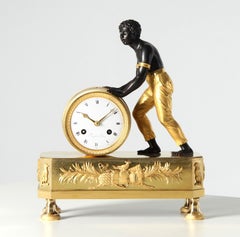
Pendule Portefaix Paris Bronze, enamel Empire around 1810 Dimensions: H x W x D: 36 x 28 x 11 cm Description: Beautiful, fire-gilded and patinated bronze pendule from the early 19...

Category

Early 19th Century French Empire Antique C. Detouche Decorative Objects
Materials

Ormolu

19th Century, Denière à Paris Gilt Bronze Mantel Clock with Japy Frères Movement

19th Century, Denière à Paris Gilt Bronze Mantel Clock with Japy Frères Movement

By Jean-François Denière

Located in SANT ADRIÀ DE BESÒS, ES

Magnificent gilt bronze mantel clock crafted in Paris circa 1850–1870 by Denière, one of the most celebrated French bronze workshops of the 19th century. The clock is fitted with an ...

Category

19th Century French Louis XVI Antique C. Detouche Decorative Objects

Materials

Bronze, Enamel

A fine large 19th century French fire gilt bronze mantel clock.

A fine large 19th century French fire gilt bronze mantel clock.

Located in Dallas, TX

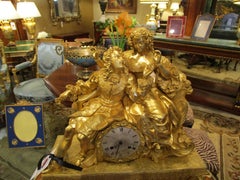
A fine 19th century Louis Philippe fire gilt large mantel clock. Depicting Louis XV and his wife Marie Leszczynska

Category

Late 19th Century French Louis Philippe Antique C. Detouche Decorative Objects

Materials

Bronze

Early 19th Century Mantel Clock - "Pendule au Noir", Faizan à Paris circa 1810

Early 19th Century Mantel Clock - "Pendule au Noir", Faizan à Paris circa 1810

By Faizan A Paris

Located in Greven, DE

The barrel roller - so-called "Pendule au Noir" Paris fire-gilt bronze early 19th century Dimensions: H x W x D: 34 x 27 x 11 cm Description: Fire-gilt bronze clock from the early...

Category

Early 19th Century French Empire Antique C. Detouche Decorative Objects

Materials

Bronze, Enamel, Ormolu

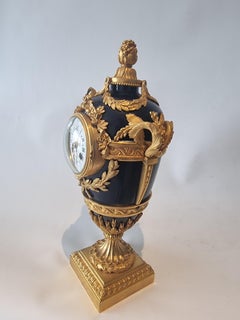
Napoleon III enamel and ormolu urn clock signed in the bronze Eug. Hazard

Napoleon III enamel and ormolu urn clock signed in the bronze Eug. Hazard

Located in London, GB

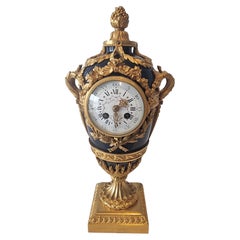
A small French vase clock of the highest quality. The clock is fitted within the body of an enamelled lidded vase. The body of the vase of silvered bronze & enamelled in deep blue. T...

Category

1890s French Napoleon III Antique C. Detouche Decorative Objects

Materials

Bronze, Enamel

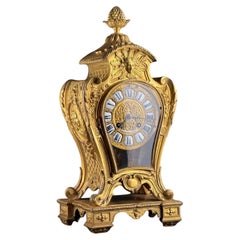
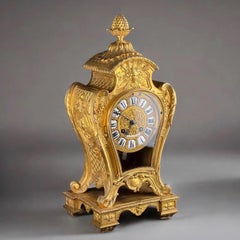
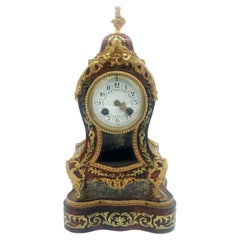
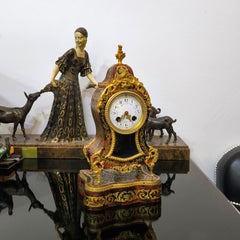
Antique Ormolu French Cartel Clock on its Stand, Mantle Clock, Napoleon III Era

Antique Ormolu French Cartel Clock on its Stand, Mantle Clock, Napoleon III Era

By Ecole Boulle, Napoléon III

Located in Bochum, NRW

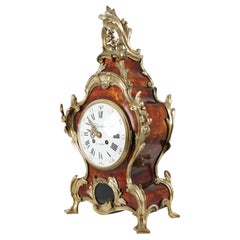
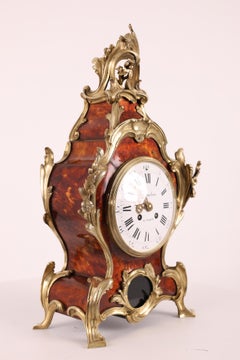
Antique Ormolu French Cartel Clock on its stand, Napoleon III Era. This is a good-sized French mantel clock dating from around 1880. It has a waisted case with applied brass decoration and brass and tortoiseshell-style inlaid panels. The white enameled dial has fancy pierced brass hands and a beaded bezel. It is hand-painted with Arab numerals and decorated with garlands of flowers and leaves. The clock has a center window showing the pendulum shaped like a fairy. It drives the movement that seems to strike the hours and halves on a bell. This gorgeous antique cartel clock...

Category

Late 19th Century French Napoleon III Antique C. Detouche Decorative Objects

Materials

Brass

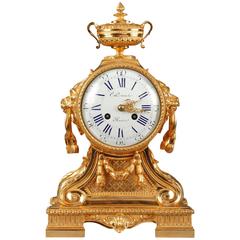
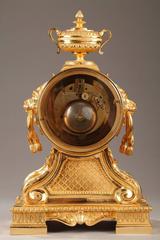
Late 19th Century French Bronze Mantel Clock with Lion Handles

Late 19th Century French Bronze Mantel Clock with Lion Handles

Located in Stamford, CT

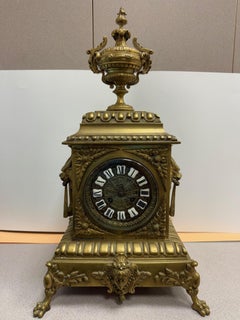
Late 19th Century French bronze bracket mantel clock with an urn formed final mount. Raised enamel roman numeral dial and lion handles resting on cabriole legs and paw feet. The ela...

Category

Late 19th Century French Antique C. Detouche Decorative Objects

Materials

Brass

Exquisite 19th Century Mantel Clock – Planchon Paris

Exquisite 19th Century Mantel Clock – Planchon Paris

$3,376

H 18.51 in W 10.63 in D 4.73 in

Exquisite 19th Century Mantel Clock – Planchon Paris

Located in Stahnsdorf, DE

Exquisite 19th Century Mantel Clock – Planchon Paris This exceptional mantel clock, crafted by the renowned Planchon manufactory in Paris during the second half of the 19th century,...

Category

1890s French Napoleon III Antique C. Detouche Decorative Objects
Materials

Bronze

Previously Available Items

C. Detouche decorative objects for sale on 1stDibs.

C. Detouche decorative objects are available for sale on 1stDibs. These distinctive items are frequently made of metal and are designed with extraordinary care. There are many options to choose from in our collection of C. Detouche decorative objects, although gold editions of this piece are particularly popular. If you’re looking for additional options, many customers also consider decorative objects by Aubert & Klaftenberger, Eugene-Antoine Aizelin, and Louis-Constant Sévin. Prices for C. Detouche decorative objects can differ depending upon size, time period and other attributes — on 1stDibs, these items begin at $7,443 and can go as high as $2,500,000, while a piece like these, on average, fetch $1,253,721.