Raymond Booth Art

to
1
Overall Width
to
Overall Height
to
1
1
1
1
1
1
1
1
1
1
1
1
1
11,047
2,850
2,494
1,431
1
1
Artist: Raymond Booth
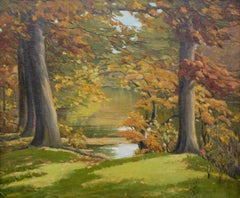
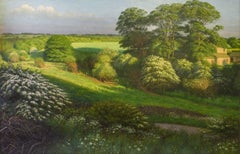
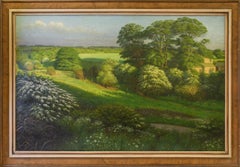
Afternoon Sunshine in Late May, 1970s Yorkshire Landscape, Oil on Board, Signed

Afternoon Sunshine in Late May, 1970s Yorkshire Landscape, Oil on Board, Signed

By Raymond Booth

Located in London, GB

Oil on board, signed and dated '1974' lower right Image size: 31 x 48 inches (79 x 122 cm) June 1987 Exhibition label on verso Original frame Provenance The Artist's Estate Exhibited "Raymond Booth, A Memorial Exhibition", The Fine Art Society, London, 12th August - 9th September 2016, no.62 "Raymond Booth, In the Wild", The Fine Art Society, London, 02 May -29 May 2017, No. 11 Booth was above all a great recorder of the natural world who could translate his observations of the Yorkshire countryside, its fauna and flora, into compositions of a beauty and intensity rivalling the greatest of his Victorian predecessors. This intense, yet intimate, landscape depicts a section of woods around Booth's home in Alwoodley, Leeds, where he spent much of his time. Here Booth has worked slowly to develop the densely worked, close-up, landscape in which the woodland and meadows have acquired a poetic quality through his sensitivity to season, weather and time of day. Raymond Charles Booth Intensely private, and possessing an obsessive work ethic and passion for the natural world, Raymond Booth earned a reputation as one of the greatest botanical painters and illustrators, despite rarely leaving his Yorkshire home. Eschewing the more fashionable modernist principles of the early mid-twentieth century, he instead produced beautiful, intense compositions in oil of British flora and fauna, that rival the very finest Victorian followers of the genre. Raymond Booth was born in Wetherby, West Yorkshire, on 8 August 1929, to John Booth, a member of the local police force, and his wife Margaret Edna. When Raymond was still a young child, the family moved from their first home in the crowded streets of central Leeds, to Fearnville Place, in the leafy suburb of Roundhay. His father was a keen rambler and impressed upon Booth from an early age a respect and understanding for the British countryside. Just a short walk from his childhood home was Roundhay Park, the second largest urban park in Europe, comprised of over 700 acres of parkland, lakes and woodland. It is likely that growing up so close to such an environment had a profound influence on him, helping to develop what would become a lifelong obsession with natural world. Booth’s early passion for nature was surely heightened by the number of summer holidays he spent on an estate near Winterslow, Wiltshire, where an uncle worked as a gamekeeper. In 1946, at the age of 17, Booth won a scholarship to study at Leeds College of Art. However, his studies were put on hold during two years of National Service, which he spent largely with the RAF in Egypt, guarding the Suez Canal. He returned to Leeds College in 1949, graduating in 1953. While at Leeds College, he had frustrated his teachers and fellow students by insisting on working in a more traditional, precise style, and rejecting the more Modernist principles that were being promoted. As a result, his teachers convinced him that he was unlikely to earn a living as an artist, and encouraged him instead to study for a teaching diploma. Shortly after graduation however, he was diagnosed as suffering from tuberculosis, a consequence of his time in Egypt, and was admitted to a sanatorium, where he would stay for the next six months. Years later, Booth would joke ‘I am one of the few people who can say, “Thank God for TB”’ (The Times obituary, 9 September 2015), as his months of recuperation gave him countless hours to develop his skills as a botanical artist. This enforced focus on his work gave him the confidence to submit a number of his drawings to a botanical art exhibition in London organised by the Royal Horticultural Society. These works attracted the attention of a number of prominent horticulturalists, including Dr Harold Fletcher, the director of the RHS’s gardens at Wisley, Sir George Taylor...

Category

1970s Modern Raymond Booth Art

Materials

Oil, Board

Related Items
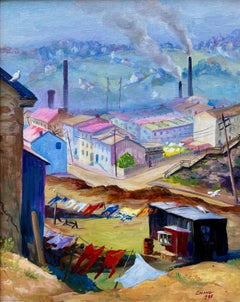
Manayunk Fountain & Silverwood Sts

Manayunk Fountain & Silverwood Sts

By Florence Prince Ewing

Located in Los Angeles, CA

Manayunk Fountain & Silverwood Sts, 1938, oil on canvas board, signed and dated lower right, titled and dated verso, 20 x 16 inches Although Florence Prince Ewing’s paintings ex...

Category

1930s American Modern Raymond Booth Art

Materials

Oil, Canvas, Board

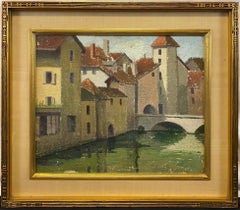
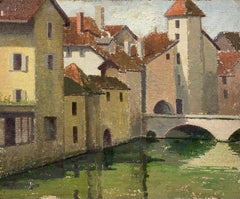
"Canals in Annecy, France" by Emma Fordyce MacRae (1887-1974) American Framed

"Canals in Annecy, France" by Emma Fordyce MacRae (1887-1974) American Framed

By Emma Fordyce MacRae

Located in Yardley, PA

A lovely scene of the canals in Annecy, France by renowned American artist Emma Fordyce MacRae (1887-1974). This work highlights the geometric nature of the historic architecture al...

Category

Mid-20th Century American Modern Raymond Booth Art

Materials

Gesso, Oil, Board

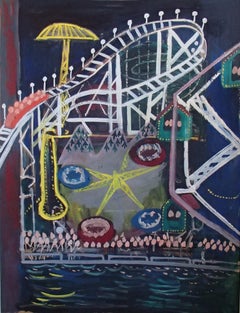
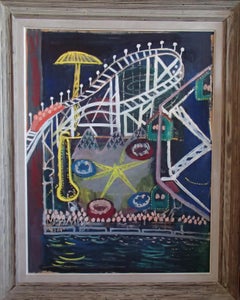
"Coney Island" Brooklyn NYC Amusement Park Mid-century American Scene WPA Modern

"Coney Island" Brooklyn NYC Amusement Park Mid-century American Scene WPA Modern

By Ludwig Bemelmans, 1898-1962

Located in New York, NY

"Coney Island" Brooklyn NYC Amusement Park Mid-century American Scene WPA Modern Ludwig Bemelmans (1898 – 1962), “Coney Island" 35 x 27 inches Oil on board Signed lower right Orig...

Category

1940s American Modern Raymond Booth Art

Materials

Oil, Board

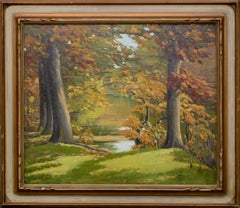
Elm Trees in Autumn Landscape in Antique Newcomb-Macklin Frame

Elm Trees in Autumn Landscape in Antique Newcomb-Macklin Frame

By Mary H. Brubaker

Located in Soquel, CA

Elm trees in autumn at the edge of Salt Creek, Illinois, by Mary H. Brubaker (American, b. 1891). Signed and dated "Mary H. Brubaker 35" in the lower left cor...

Category

1930s American Modern Raymond Booth Art

Materials

Canvas, Oil, Illustration Board

Church And Churchyard Landscape Oil Painting Mid-20th Century Cornish Artist

Church And Churchyard Landscape Oil Painting Mid-20th Century Cornish Artist

By Joan Gillchrest

Located in Sutton Poyntz, Dorset

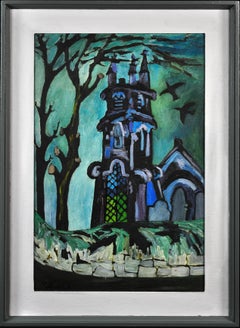
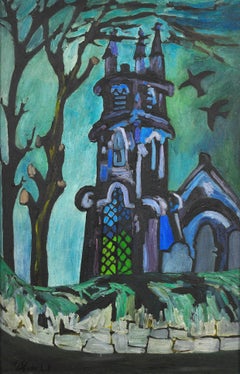
Joan Gillchrest. English ( b.1918 - d.2008 ). Church And Churchyard. Oil On Board. Signed. Image size 33.9 inches x 21.8 inches ( 86cm x 55.5cm ). Frame size 42.3 inches x 30.3 inch...

Category

Mid-20th Century Modern Raymond Booth Art

Materials

Oil, Board

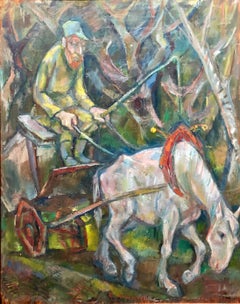
Large Modernist Oil Painting 1940s, Judaica Hasidic Shtetl Wagon Driver WPA Era

Large Modernist Oil Painting 1940s, Judaica Hasidic Shtetl Wagon Driver WPA Era

By Emanuel Glicenstein Romano

Located in Surfside, FL

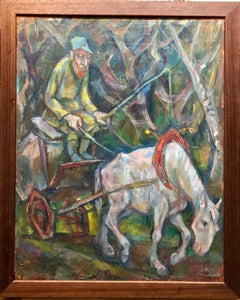
Genre: Modern Subject: Landscape with figure of horse, driver and wagon Medium: Oil Surface: wood Board Hand signed lower middle E.Romano EMANUEL ROMANO Rome, Italy, b. 1897, d. 1984 Emanuel Glicen Romano was born in Rome, September 23, 1897. His father Henryk Glicenstein was a sculptor and was living in Rome with his wife Helena (born Hirszenberg) when Emanuel was born. His father obtained Italian citizenship and adopted the name Enrico. Emanuel was brought up in Italy, Switzerland, Germany, England and Poland. In 1926 Emanuel Glicenstein Romano and his father sailed for New York. They briefly visited Chicago. Romano's sister, Beatrice, and mother only joined them in New York years later. Romano changed his name on his arrival to America and some have erroneously speculated that this was to avoid antisemitic discrimination. In truth, as the son of a highly-regarded artist, Romano changed his name to ensure that any success or recognition he would later attain, would be the result of nothing other than his own merit as an artist, and not on account of his father's fame. In 1936 Romano was worked for the WPA Federal Art Project creating murals. ( there were many jewish artists active with in the WPA period. notably Chaim Gross, Ben Shahn, Isaac and Moses Soyer, Abraham Rattner and many others. During and immediately after World War II, Romano created a series of allegorical works depicting graphic holocaust images that were held closely by the family until after his passing. One of these works is now on permanent display in the Florida Holocaust Museum in St. Petersburg Florida. Emanuel's father died in 1942 in a car accident before they could realize their shared dream of visiting Israel. In 1944 Romano, having completed his degree at the Pennsylvania Academy of Fine Arts and the Art Institute of Chicago, began teaching at the City College of New York. Romano moved to Safed, Israel in 1953 and established an art museum in his father's memory, the Glicenstein Museum. COLLECTIONS Indianapolis Museum of Art Metropolitan Museum of Art Boston Fine Arts Museum Fogg Museum Musée Nacional de France Recently his work has been added to the Florida Holocaust Museum collection. His notable works include his holocaust themed allegorical paintings as well as portraits of Marianne Moore, his father and William Carlos Williams...

Category

1930s American Modern Raymond Booth Art

Materials

Oil, Board

Cornish Fishing Boats At First Light Mid-20th Century Cornwall Original Painting

Cornish Fishing Boats At First Light Mid-20th Century Cornwall Original Painting

By Joan Gillchrest

Located in Sutton Poyntz, Dorset

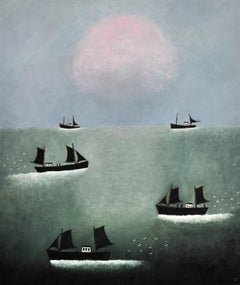
Joan Gillchrest. English ( b.1918 - d.2008 ). Cornish Fishing Boats At First Light. Oil On Paper Mounted On Board. Signed Monogram Lower Right. Image size 26.2 inches x 22 inches ( 66.5cm x 56cm ). Frame size 35.8 inches x 31.3 inches ( 91cm x 79.5cm ). Available for sale; this original oil painting is by the Cornish artist Joan Gillchrest and dates from around the late 1980s. The oil painting is presented and supplied in a sympathetic new replacement frame (which is shown in these photographs) that suits the artwork’s color palette and behind non-reflective Tru Vue UltraVue® UV70 glass. This painting is in excellent condition and presents superbly. It wants for nothing and is ready to hang and display. The painting is signed with her monogram lower right. Joan Gillchrest is one of Mousehole’s and Cornwall’s most recognised and celebrated artists. Her vibrant art sits firmly alongside other great artists of the St. Ives School from the 1960s. She was born Joan Scott in London in 1918 into a wealthy and illustrious family. She was the third of four children. Her father was a pioneer of radiology – and a skilful caricaturist - and her Australian mother was an accomplished pianist. Sir George Gilbert Scott was her great grandfather, who designed the imposing Midland Grand Hotel at St. Pancras as well as countless parish churches. Grandfather, George Gilbert Scott Jnr, is remembered for three Cambridge colleges, Christ’s, Pembroke and Peterhouse. Her uncle Giles, (Giles Gilbert Scott) to whom Joan was close, is best known for his magnificent Anglican Liverpool Cathedral, Battersea Power Station and the iconic and ubiquitous red telephone box. Coming from such a long line of eminent architects it is not surprising that Joan always loved architecture and the churches and chapels of the Penwith peninsula feature prominently in her work. She said that buildings were “in her blood”. Her early childhood was spent at the family home in Buckinghamshire, but she was a difficult child – the family hired one nanny for her and one for the other three children- and at one point she was sent to Upper Chine School in the Isle of Wright to give her family some peace! She was however the apple of her father’s eye and he encouraged her obvious artistic talent. In 1934, aged only 15 but encouraged by her parents, she went to Paris to study art and learn the language. There she met Gwen John and studied in various studios, sometimes working as a model. In 1936 she enrolled at the Grosvenor School of Art and subsequently studied there under Iain McNab, whom she described as a marvelous teacher. Her early artistic career was very promising; she first exhibited at the Royal Academy when she was just 18 and showed works at the New England Art Club in 1937 and the London Group in 1938. When the Second World War broke out Joan was 21. She took a crash course in nursing and first aid and volunteered as an ambulance driver for Westminster Hospital. She later drove a mobile rescue unit. She was not able to paint much during the war but kept in touch with McNab; when the area around St Paul’s was blitzed, leaving the cathedral relatively unscathed, McNab got Joan and a few others to paint the scene. Her work, created with a thick paint and a palette knife, hung in the art school for many years. Joan’s painting career stalled in the 1940s. In 1942 she married a barrister and Coldstream Guards officer Samuel Gillchrest, and they soon had a son, then a daughter. With a young family, she had little time to paint, and had to hide the work she did produce as her husband thought that work as an artist was beneath them. Sadly, the marriage broke down and in 1953 they divorced. In leaving a difficult marriage at this time, she forfeited money, security and her previous place in society. Despite the huge changes in her life, her overwhelming desire to paint remained constant. She ignored the disapproval of her friends and family and started to explore new ways of expressing herself on canvas. She moved to a studio in Chelsea, an area much favored by the artistic community. To support herself, her children and her painting she also found regular work as an artist’s model. She was tall, strikingly good looking and combined elegance with bohemianism. She also carried an air of mystery from her rich and privileged past, and so she became sought after as a fashion model. In the flat below hers lived an artist who had enjoyed some professional acclaim, Adrian Ryan...

Category

Mid-20th Century Modern Raymond Booth Art

Materials

Paper, Oil, Board

Family of Farmers by the Barn

Family of Farmers by the Barn

$450

H 19.25 in W 14.75 in

Family of Farmers by the Barn

Located in Surfside, FL

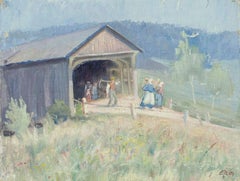
Barn in a serene landscape, oil painting.

Category

20th Century Modern Raymond Booth Art

Materials

Oil, Board

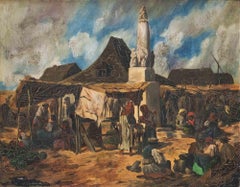
Market in the Puszta - Oil on Board - 19th Century

Market in the Puszta - Oil on Board - 19th Century

Located in Roma, IT

Market in the Puszta is an original modern artwork realized by Artist of 19th Century. Mixed colored oil on board. Includes frame.

Category

19th Century Modern Raymond Booth Art

Materials

Oil, Board

Previously Available Items
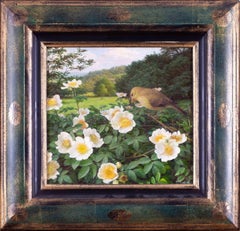
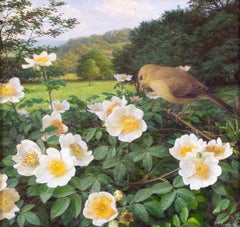
British Botanical artist Raymond Booth, 'Field Rose and Willow Warbler' oil

British Botanical artist Raymond Booth, 'Field Rose and Willow Warbler' oil

By Raymond Booth

Located in Petworth, West Sussex

This is a stunning example of British 20th Century botanical artist Raymond Booth's work for a Willow Warbler bird perched on a Field Rose. Intensely private, and possessing an ob...

Category

20th Century English School Raymond Booth Art

Materials

Oil, Board

Raymond Booth art for sale on 1stDibs.

Find a wide variety of authentic Raymond Booth art available for sale on 1stDibs. You can also browse by medium to find art by Raymond Booth in board, oil paint, paint and more. Much of the original work by this artist or collective was created during the 1970s and is mostly associated with the modern style. Not every interior allows for large Raymond Booth art, so small editions measuring 46 inches across are available. Customers who are interested in this artist might also find the work of Patrick Procktor, Francis Plummer, and Jason Berger. Raymond Booth art prices can differ depending upon medium, time period and other attributes. On 1stDibs, the price for these items starts at $13,297 and tops out at $13,297, while the average work can sell for $13,297.

Artists Similar to Raymond Booth