Want more images or videos?
Request additional images or videos from the seller
1 of 9

Antique America Engraving Chile Natives & Guatemala Serpents Drake, 1771

$332.38
£243.66
€279VAT Included
CA$457.83
A$463.69
CHF 266.37
MX$5,622.88
NOK 3,089.84
SEK 3,145.10
DKK 2,127.54

About the Item

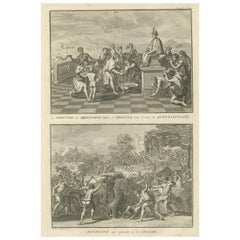
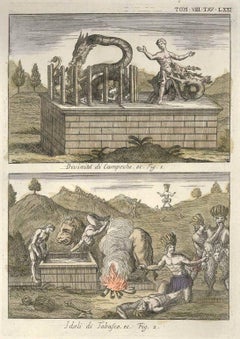
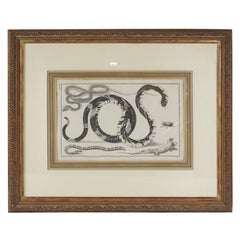
Antique America Engraving Chile Natives & Guatemala Serpents Drake 1771 This striking eighteenth-century copperplate engraving presents two fascinating scenes from the Americas as imagined and described in early European travel literature. The print was engraved for Edward Cavendish Drake’s influential travel compilation, A New Universal Collection of Authentic and Entertaining Voyages and Travels, published in London around 1771. Works such as Drake’s sought to bring together accounts of exploration and discovery from across the globe, combining geography, natural history, and ethnographic observations into richly illustrated volumes for European readers fascinated by the distant lands of the New World. The engraving is divided into two separate scenes, each framed within its own decorative border and accompanied by an explanatory caption. The upper scene is titled “Habits of the People of Chili in America.” It depicts a small group of inhabitants of Chile represented in traditional dress as interpreted by eighteenth-century European artists. A central male figure carries a large agricultural implement or tool over his shoulder while speaking with a woman dressed in flowing garments. Nearby figures hold baskets, pottery vessels, and domestic objects, suggesting everyday life and rural activity. Such images were intended to illustrate the clothing, customs, and lifestyle of Indigenous peoples for European audiences who had little direct knowledge of these distant cultures. The lower scene, titled “Remarkable Serpents and Baboons of Gautimala in America,” reflects the fascination with exotic animals and natural wonders reported by early explorers. The animals depicted include large serpents and primate-like creatures, referred to in the original caption as “baboons.” In reality these figures likely represent monkeys native to Central America, though European engravers often relied on second-hand descriptions rather than direct observation. As a result, the creatures appear somewhat fantastical, with expressive human-like faces and exaggerated features. One serpent even bears a dramatic dragon-like head, emphasizing the sense of marvel and mystery associated with the natural world of the Americas. Many illustrations in Drake’s work were inspired by earlier seventeenth-century sources, including the engravings of the Dutch scholar Arnoldus Montanus in his famous book De Nieuwe en Onbekende Weereld (1671). These images circulated widely in Europe and helped shape European perceptions of the New World during the early modern period. The engraving demonstrates the refined craftsmanship of eighteenth-century British printmaking, with careful cross-hatching, balanced composition, and crisp engraved lines. As both a historical document and a decorative print, it offers insight into how Europeans visualized the cultures and wildlife of the Americas during the age of exploration. Condition: Good antique condition with age-appropriate toning and light foxing. Minor handling marks and faint creases consistent with an eighteenth-century book plate. Plate mark visible. Framing tip: This engraving displays beautifully with a generous ivory mat and a dark walnut or black frame, allowing the two scenes to read clearly as a paired composition while highlighting the fine engraved detail. Technique: Copperplate engraving Maker: Engraved for Edward Cavendish Drake, London, circa 1771 Keywords: Chile, Chili, Guatemala, Gautimala, South America, Central America, New World, Drake voyages, Edward Cavendish Drake, Sir Francis Drake, Americas exploration, indigenous Chile, South American natives, Guatemala monkeys, Guatemala serpents, exotic animals engraving, early travel illustration, Montanus influence, De Nieuwe en Onbekende Weereld, 18th century engraving, antique America print, colonial travel book illustration
  • Dimensions:
    Height: 11.11 in (28.2 cm)Width: 7.68 in (19.5 cm)Depth: 0.01 in (0.2 mm)
  • Materials and Techniques:
  • Place of Origin:
  • Period:
  • Date of Manufacture:
    1771
  • Condition:
    Good antique condition with age-appropriate toning and light foxing. Minor handling marks and faint creases consistent with an eighteenth-century book plate. A small tear touching the lower plate mark.
  • Seller Location:
    Langweer, NL
  • Reference Number:
    Seller: BG-13599-961stDibs: LU3054349098272

More From This Seller

View All
Antique Copperplate Engraving of Serpents and Amphibians, 1805

Antique Copperplate Engraving of Serpents and Amphibians, 1805

Located in Langweer, NL

Title: Antique Copperplate Engraving of Serpents and Amphibians, 1805 Description: This striking copperplate engraving from 1805 presents two captivating depictions of serpentin...

Category

Antique Early 1800s Prints

Materials

Paper

18th Century Engravings of Exploration: Banks, Tolago Bay, Terra del Fuego, 1790

18th Century Engravings of Exploration: Banks, Tolago Bay, Terra del Fuego, 1790

Located in Langweer, NL

The sheet contains three separate engravings, each depicting a different scene: 1. Top Engraving: "Mr. Banks receiving a Visit from the King of Duke of York's Island" - This eng...

Category

Antique 1790s British Prints

Materials

Paper

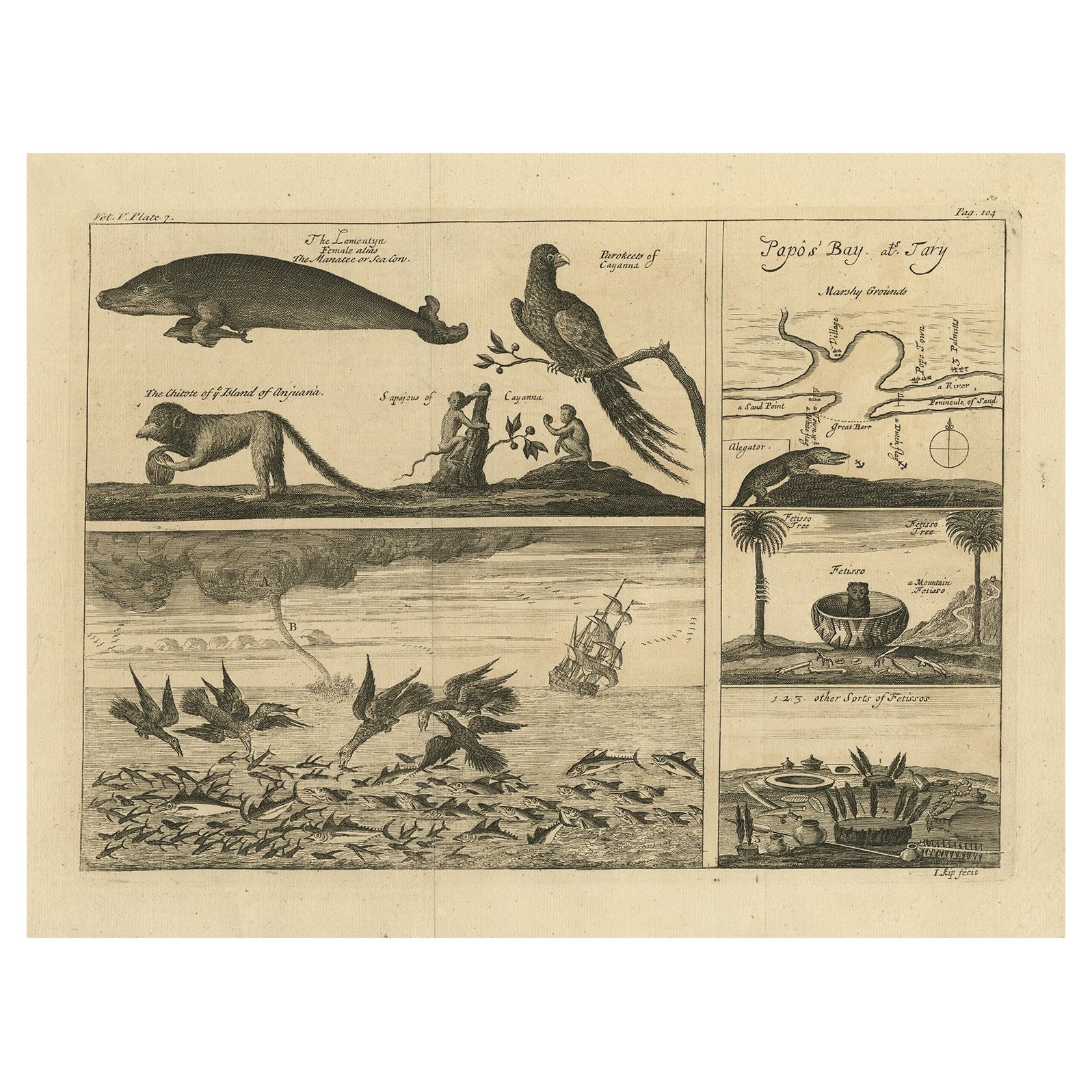
Rare Antique Engraving of Life Near The Sestro River, Liberia in Africa, 1744

Rare Antique Engraving of Life Near The Sestro River, Liberia in Africa, 1744

Located in Langweer, NL

Description: Antique print, titled: 'A map of Sestro River (…).' - This plate shows Fish, birds, animals and people in the area around the Sestro River, Liberia. Inset; a small map o...

Category

Antique 1740s Prints

Materials

Paper

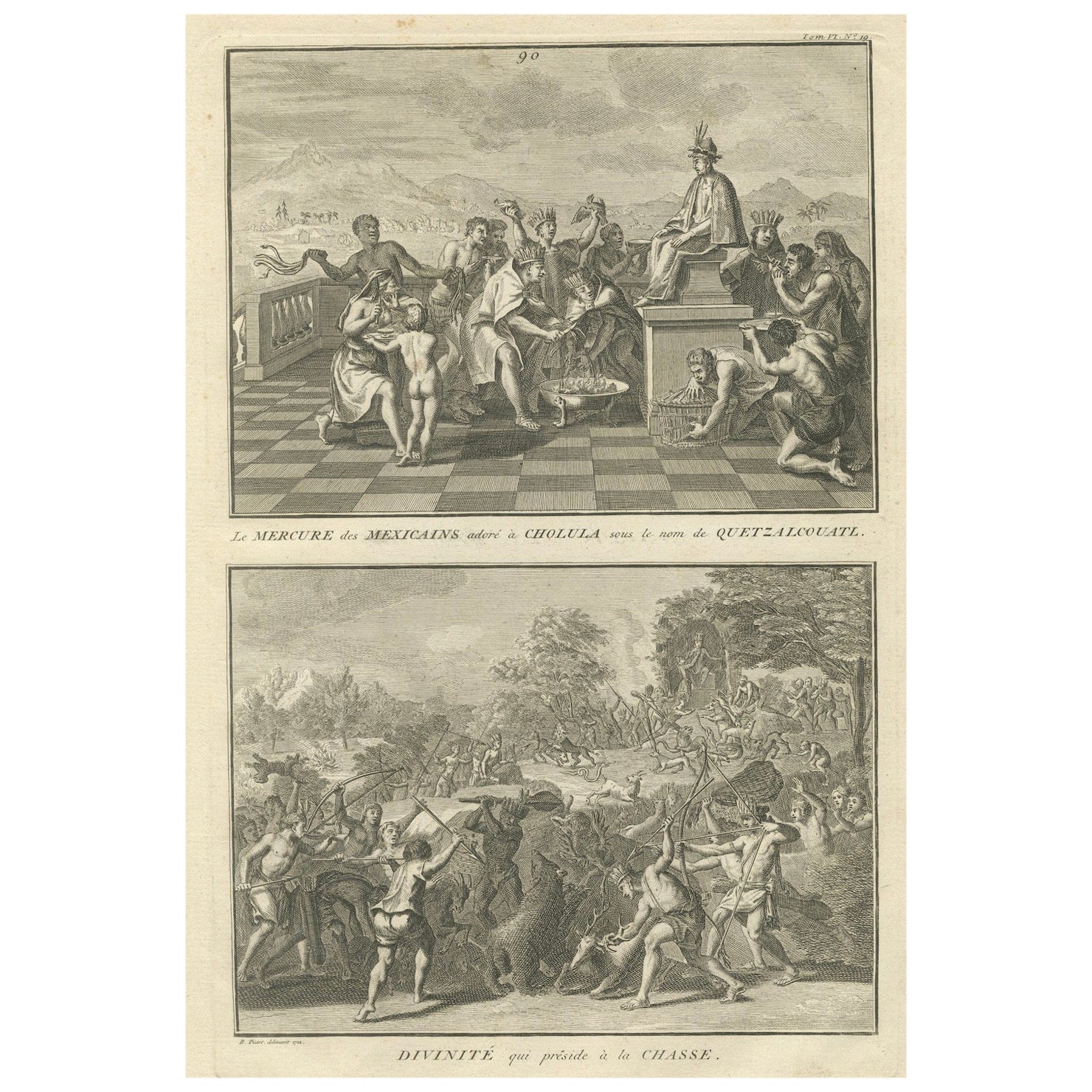
Quetzalcoatl Worship and Hunting Deity – Rare 1734 Engraving of Aztec Rituals

Quetzalcoatl Worship and Hunting Deity – Rare 1734 Engraving of Aztec Rituals

Located in Langweer, NL

Quetzalcoatl Worship and Hunting Deity – Rare 1734 Engraving of Aztec Rituals This finely detailed copperplate engraving from 1734 presents two theatrical interpretations of religio...

Category

Antique 1730s Prints

Materials

Paper

18th Century Ethnological Engravings of Peruvians and Ecuadorians

18th Century Ethnological Engravings of Peruvians and Ecuadorians

Located in Langweer, NL

Title: 18th Century Ethnological Engravings of Peruvians and Ecuadorians Description: These two 18th-century engravings, printed in 1756, are detailed depictions of the social and cultural life in Peru and Ecuador during the colonial era. Created by Quentin-Pierre Chedel (1705–1762), they are part of Histoire générale des voyages by Antoine François Prévost, a monumental collection that documented the world's exploration and cultural encounters. First Engraving (Residents of Peru): This print illustrates the residents of Lima, Peru, highlighting the various social classes and ethnic groups present in the region during the colonial period. The detailed engraving captures: A. Femme de Lima en Habit de Ville – A woman from Lima in formal city dress, representing the elite of society. B. Femme en Habit de Ménage – A woman in household dress, typical of a middle or upper-class domestic attire. C. Espagnol vêtu comme on l’est au Pérou – A Spanish man dressed as one would in Peru, showing the influence of Spanish colonial fashion on local attire. D. Mulatresse – A woman of mixed African and European descent, reflecting the diverse ethnic makeup of colonial Peru. E. Nègre Domestique – A domestic servant of African descent, showcasing the role of enslaved individuals in colonial households. The scene is set in a lush, natural landscape, with attention to the differences in social standing and attire. Second Engraving (Residents of Quito, Ecuador): The second engraving, although similar in style, depicts residents of Quito, Ecuador, and provides an ethnological view of the city’s diverse inhabitants. The composition shows: 1. Espagnole de Quito – A Spanish woman of high status, dressed elegantly, representing the colonial upper class in Quito. 2. Indienne de Distinction – An Indigenous woman of notable status, likely representing the local nobility or important community figures. 3. Barbier Indien – An Indigenous barber, reflecting the occupational diversity and social roles of the Indigenous population in colonial society. 4. Métive de Quito – A Métis woman from Quito, showing the mixed-race population that emerged during the colonial era. 5. Paysan Indien – An Indigenous farmer, indicating the essential role of agriculture and rural labor in the economy of colonial Ecuador. 6. Indienne du Commun – A common Indigenous woman, dressed in traditional attire, representing the majority of the Indigenous population. Like the first engraving, this print captures the varied ethnic and social dynamics in a colonial society, with figures placed in a landscape setting, emphasizing the connection between people and their environment. These engravings are not only artistic representations but also important historical records of colonial Latin America...

Category

Antique Mid-18th Century French Prints
Materials

Paper

Colonial Curiosities: Fauna of the West Indies, by R. de Hooghe, circa 1708

Colonial Curiosities: Fauna of the West Indies, by R. de Hooghe, circa 1708

Located in Langweer, NL

This original antique print is an intricate engraving from the early 18th century, titled "India Occidentalis," also known as the West Indies. Created by Romeyn de Hooghe, a distingu...

Category

Antique Early 1700s Prints

Materials

Paper

You May Also Like

Robert Bénard - Lizard Engravings, c.1798

Robert Bénard - Lizard Engravings, c.1798

By Robert Benard

Located in Savannah, GA

Robert Bénard (French, 1734-1794) Original hand-colored copperplate engravings published in ‘Tableau Encyclopedique et Methodique …’. by M. L’Abbe Bonnaterre, 1789 sight: 7 by 10 i...

Category

Antique 1790s French Prints

Materials

Glass, Wood, Paper

Serpents and Roman Ceremony- Etching by Carlo Nolli - 18th Century

Serpents and Roman Ceremony- Etching by Carlo Nolli - 18th Century

By Carlo Nolli

Located in Roma, IT

Serpents and Roman Ceremony from "Antiquities of Herculaneum" is an etching on paper realized by Carlo Nolli in the 18th Century. Signed on the plate. Good conditions with some fox...

Category

Late 18th Century Old Masters Figurative Prints

Materials

Etching

Four Framed Early 19th Century Large Folio Engravings of Lizards, Snakes & Bats

Four Framed Early 19th Century Large Folio Engravings of Lizards, Snakes & Bats

Located in Hudson, NY

This set of four engravings in detail with compendium landscape details and related prey animals are done in steel engraved plates and come from the first quarter of the 19th century...

Category

Antique Early 19th Century Prints

Materials

Glass, Wood, Paper