Want more images or videos?
Request additional images or videos from the seller
1 of 7

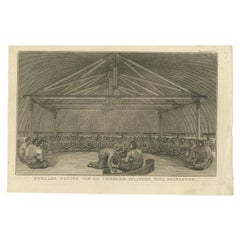
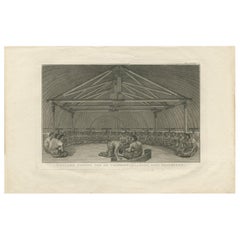
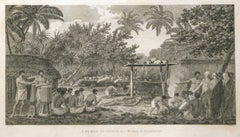
Poulaho, King of Tonga, Participating in a Kava Ceremony in the Friendly Islands

$133.21
$166.7820% Off
£97.74
£122.5120% Off
€112VAT Included
€14020% Off
CA$184.54
CA$230.1420% Off
A$186.28
A$234.2620% Off
CHF 107.04
CHF 133.3520% Off
MX$2,257.94
MX$2,827.7320% Off
NOK 1,238.90
NOK 1,554.9020% Off
SEK 1,265.47
SEK 1,573.6520% Off
DKK 853.98
DKK 1,067.5120% Off

About the Item

The engraving is titled "Poulaho, King of the Friendly Islands, Drinking Kava." It depicts a ceremonial scene with Poulaho, the King of the Friendly Islands (modern-day Tonga), participating in the traditional kava-drinking ceremony. The setting is a large meeting house, with many participants sitting in rows, observing the ritual. The image reflects the significance of kava as part of Tongan ceremonial and cultural life. This engraving captures an important cultural ritual of the Friendly Islands (Tonga) in the late 18th century, showing King Poulaho engaged in the kava-drinking ceremony. Kava, a drink made from the root of the kava plant, holds great ceremonial importance in Tongan and other Pacific Island cultures, used in formal gatherings, religious rituals, and to honor chiefs and royalty. The king is shown seated with attendants, who are preparing the kava in front of him, while numerous individuals sit in concentric rows inside a large thatched meeting house, likely a traditional 'fale'. This scene is drawn from accounts of Captain Cook’s third voyage, where he visited Tonga in 1777. The image is typical of 18th-century European engravings that sought to depict the customs and rituals of Indigenous cultures encountered during these explorations. The publication that features this engraving was published by Alex Hogg in London, around 1784-86, as part of a series that chronicled the voyages of Captain James Cook and other explorers. The kava ceremony was one of the many cultural practices noted during Cook’s interactions with Tongan society, particularly as it emphasized the hierarchical and ritualistic aspects of Polynesian governance. This engraving serves as an ethnographic record of Tongan society and its customs, as observed by European explorers. The kava ceremony, a deeply significant cultural practice, is portrayed with attention to the social structure of the event, including the positioning of the king and the gathering of the people. The image also reflects the broader European interest in documenting the ceremonial practices of non-Western cultures during the age of exploration. Interesting Aspects: - The structure of the fale (meeting house) is intricately detailed, showcasing the traditional architecture with its wooden supports and thatched roof. - The formal arrangement of the participants, all seated and watching the ceremony, reflects the respect and importance of the occasion. - The focus on Poulaho, the king, emphasizes the hierarchical nature of Tongan society, where the kava ceremony is a key aspect of leadership and authority. - The depiction of the kava preparation, with attendants working before the king, gives insight into the traditional roles involved in the ceremony. This engraving provides valuable insight into the ceremonial life of the Friendly Islands and serves as a visual record of the interactions between European explorers and the cultures of the Pacific.
  • Dimensions:
    Height: 9.45 in (24 cm)Width: 15.04 in (38.2 cm)Depth: 0 in (0.02 mm)
  • Materials and Techniques:
    Paper,Engraved
  • Period:
    1780-1789
  • Date of Manufacture:
    circa 1785
  • Condition:
    Condition: fair, given age. With soiling and light foxing. General age-related toning and minor defects from handling. Lower border cut off rough, outside the image. Study images carefully.
  • Seller Location:
    Langweer, NL
  • Reference Number:
    Seller: BG-13597-471stDibs: LU3054341693632

More From This Seller

View All
Engraving of King Poulaho of the Friendly Islands (Tonga) drinking Cava, ca.1801

Engraving of King Poulaho of the Friendly Islands (Tonga) drinking Cava, ca.1801

Located in Langweer, NL

Antique print titled 'Poulaho, Koning van de Vrienden-Eilanden, Kava drinkende'. This print depicts King Poulaho drinking Cava. Originates from 'Reizen rondom de Waereld' by J. Cook....

Category

Antique 19th Century Prints

Materials

Paper

Antique Print of King Poulaho of the Friendly Islands by Cook, 1803

Antique Print of King Poulaho of the Friendly Islands by Cook, 1803

Located in Langweer, NL

Antique print titled 'Poulaho, Koning van de Vrienden-Eilanden, Kava drinkende'. This print depicts King Poulaho drinking Cava, Friendly Islands or nowadays Hawaii. Originates from '...

Category

Antique Early 19th Century Dutch Prints

Materials

Paper

De Natsche – Ceremony for the King's Son, Tonga c.1795

De Natsche – Ceremony for the King's Son, Tonga c.1795

Located in Langweer, NL

De Natsche – Ceremony for the King's Son, Tonga c.1795 This antique print depicts a grand ceremony held in honour of the son of the King of Tonga, known as the Natsche, in the villa...

Category

Antique Early 1800s European Prints

Materials

Paper

"Natives of the Island of Rotuma: Antique Ethnographic Print, circa 1825

"Natives of the Island of Rotuma: Antique Ethnographic Print, circa 1825

Located in Langweer, NL

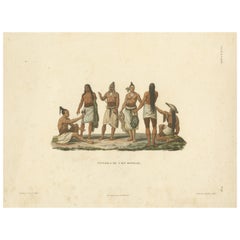
This antique print titled "Naturels de l'Ile Rotouma" depicts the indigenous people of the Island of Rotuma. The print offers a glimpse into the appearance and attire of the island's...

Category

Antique Mid-19th Century Prints

Materials

Paper

Celebration of Tahitian Culture: Traditional Dance at Otaheite, circa 1785

Celebration of Tahitian Culture: Traditional Dance at Otaheite, circa 1785

Located in Langweer, NL

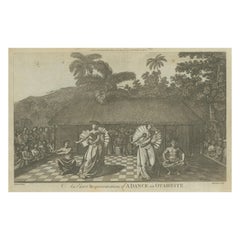
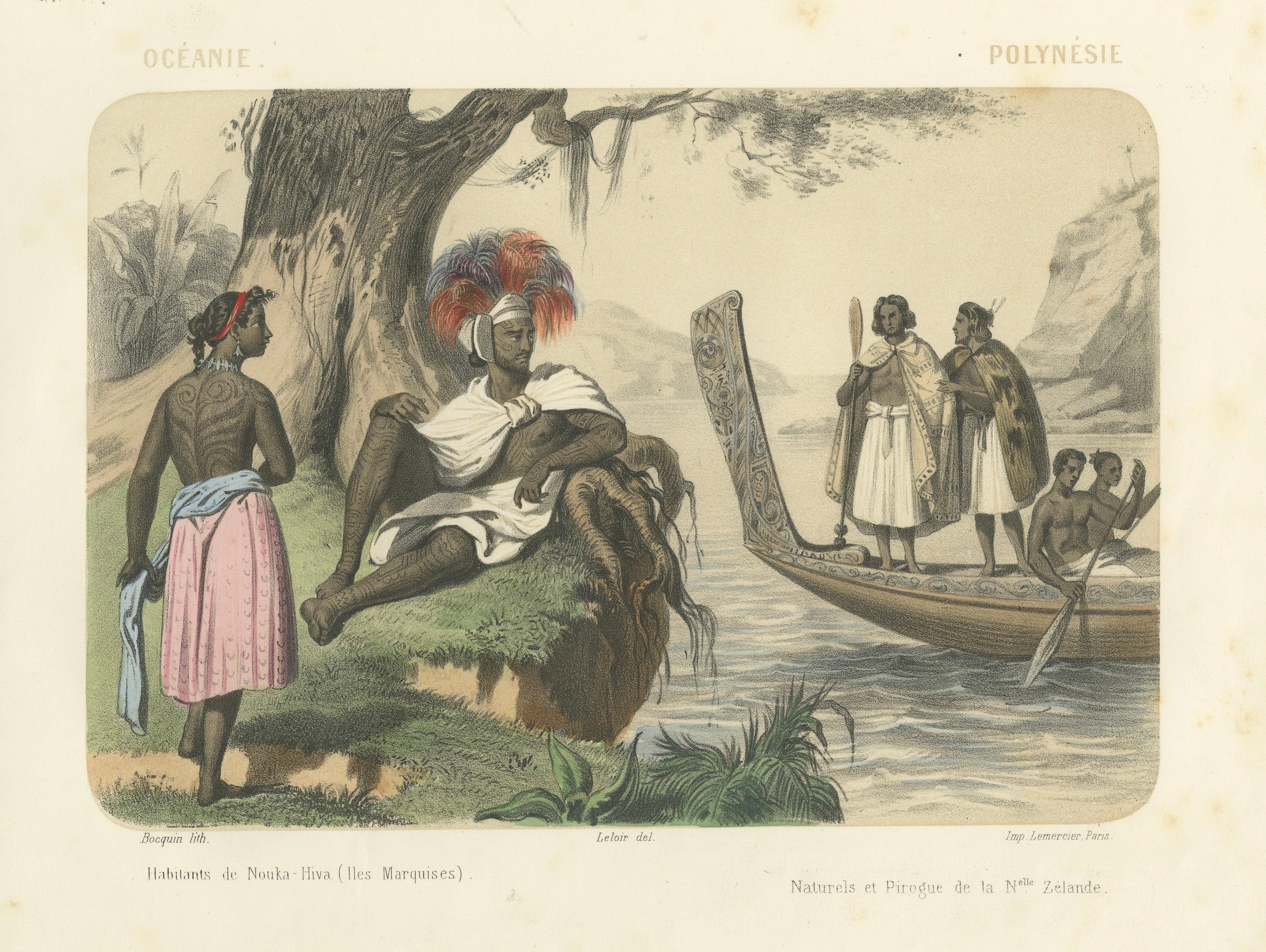
An antique engraving depicting a dance scene titled "An Exact Representation of a Dance in Otaheite," Otaheite being an archaic name for Tahiti in French Polynesia. This engraving would have been created as a part of a series to document the culture and life of the Tahitian people, likely observed by European explorers during one of the many voyages to the South Pacific in the 18th century. In the foreground, there are central figures engaged in a dance, wearing traditional Polynesian attire, which includes wraps around their waists and adornments that seem to represent status or a part of the dance costume. They are holding what appear to be fans, which may be part of the traditional dance. The dancers' poses suggest movement and a performance aspect to the scene. Behind the dancers, we can see a group of musicians providing the accompaniment, playing drums, which indicates the importance of music and rhythm in the dance. To the right, there is an audience of seated individuals, likely members of the community, watching the performance. The background of the scene includes thatched huts and a lush landscape with palm trees, depicting a typical village setting in Tahiti. The checkerboard pattern on the ground where the dance takes place is notable, as it adds a sense of structure to the scene. This image would have been intended for a European audience unfamiliar with Tahitian culture and would have served as a visual record of the encounters between European explorers and the peoples of the Pacific Islands. The engraving you've uploaded, titled "An Exact Representation of a Dance in Otaheite," is likely from a work documenting the voyages of Captain James Cook, given the style and subject matter. Captain Cook made three voyages to the Pacific Ocean during the 18th century, and his encounters with the peoples of the Pacific, including those of Tahiti (Otaheite), were extensively recorded and published. The engravings from Cook's voyages were made by artists who accompanied him, such as John Webber on his third voyage, or were based on sketches made by other crew members. These images were then published in the official accounts of the voyages. The most notable of these accounts is "A Voyage to the Pacific Ocean" undertaken during Cook's third voyage from 1776 to 1780, which was published in the years following his death in 1779. Another possible source for this engraving could be from the accounts of Joseph Banks. Banks was a naturalist who joined Cook on his first voyage (1768-1771) aboard the HMS Endeavour and was responsible for extensive collections and descriptions of Pacific cultures. His collections and later works also included illustrations and engravings of the scenes and peoples encountered. Given that the engraving is labeled as "London Published as the Act directs by Alexr. Hogg at the Kings Arms...

Category

Antique 1780s Prints
Materials

Paper

Royal Celebration in Tongatapu: The Natche Ceremony Engraved in circa 1785

Royal Celebration in Tongatapu: The Natche Ceremony Engraved in circa 1785

Located in Langweer, NL

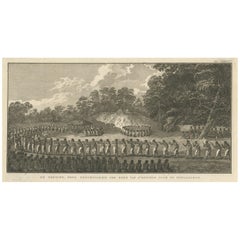
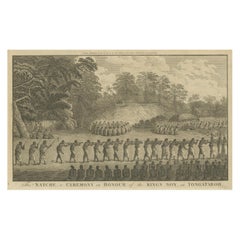
An authentic antique engraving titled "The NATCHE: a Ceremony in Honour of the KING'S SON, in TONGATABOO." It is likely from a work related to the voyages of Captain James Cook miss...

Category

Antique 1780s Prints
Materials

Paper

You May Also Like

The Body of Tee, a Chief, as preferred after Death, in Otaheite (Tahiti)

The Body of Tee, a Chief, as preferred after Death, in Otaheite (Tahiti)

By John Webber

Located in Paonia, CO

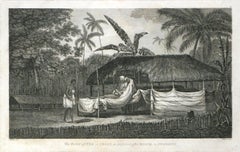
The Body of Tee a chief as preferred after Death in Otaheite (Tahiti) is from the 1784 First Edition Atlas Accompanying Capt. James Cook and King; Third and Final Voyage of Capt...

Category

1870s Realist Figurative Prints

Materials

Engraving

Reproduction Print “Tuch-ee, a Cherokee War Chief” by S. Howitt, 1855

Reproduction Print “Tuch-ee, a Cherokee War Chief” by S. Howitt, 1855

By Samuel Howitt

Located in Oklahoma City, OK

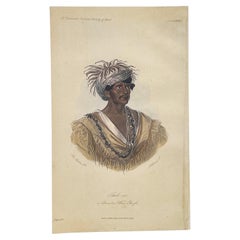
An important 19th-century hand-colored engraving depicting Tuch-ee, a Cherokee War Chief, published in 1855 as part of Dr. Prichard’s Natural History of Man. This striking portrait p...

Category

20th Century American Native American Prints

Materials

Paper

18th Century Māori Chief "Poear Joe" Sailor Maritime New Zealand Oceania

18th Century Māori Chief "Poear Joe" Sailor Maritime New Zealand Oceania

Located in Lowestoft, GB

Late 18th century naively portrayed painting of a New Zealand Māori Chief titled “Poear Joea”. It’s painted on thin parchment paper and bares reference to the artist “H Heasham” or “...

Category

Antique Late 18th Century New Zealand Paintings

Materials

Parchment Paper

Kerels Henry, Kongo Indigenous Market, Etched and Colored

Kerels Henry, Kongo Indigenous Market, Etched and Colored

By Henri Kerels

Located in Leuven , BE

This authentic colored etch by Henry Ketels(1896-1956) depicts an indigenous market. Measurements of this beautiful piece are 71.5 x 53 cm without frame, 91.5 x 72 cm with frame. ...

Category

20th Century Belgian Prints

Materials

Other