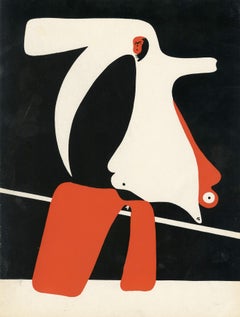
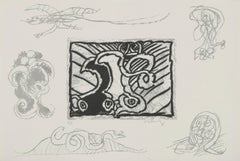
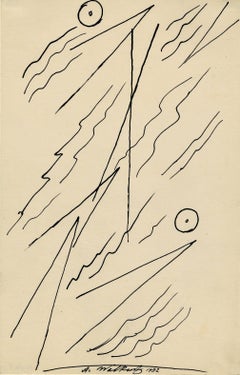
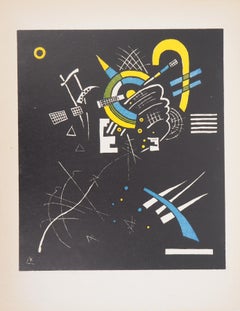
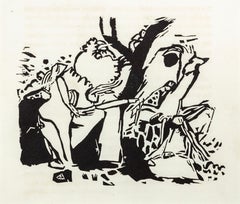
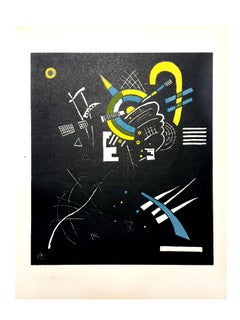
Composition
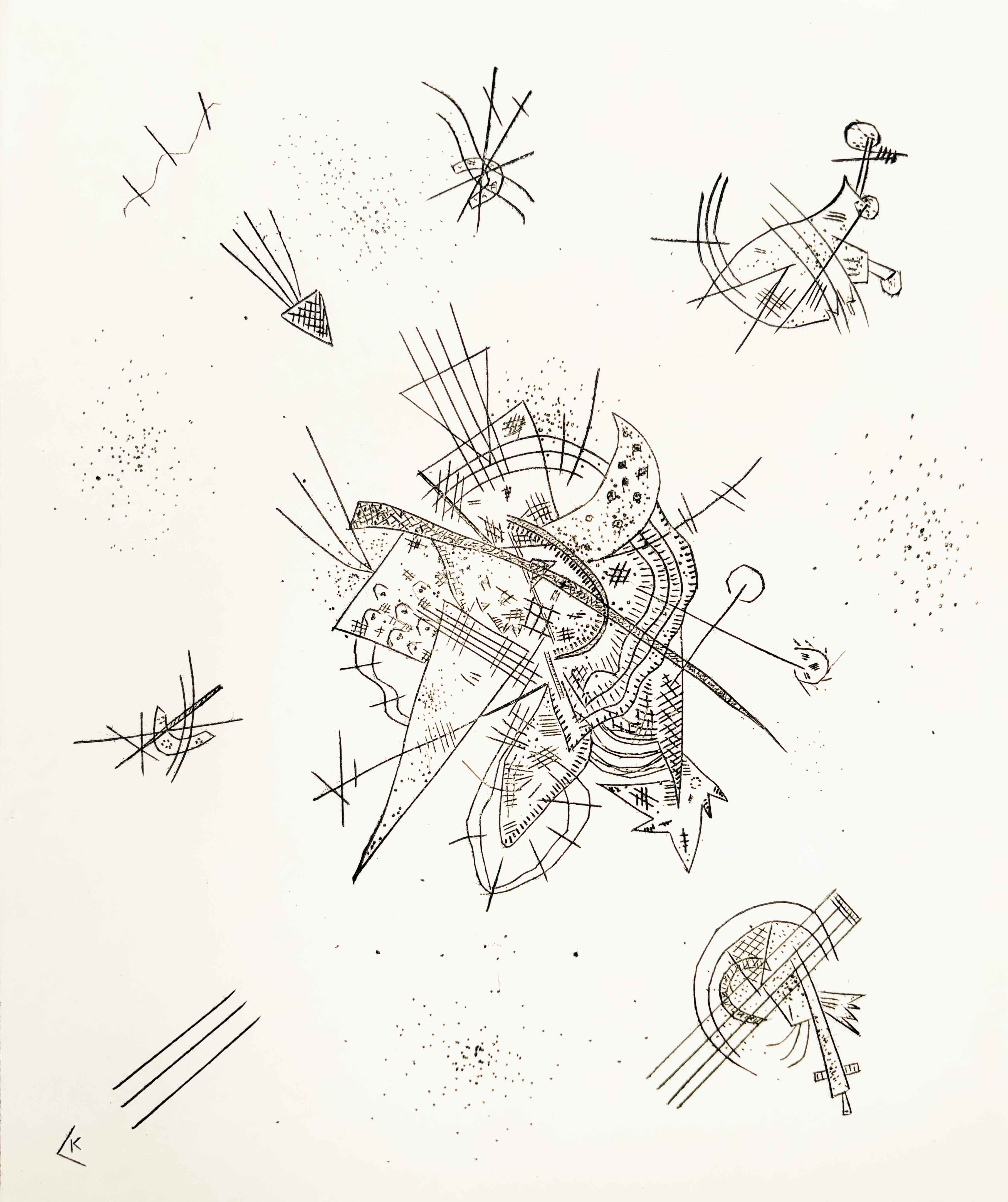
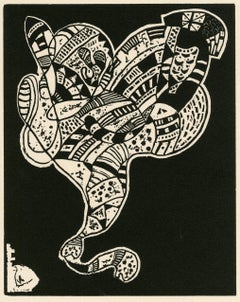
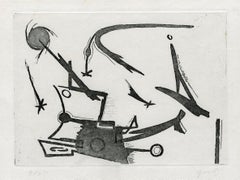
Woodcut, c. 1935, printed 1966
Signed in the block lower left (see photo)
This is the first printing of this image. Created in 1935, it was never printed during Kandinsky's lifetime. It is a POSTHUMOUS printing.
Published by Gualtieri di San Lazzaro, Éditions XXe Siècle, Paris
Issued in XXe Siècle, nouvelle série, no. 27, December 1966, Centenaire de Kandinsky
Unsigned and unnumbered, as issued
Edition commonly reported as approximately 2,000
Condition: Excellent
Image size: 9 1/8 x 10 15/16 inches
Reference: Roethel 24b
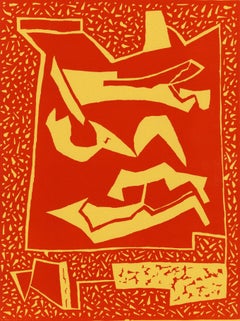
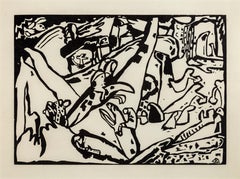
Created in 1935 but apparently left unprinted during Kandinsky’s lifetime, Composition was first issued posthumously in December 1966 in the Kandinsky centenary number of the Parisian art review XXe Siècle. The woodcut was printed from Kandinsky’s original block rather than reproduced photographically. It is therefore properly described as an original, posthumously printed woodcut—not as a reproductive print “after” Kandinsky. Contemporary documentation identifies the composition as having been cut by the artist in 1935 and first published by Éditions XXe Siècle in 1966. Publication details and dimensions
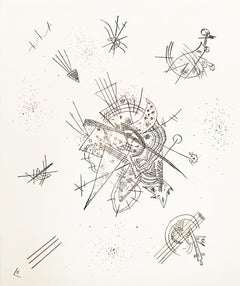
The print belongs to Kandinsky’s final period, begun after the closing of the Bauhaus and his move from Germany to Neuilly-sur-Seine, near Paris, in 1933. Its vocabulary differs markedly from the romantic landscapes, horsemen and apocalyptic subjects of his early Munich woodcuts. The forms are now self-contained and biomorphic: circles, hooks, floating linear elements and irregular organic silhouettes coexist within an open field. Although nonrepresentational, they suggest minute organisms, astronomical bodies or signs belonging to an invented visual language.
The black-and-white medium gives the image unusual clarity. Solid forms function like sustained musical tones, while thin lines, dots and isolated marks provide accents and intervals. Areas of untouched paper are equally active, allowing the components to float without conventional gravity or horizon. Kandinsky organizes these elements through visual tension rather than perspective: large and small, dense and open, curved and angular forms establish a rhythmic equilibrium across the sheet.
The woodcut process was fundamental to Kandinsky’s development. Its demand for simplification encouraged him to reduce images to essential contrasts of shape, line and ground. Nearly two-thirds of his approximately two hundred prints were made between 1900 and 1911, and his increasingly abstract woodcuts for Klänge played a decisive role in his movement away from representation. MoMA’s Kandinsky printmaking overview In this late composition, Kandinsky returned to the medium with the more refined geometry and organic imagery of his Paris years.
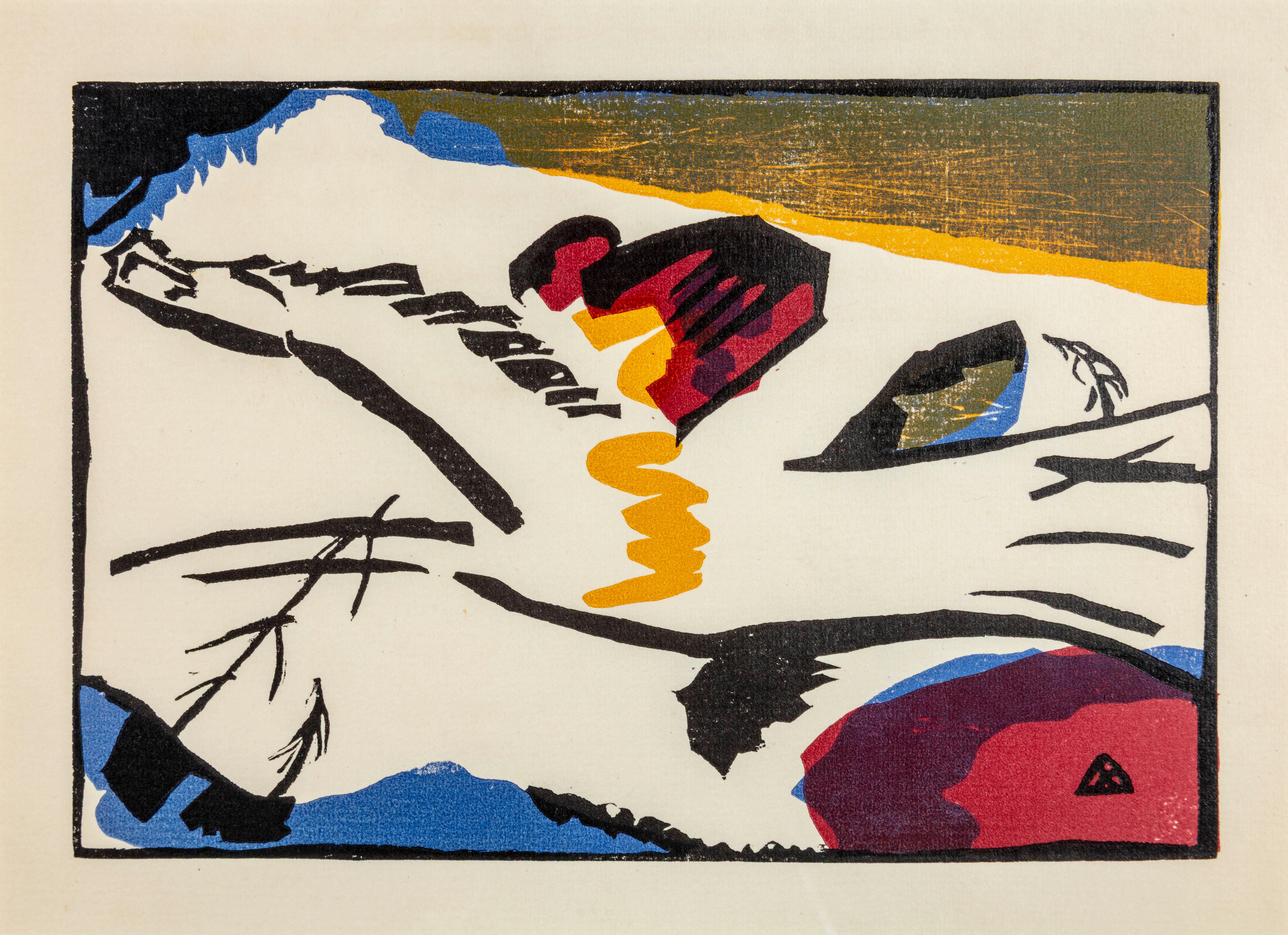
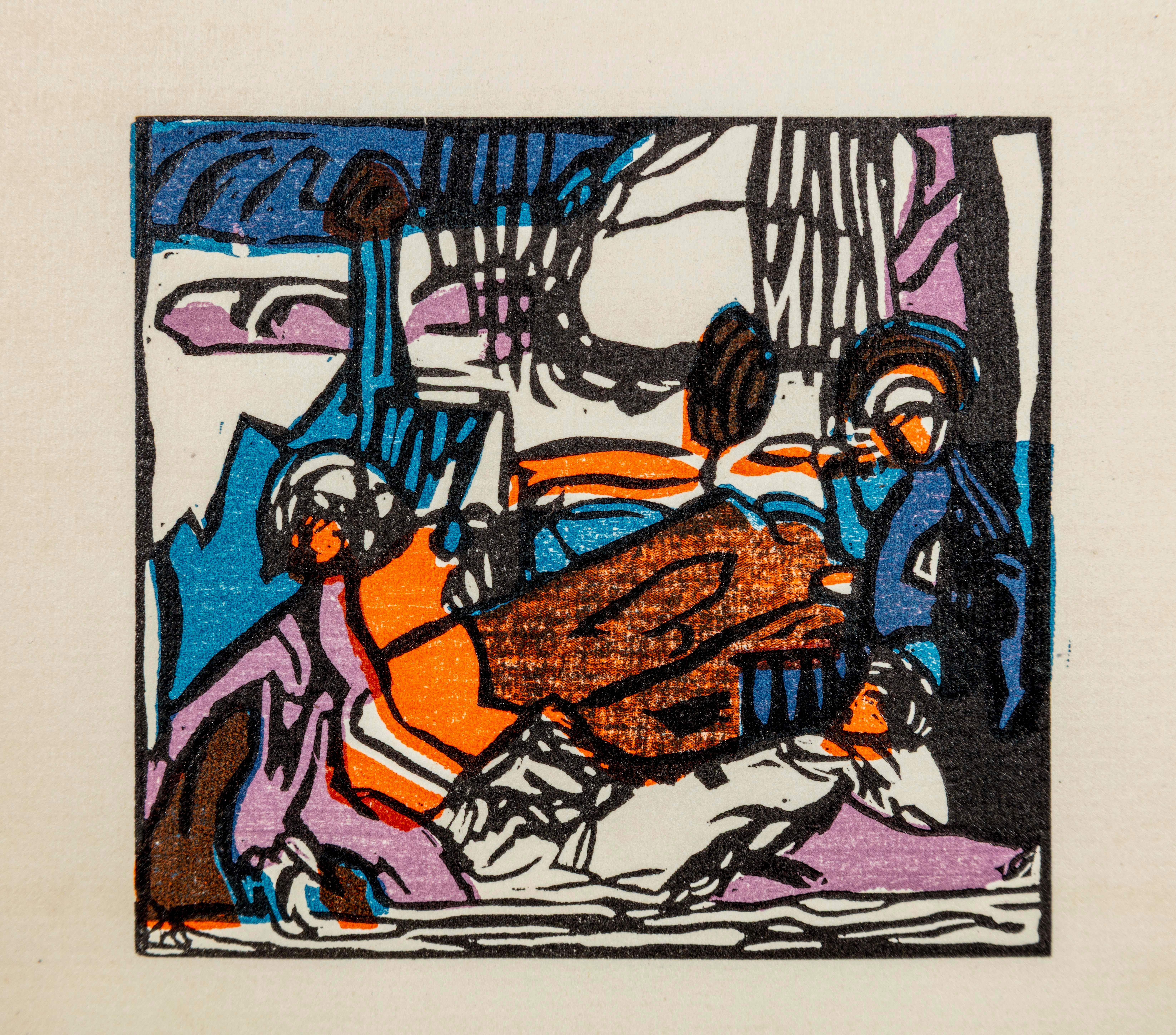
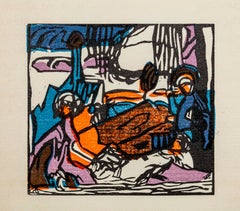
The circumstances of the 1966 publication are integral to the work’s history. XXe Siècle, directed by the Italian-born critic and publisher Gualtieri di San Lazzaro, regularly included original prints by major modern artists. Issue no. 27, entitled Centenaire de Kandinsky, commemorated the hundredth anniversary of Kandinsky’s birth. It contained two original Kandinsky woodcuts—one in black and one in color—as well as essays and tributes by Nina Kandinsky, Jean Arp, Alberto Magnelli, Joan Miró and other figures associated with the European avant-garde. Description of the centenary volume
Because impressions were bound into the journal, surviving examples may retain a central binding fold, binding holes, trimmed margins or traces of the original mounting. Such features generally reflect the print’s publication history rather than later damage. Detached impressions should be cataloged as “from XXe Siècle, no. 27,” and should not be described as hand-signed or individually numbered unless supported by evidence independent of the printed monogram.
Interpretation and significance
Composition embodies Kandinsky’s conviction that abstract art could operate like music. Forms do not describe external objects; instead, they create relationships of weight, movement, pause and resonance. The compact black shapes act as dominant chords, while scattered lines and dots supply counterpoint. The result is neither purely geometric nor entirely organic. It occupies the fertile territory between Bauhaus discipline and the freer, microscopic imagery of Kandinsky’s French period.
The 1966 printing also represents an important episode in Kandinsky’s postwar reception. Published for his centenary, it introduced an otherwise unavailable original matrix to a broad international readership and positioned Kandinsky as a foundational figure for postwar abstraction. Although printed twenty-two years after his death, the impression preserves the direct action of the block carved by the artist in 1935.
Biography
Wassily Kandinsky was born in Moscow on December 16, 1866. Raised partly in Odessa, he studied law and economics at Moscow University and appeared destined for an academic career. In 1896, at the age of thirty, he abandoned law and moved to Munich to study painting. There he became a central participant in the city’s progressive artistic culture, founding the Phalanx association and later the Neue Künstlervereinigung München.
In 1911 Kandinsky and Franz Marc established Der Blaue Reiter—the Blue Rider—which brought together artists interested in color, spirituality, folk art and alternatives to naturalistic representation. Kandinsky’s theoretical book Über das Geistige in der Kunst (Concerning the Spiritual in Art) argued that colors and forms possessed intrinsic psychological and spiritual force. His concept of “inner necessity” became one of the intellectual foundations of abstract art.
Printmaking was essential to this transformation. Kandinsky’s early woodcuts drew upon Russian folk prints, medieval legends, fairy tales and Jugendstil design. In Klänge (Sounds), published in 1913 with fifty-six woodcuts and thirty-eight prose poems, imagery progressively dissolves into abstract configurations. Kandinsky described the publication as a “musical album” in which word, image and typography contributed to a synthesis of the arts. MoMA, Klänge
The First World War forced Kandinsky, a Russian citizen, to leave Germany. He returned to Moscow, where he participated in the reorganization of Russian artistic institutions after the Revolution. Increasing disagreements with Constructivism led him back to Germany in 1921. From 1922 until 1933 he taught at the Bauhaus, first in Weimar and later in Dessau, developing a more geometric vocabulary based on the expressive interaction of points, lines, circles and planes. His ideas were summarized in Point and Line to Plane, published in 1926.
After the Nazi regime closed the Bauhaus in 1933, Kandinsky moved with his wife Nina to Neuilly-sur-Seine. His late French works combine geometric structures with organic and biomorphic forms, partly reflecting contemporary interest in biology, microscopy and Surrealism. He became a French citizen in 1939 and continued working in relative isolation during the German occupation. Kandinsky died at Neuilly-sur-Seine on December 13, 1944.
Conclusion
The 1966 XXe Siècle impression of Composition is an original posthumous printing from Kandinsky’s 1935 woodblock. Its importance lies both in the directness of its medium and in its publication for the artist’s centenary. Combining forceful black silhouettes, delicate linear incidents and carefully activated empty space, the image offers a concentrated statement of Kandinsky’s mature belief that abstract forms could communicate through rhythm, tension and “inner necessity.”